


I’ll admit something that may shock the ecologists among you:
I never fully understood how important bees are.
Oh, I knew the talking points. We’ve all heard them: “Bees pollinate this,” “Bees keep that alive,” “No bees, no food,” and so on. But knowing something is not the same as really feeling its gravity. It’s like reading the user manual for a parachute—you understand it, but you don’t appreciate it until you’re looking down at the Earth from 12,000 feet.
My awakening happened during one of those quiet, ordinary moments—the kind where nature taps you on the shoulder and whispers:
“Hey… you’ve missed something.”
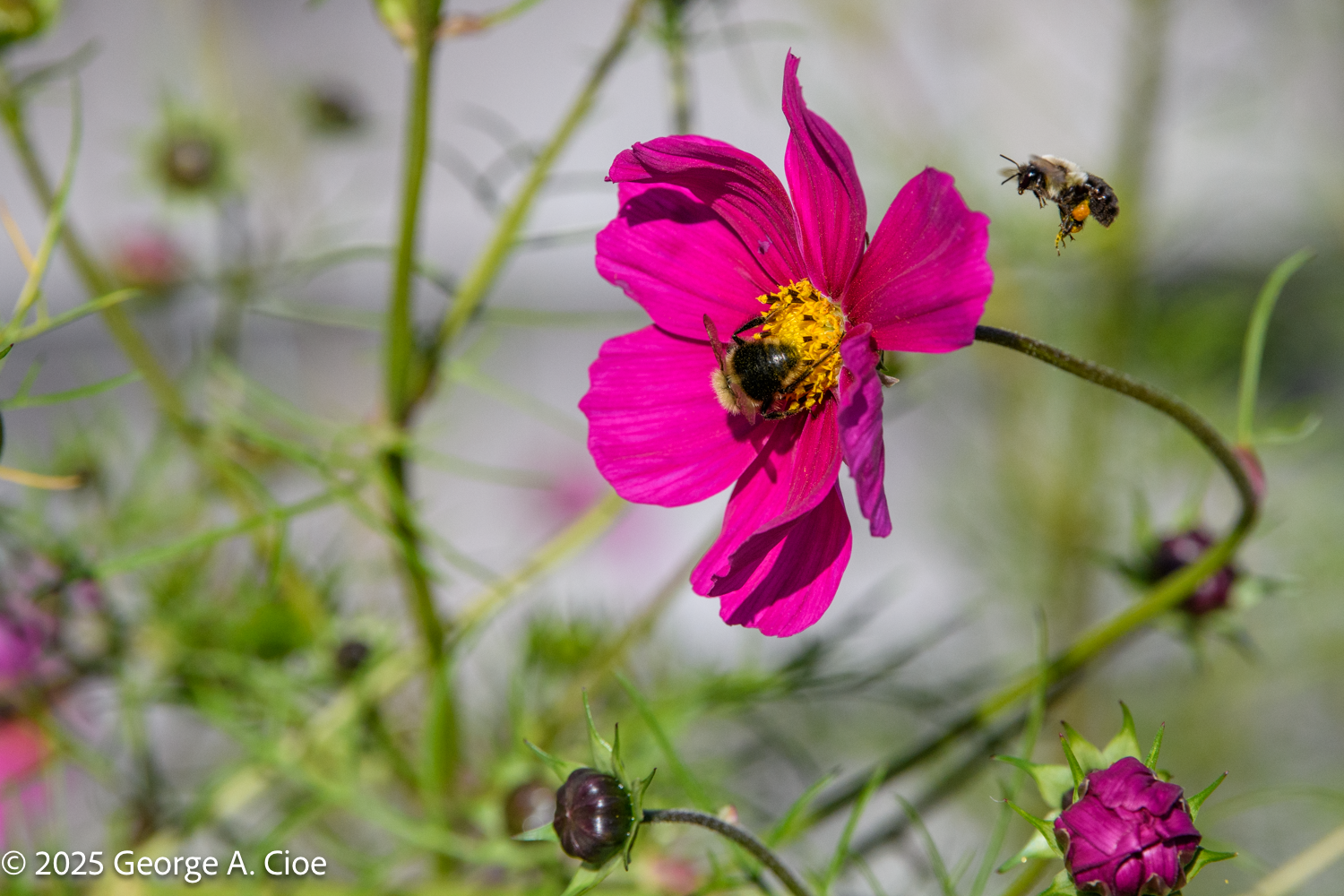
I was photographing a patch of wildflowers, lost in my usual meditative trance behind the lens, when I heard the faintest hum. At first, I assumed it was one of my grandkids’ toys left behind in the grass—some plastic contraption designed to mimic a noise between “space laser” and “mosquito having a meltdown.” But no, this hum was steady… purposeful… alive.
A bee drifted into my frame like a tiny, hovering aircraft making a controlled landing. She wasn’t large or glamorous. No iridescent wings. No bold coloring. Just a small, fuzzy body with legs carrying what looked like orange saddlebags. Yet the moment she touched down on the flower, the world shifted.
I had been so focused on the flower—its color, shape, composition—that I forgot the flower wasn’t the main event. It was the bee’s fuel station, workplace, pantry, and social mission all rolled into one. And here she was, performing the quiet miracle that keeps fruit on our tables, blooms in our gardens, and birds singing in our backyards.
She worked with such intention that I felt a little lazy in comparison. I’m pretty sure if she could talk, she’d have said something like:
“Buddy, this entire ecosystem is running on my overtime shift. Maybe… take note?”
So I did.
And once I started watching, I couldn’t stop.
Every blossom had a visitor. Every visitor had a job. And without any of them—not one—I’d be photographing a very different world: fewer flowers, fewer berries, fewer birds, fewer everything.
The more I read, the more humbled I became.
Bees pollinate one-third of the world’s food supply.
They sustain orchards, meadows, farms, forests, and the entire chain of life that depends on them.
Meanwhile, we walk around like we invented civilization.
I realized I’d lived decades thinking bees were just little buzzing interruptions—polite ones, at that—until I finally understood:
They’re the unsung workforce of the planet.
They’re the tiny engineers keeping nature’s grand machine from collapsing.
And now?
I stop for every hum.
I watch every flower visitor like an invited guest.
And I’m oddly proud—yes, proud—every time a bee chooses a flower near me, as if I’ve somehow passed her background check.
Funny how we can overlook something so small, yet so vital.
Sometimes the world doesn’t need to shout to get our attention.
Sometimes all it takes is a little buzz.
I’d love to share my posts with you. If you subscribe, they’ll come straight to your inbox—most days, like a little note from me to you. It means a lot to know you’re reading along.
Browse my complete art portfolio and shop for prints at imagesbygacioe.shop




Leave a Reply