

A Narragraphy® Study in Light, Time, and a Very Patient Tripod
Amsterdam doesn’t sleep.
It glows.
Some cities whisper at night. Amsterdam hums — a soft electric hymn reflected in canals, polished stone, tram wires, café windows, and the occasional slightly confused tourist staring at a map upside down.
And if you love photography — the kind that requires patience, planning, and a tripod sturdy enough to double as defensive equipment — night becomes a playground.
Long exposure photography isn’t just “taking pictures in the dark.”
It’s negotiating with time.
The Courtyard at Café American – Where Water Becomes Silk
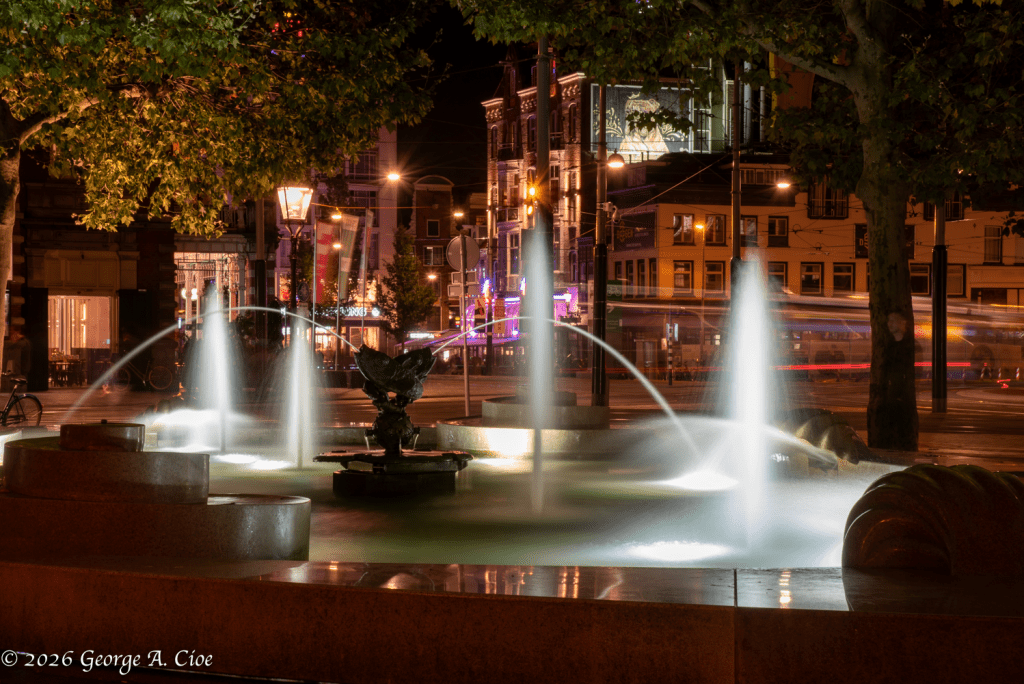
I first noticed the fountains at Café American during daylight — polished granite, dramatic uplighting, clean geometry. Even then I knew they were not meant for noon. They were waiting for night.
So I scouted the scene. Checked sightlines. Studied where the accent lights hit the stone. Imagined the reflections. Made mental notes of foot traffic. And most importantly — I returned after dusk.
Tripod deployed.
Camera mounted.
ISO lowered to preserve detail.
Aperture tightened for sharpness and starburst potential.
Shutter? Long enough to let the water forget it was ever droplets.
That’s the magic of long exposure. At 10, 15, even 30 seconds, water stops being splash and becomes silk. Motion turns to glow. The fountain no longer sprays — it breathes. The accent lights stretch into pillars. The granite mirrors the night like a polished piano lid.
This isn’t guesswork. It’s controlled surrender.
You allow time to paint.
What do you think — did the pillars of light dance?
The Park Hotel Corner – Engineering Motion
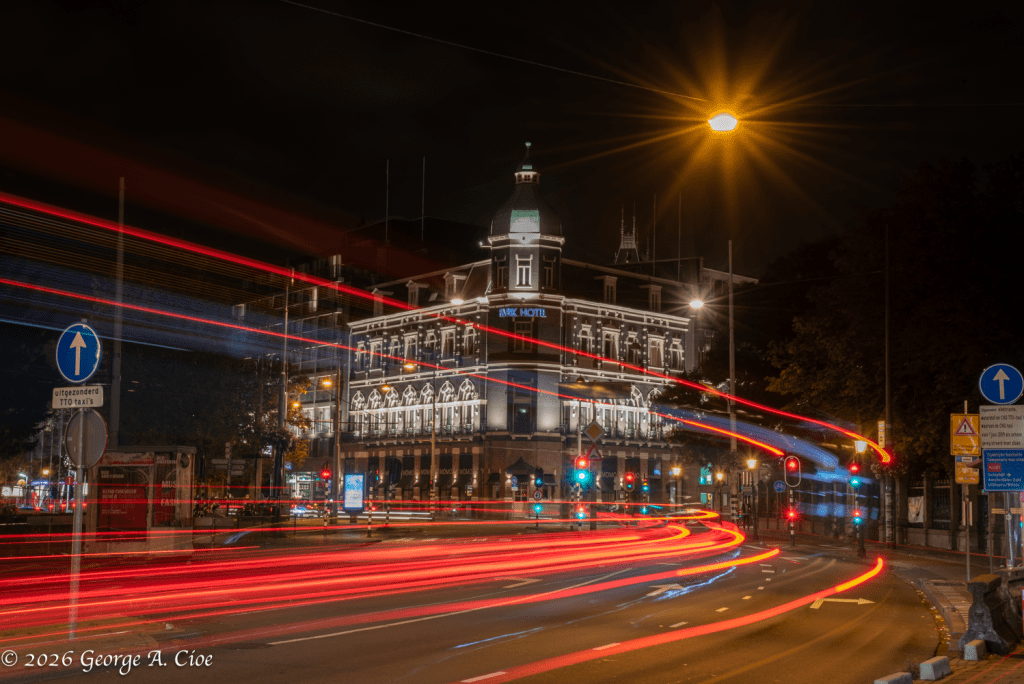
Next stop: a corner near the Park Hotel. I had walked past earlier and recognized the geometry immediately — well-traveled road, consistent bus traffic, layered lighting, clean lines. A one-way street. That matters.
In long exposure, traffic becomes brush strokes. But brush strokes need direction. A one-way street gives you disciplined red trails — taillights flowing like molten ribbons. Had headlights entered the frame from the opposite direction, they would have blasted the exposure, washing out the subtler reds and overpowering the balance.
Planning matters.
Buses are especially generous subjects. Their high marker lights add vertical dimension — stacked ribbons of red and white that float above the pavement. With a 20-second exposure, the city stops being static architecture and becomes choreography.
Fun fact: you can often spot a long exposure because traffic lights show red and green simultaneously — frozen in time over a span where both cycles occurred. It’s a subtle tell. A wink from physics.
(And in Amsterdam? No yellow. Efficiency, apparently, even in traffic.)
Long exposures aren’t accidents. They are calculated patience. You stand there. You wait for the bus. You time the tram. You breathe when the shutter opens. You don’t touch the tripod. You let vibration settle. You watch time pass in real time — knowing you are compressing it into one frame.
The Canal Shot – Straight Lines in a Liquid World
And then, because we’re in Amsterdam, there had to be a canal.
Reflections are expected.
Light trails on water are something else entirely.
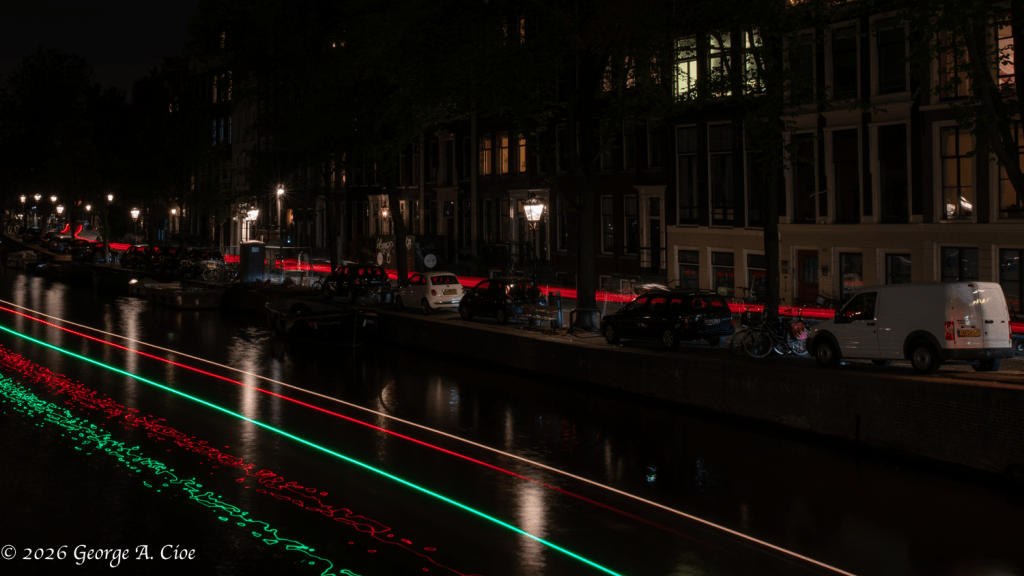
The trick was alignment. I wanted a boat passing through the frame — navigation lights bright enough to register, but not so erratic as to look chaotic. I positioned myself carefully, leveled the tripod, checked the horizon twice. Water forgives nothing; crooked canals betray you instantly.
When the boat came, I triggered the shutter and held my breath. Thirty seconds of negotiation between motion and stillness. The boat moved in a straight line. The canal did not. The resulting light trail bent and shimmered — a non-linear signature carved into liquid darkness.
Buildings stayed sharp.
Water diffused.
Light wrote poetry.
That’s the gift of long exposure: solid objects remain grounded, while anything that moves becomes interpretation.
The Technical Ritual
For those who love the details:
- Tripod — non-negotiable.
- Remote release or timer — avoid camera shake.
- Low ISO — protect dynamic range.
- f/8 to f/22 — sharpness and defined light stars.
- Manual focus — lock it and don’t let autofocus hunt in the dark.
- Scout during daylight — identify compositions before the city turns theatrical.
Night photography rewards preparation. It punishes improvisation.
The Real Exposure
But here’s the part no spec sheet covers.
Standing alone at night, waiting for buses, boats, fountains, you begin to see differently. The city slows. Your breathing syncs with the shutter. You notice reflections before buildings. Motion before mass. Glow before structure.
Photography becomes less about capturing and more about collaborating.
All things considered, I had a blast — negotiating with time, partnering with light, and letting Amsterdam show me how she prefers to be remembered.
And now when I look at those images, I don’t just see light trails and softened water.
I hear trams.
I smell rain on granite.
I feel the tripod under my hands.
That’s the beauty of night moves.
I hope you enjoy the images.
I’d love to share my posts with you. If you subscribe, they’ll come straight to your inbox—most days, like a little note from me to you. It means a lot to know you’re reading along.
Browse my complete art portfolio and shop for prints at imagesbygacioe.shop


Leave a Reply