


Well, besides Don Toothaker, for sure.
One of the things I’ve learned about photography is that sometimes the best way to improve isn’t to take more pictures.
It’s to try taking them differently.
When I’m out on a photo excursion, I usually choose a spot with a good vantage point and immediately start studying my surroundings.
Where is the light?
Where is it going?
What background would give me that beautiful, creamy bokeh?
Are there branches, rocks, people, signs, or other distractions I don’t want in the frame?
What might fly through here?
What might walk into there?
And, perhaps most importantly:
If something suddenly happens, am I ready?
Because Mother Nature does not take reservations.
She doesn’t send a text.
And she absolutely does not yell:
“George! Great Egret incoming! Camera ready!”
Today, I tried something different.
And I had a breakthrough.
Not a revelation.
Let’s not get carried away.
But definitely a breakthrough.
I composed a photograph before I had anything to photograph.
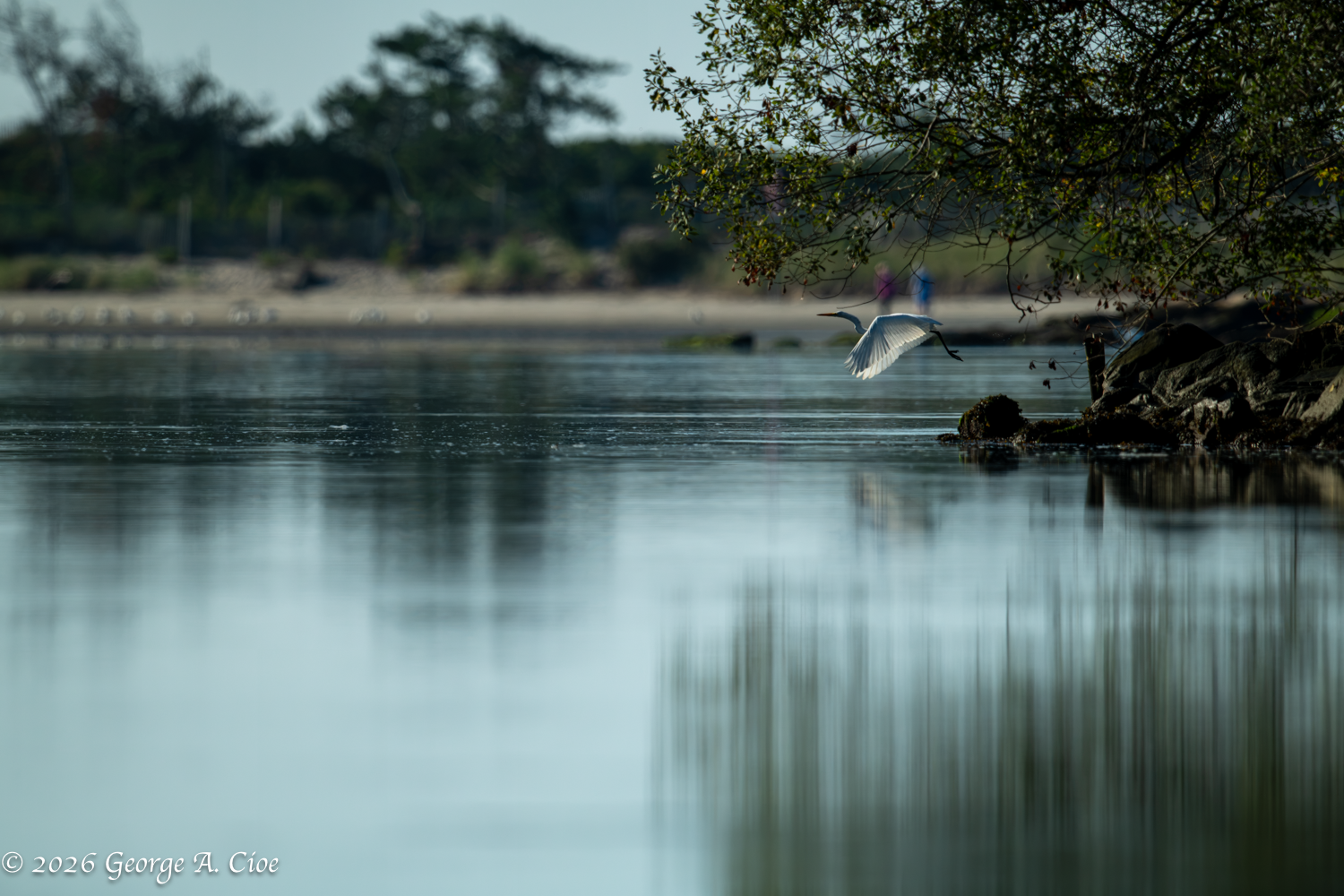
I found this beautiful stretch of the Narrow River.
Still water.
Soft reflections.
A distant shoreline fading gently out of focus.
A tree reaching into the frame from the upper right, with rocks anchoring the shoreline below.
I liked everything about the composition.
Except for one small problem.
There was no subject.
Nothing.
So I framed the photograph anyway.
Focused.
Checked my exposure.
Settled behind the camera.
And devised a highly sophisticated photographic strategy.
Wait.
That was it.
I was going to leave the camera right there and wait for Mother Nature to put something into my photograph.
Now, to the uninitiated, this may sound ridiculously easy.
It isn’t.
Because while you’re waiting for something to enter your carefully composed frame, all kinds of interesting things are happening everywhere else.
Bird over there.
Something splashing over here.
Movement behind me.
Another bird flying in completely the wrong direction.
And I had made a deal with myself.
Ignore them.
Stay with the composition.
Trust the experiment.
Three minutes.
This is interesting.
Five minutes.
This may have been a stupid idea.
Ten minutes.
Now I’m beginning to experience what I can only describe as photographic shame.
There I am, surrounded by wildlife, standing behind a camera pointed at…
nothing.
Mother Nature was humiliating me.
I could practically hear her.
“Nice composition, George. Shame there’s nothing in it.”
But I stayed.
Because experimentation requires patience.
And patience occasionally looks an awful lot like stubbornness.
Then, somewhere between ten and twelve minutes…
it happened.
A Great Egret came flying into my photograph.
Not somewhere near it.
Not in a place where I had to swing the camera around, desperately acquire focus, and hope for the best.
It flew directly into the scene I had already composed.
Suddenly that empty space had purpose.
The dark foliage framed the brilliant white bird.
The soft background separated it from everything behind it.
The quiet water provided space for it to fly into.
And the sunlight caught those enormous white wings just enough to make the Egret seem illuminated from within.
Click.
There it was.
And that’s when the experiment taught the lesson.
I had always thought of wildlife photography as reacting to what nature gives me.
See it.
Follow it.
Frame it.
Photograph it.
But this time I reversed the process.
I found the photograph first.
And waited for nature to complete it.
I never would have gotten this particular image without two things.
Luck.
And readiness.
Of course, photographers talk about luck all the time.
Right place.
Right time.
Right bird.
Right light.
But I’m beginning to think luck gets a little too much credit.
Because when that Great Egret appeared, luck didn’t choose my composition.
Luck didn’t check my settings.
Luck didn’t put the camera on the tripod.
Luck didn’t wait through ten minutes of absolutely nothing while every instinct in me was saying, Go photograph something!
Luck brought the bird.
Readiness made the photograph.
And perhaps that’s the real value of experimentation.
Sometimes it works.
Sometimes it doesn’t.
Sometimes you come home with an image that makes you smile.
And sometimes you come home having learned one more way not to make one.
Either way, you are a slightly different photographer than the one who went out that morning.
Today, I learned something.
Tomorrow?
I think I’ll try it again.
Although next time, Mother Nature…
could we maybe make it five minutes?
I’m loving this.
Naturally.
I’d love to share my posts with you. If you subscribe, they’ll come straight to your inbox—most days, like a little note from me to you. It means a lot to know you’re reading along.
Browse my complete art portfolio and shop for prints at imagesbygacioe.shop


Leave a Reply