
Movement.
That’s always what I see before I see the bird.
A twitch.
A scurry.
Something that makes my brain say:
Did that mud just move?
I look.
Nothing.
I stare a little harder.
Still nothing.
Then—
ZIP.
There it goes again.
Welcome to the world of the Least Sandpiper.
And, appropriately enough, it is the smallest sandpiper in the world.
Which seems a little unfair to photographers.
Apparently photographing birds that are merely small wasn’t challenging enough.
So nature made one sparrow-sized, dressed it to look remarkably like mud, placed it on the mud and programmed it to move in unpredictable little bursts.
Thanks.
The Least Sandpiper is only about 5 to 6 inches long and generally weighs less than an ounce.
Think about that.
I have probably carried sandwiches into the field that weighed six times as much as this bird.
Yet this tiny creature is a serious long-distance traveler.
Least Sandpipers breed far to our north—in Alaska, Canada and the Arctic—and migrate south, with some traveling all the way into Central and South America.
And during migration, places like our tidal marshes become their roadside diners.
Except the menu is considerably different.
Tiny insects.
Crustaceans.
Marine worms.
Other little invertebrates hiding in or on the mud.
No reservations required.
And the mudflat apparently has an excellent raw bar.
That explained what I was watching.
This little bird wasn’t wandering aimlessly.
It was working the shoreline.
Stop.
Probe.
Pick.
Run.
Stop.
Look.
Probe.
Run again.
The feeding technique reminded me of someone who dropped a contact lens in a shag carpet and is absolutely certain it landed right here.
But first I had to figure out what I was photographing.
And identifying small sandpipers—or “peeps,” as birders affectionately call them—is where my confidence as an amateur ornithologist goes to die.
Least Sandpiper?
Semipalmated Sandpiper?
Western Sandpiper?
Some other sandpiper deliberately placed here by the Audubon Society to humiliate me?
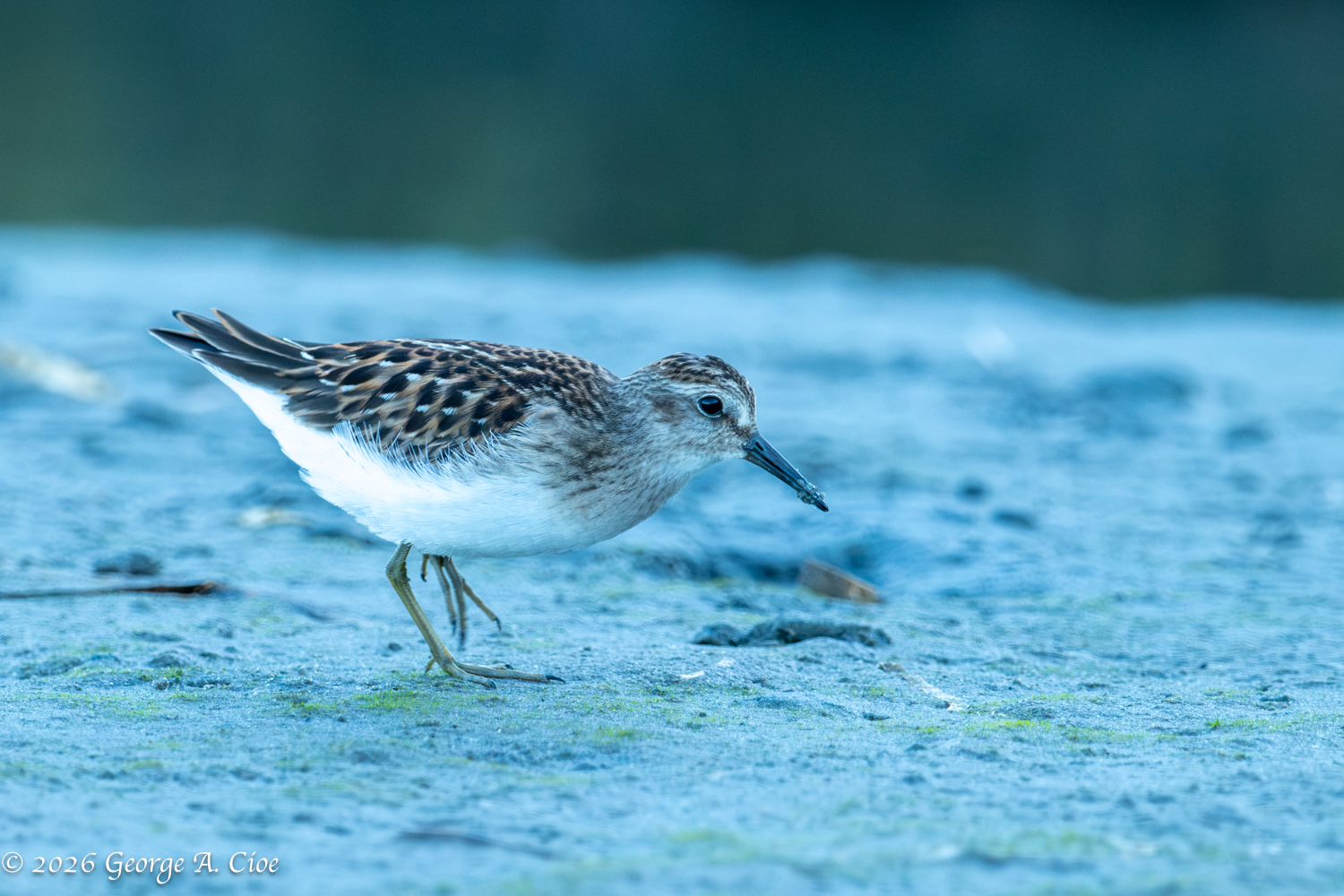
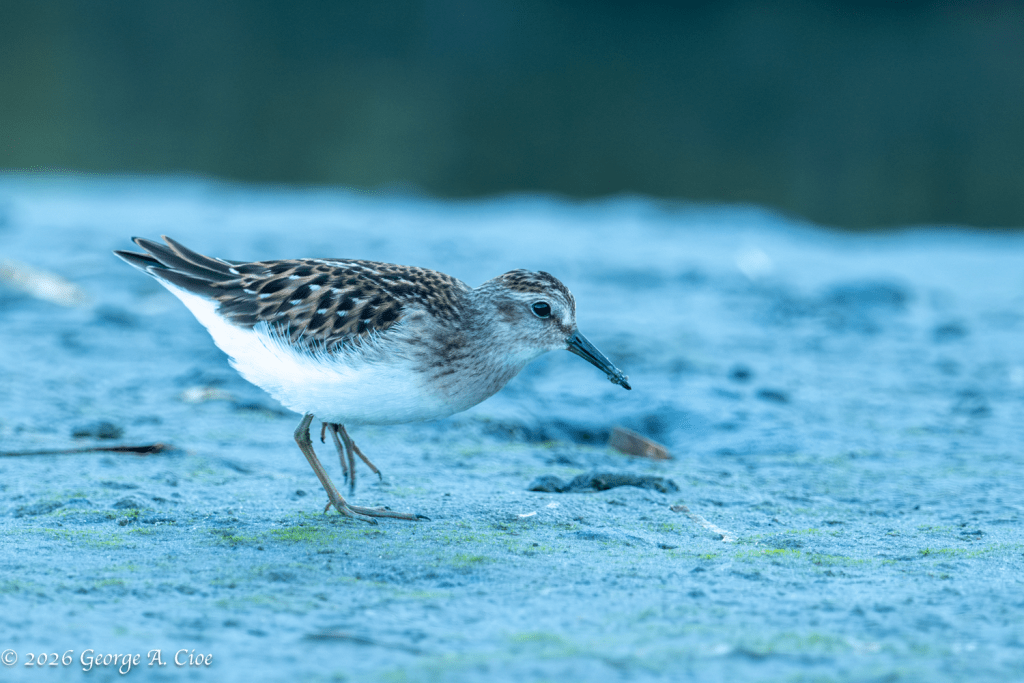
Fortunately, this little fellow eventually provided evidence.
The legs.
Look closely at the photographs.
They are yellowish to greenish.
That is one of the best field marks of a Least Sandpiper.
A Semipalmated Sandpiper—the bird most likely to make me question every life decision that led me to bird identification—has dark legs.
The Least also has a fine dark bill with a slight downward curve and tends to be browner than the Semipalmated.
Finally, I had my bird.
Least Sandpiper.
But once I knew what I was watching, I became fascinated by how I was watching it.
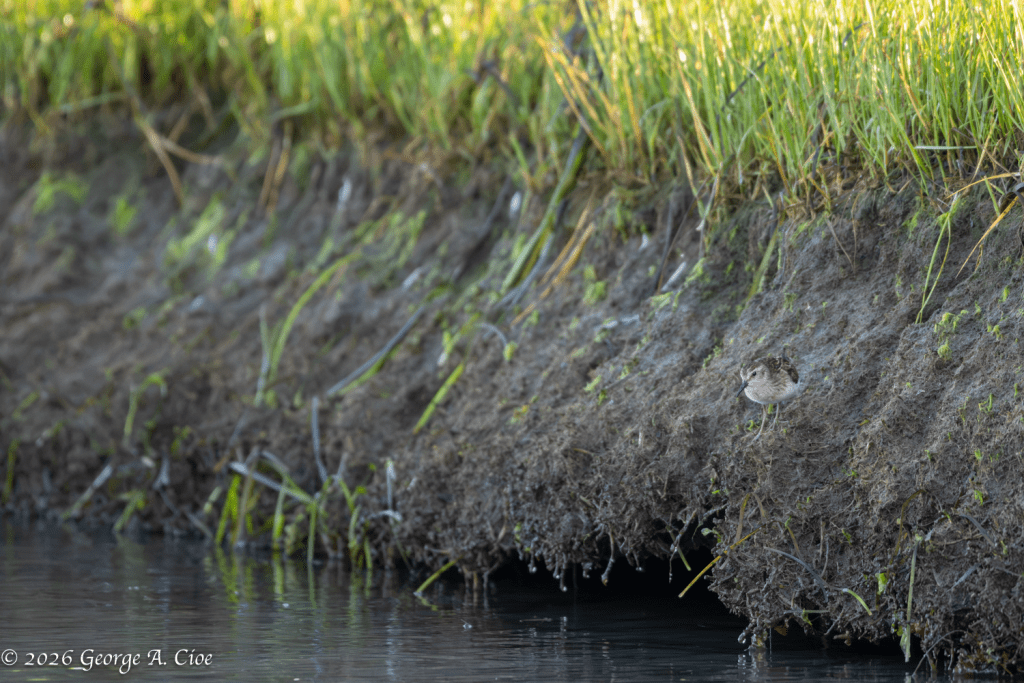
Because camouflage isn’t always about becoming invisible.
Sometimes it’s about becoming indistinguishable from everything around you.
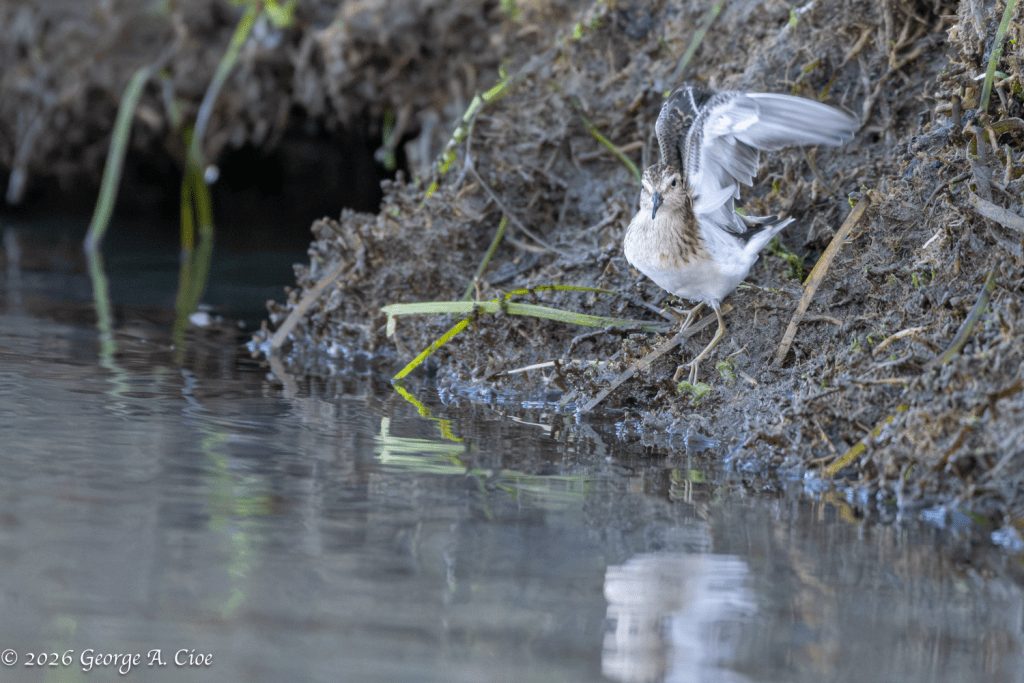
Look at the first photograph.
Step back from it.
The bird almost disappears.
Brown.
Tan.
Cream.
Black.
The same muted palette as the exposed riverbank.
Its patterned back breaks up its outline against mud, roots, grasses and decaying vegetation.
Perfect wardrobe.
Perfect location.
And apparently absolutely no interest in making life easier for the photographer.
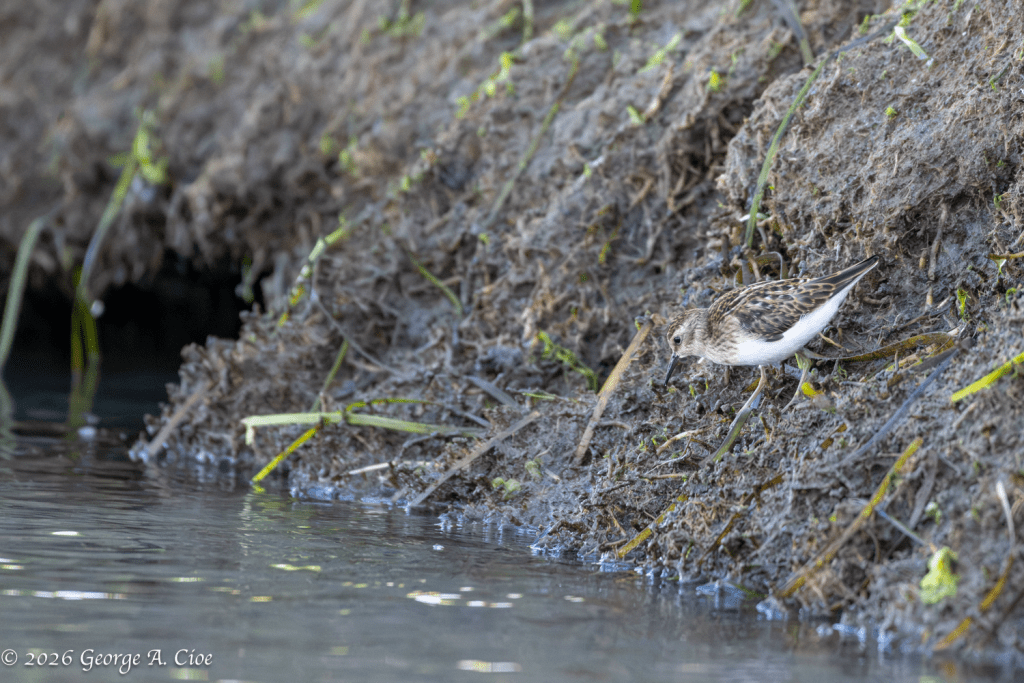
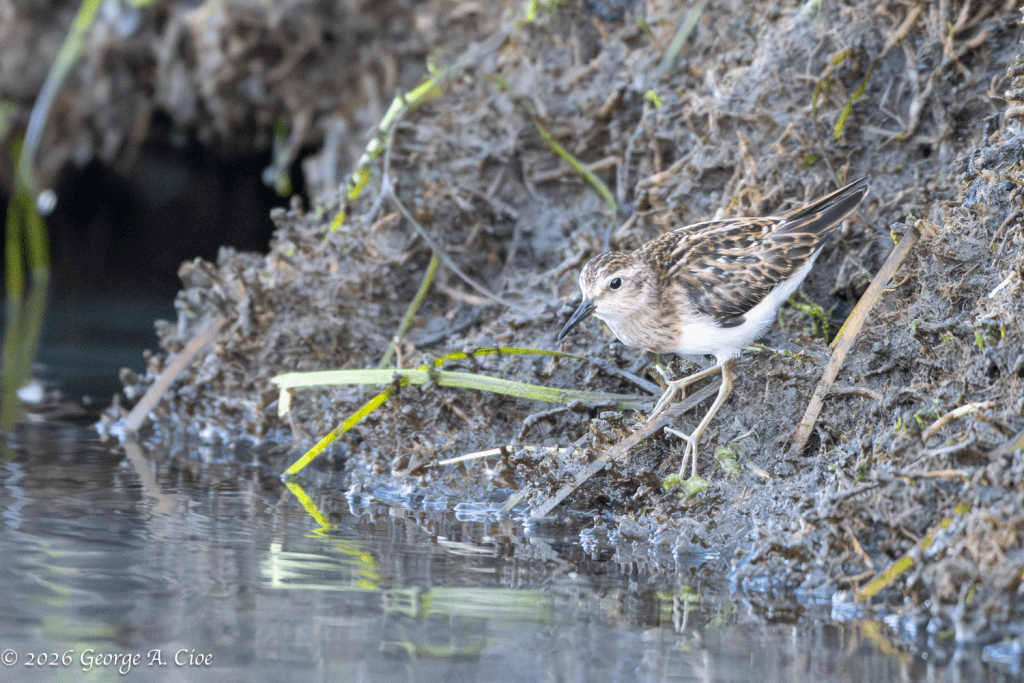
Then it moved closer to the water.
Suddenly I could see those wonderfully delicate legs.
That impossibly fine bill.
The beautiful feather pattern across its back.
And that enormous dark eye that somehow seems much too large for such a tiny head.
For a few moments, the world’s smallest sandpiper became the biggest thing in my viewfinder.
Then came the wing stretch.
Up went one wing.
Out came those beautiful flight feathers.
And for a fraction of a second this tiny, mud-colored creature transformed itself.
It wasn’t hiding anymore.
It was magnificent.
That’s one of the things photography keeps teaching me.
Size has almost nothing to do with wonder.
We naturally notice the Bald Eagle.
The Great Blue Heron.
The Osprey.
They’re big.
They’re dramatic.
They announce themselves.
But sometimes nature whispers.
Sometimes it weighs less than an ounce.
Sometimes it stands quietly on a muddy riverbank wearing camouflage so effective that you can stare directly at it and still not see it.
Until something moves.
And you stop.
And look.
And wait.
And suddenly discover an extraordinary little traveler standing right in front of you.
The smallest sandpiper in the world.
I suppose noticing it…
was the least I could do.
I’d love to share my posts with you. If you subscribe, they’ll come straight to your inbox—most days, like a little note from me to you. It means a lot to know you’re reading along.
Browse my complete art portfolio and shop for prints at imagesbygacioe.shop


Leave a Reply