
Walking in the water at twilight.
There’s no better feeling in the world.
I’m there.
Fully present.
Fully aware.
And somehow feeling more alive than any cup of coffee could possibly summon.
The river is quiet. The light is just beginning to find its way into the landscape. Shapes are becoming colors. Shadows are becoming birds.
And then I see something.
Across the river, on the far side of the sandbar.
White.
Curved.
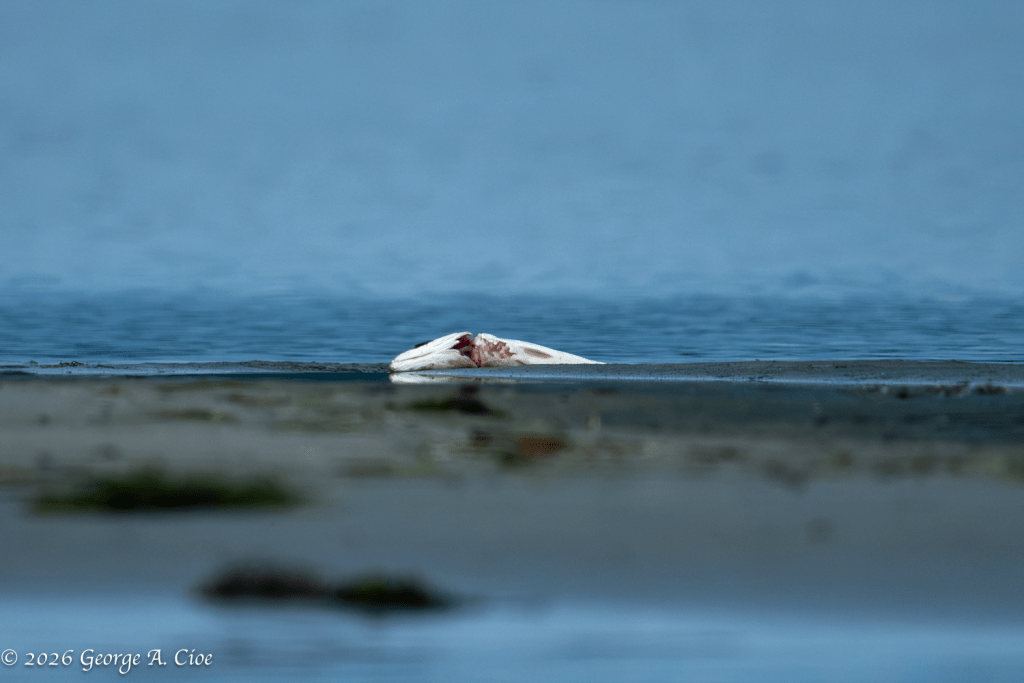
It looks like the neck of a large bird.
An egret, perhaps.
I raise the long lens.
Focus.
Phew.
It’s only a fish.
A big one.
From its shape and size, it looks like a Striped Bass.
A striper.
Dead at the water’s edge.
Oh well.
Crab food.
At least that’s what I thought.
Nature had other reservations.
The Table Is Open
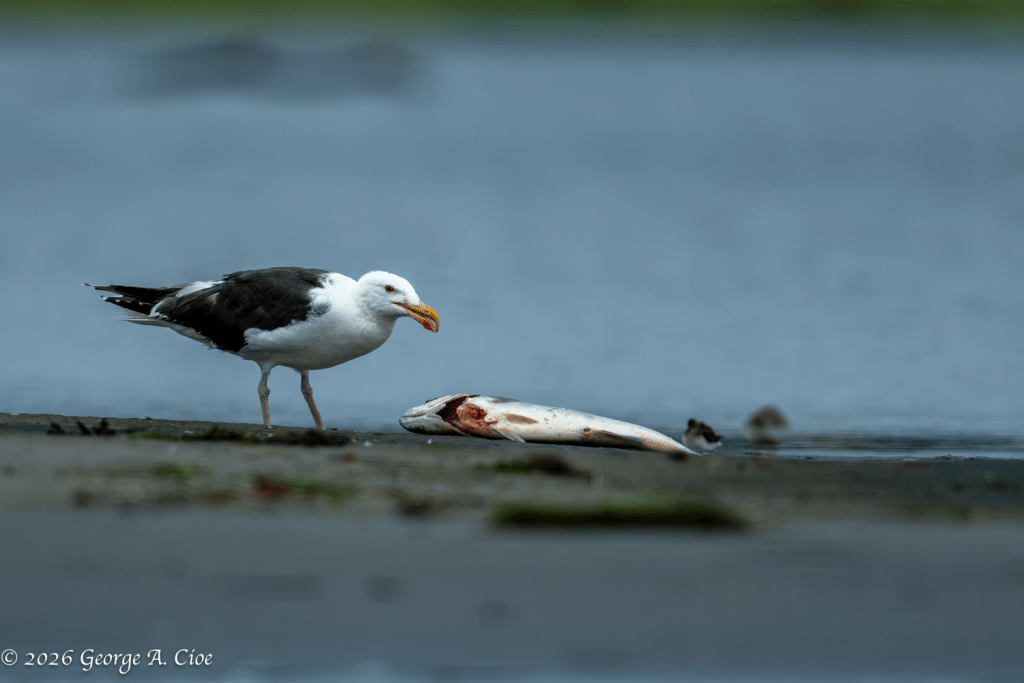
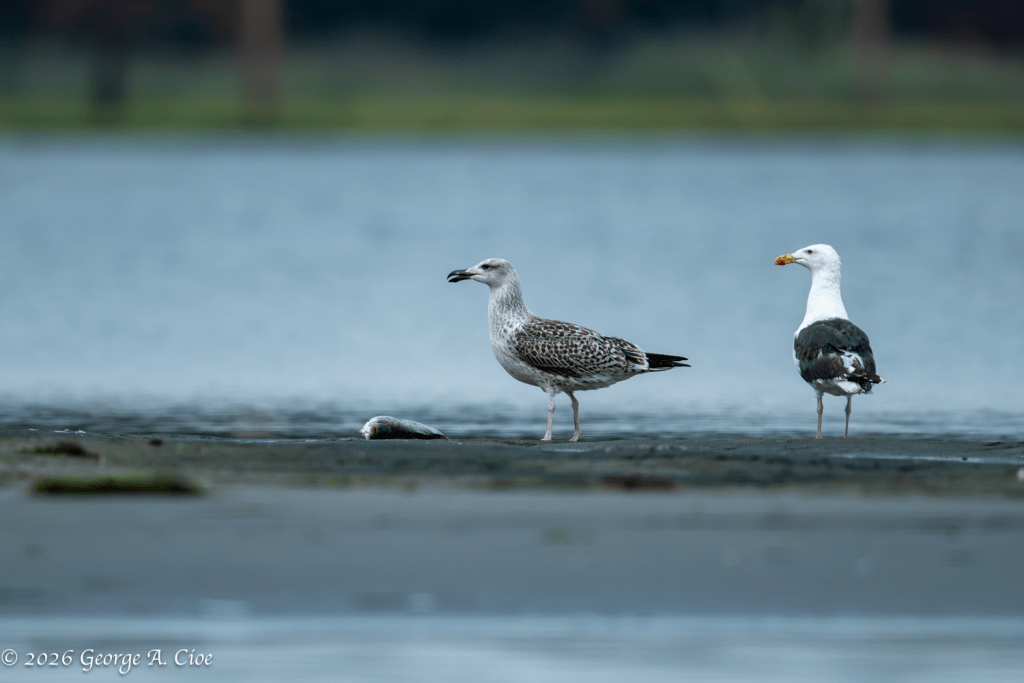
The next time I looked across the river, a Great Black-backed Gull had arrived.
And he wasn’t there to pay his respects.
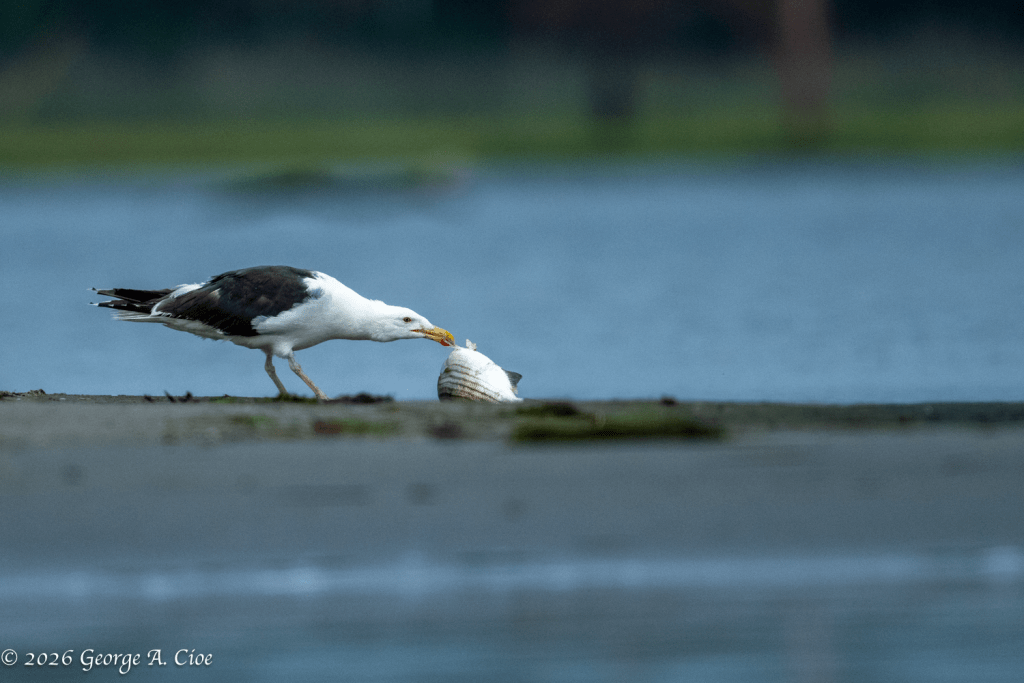
He was all over that striper.
Pulling.
Tugging.
Pecking.
Working at it with the determination of a diner who had just discovered that the breakfast buffet closes in ten minutes.
And I had to smile at the contrast.
Yesterday, I was photographing the Least Sandpiper, one of the smallest shorebirds in the world.
Today?
The Great Black-backed Gull—the largest gull in the world.
That is one of the things I love most about the Narrow River.
You never really know who’s going to show up.
The Great Black-backed Gull is built for exactly this kind of opportunity. Powerful, imposing and wonderfully indiscriminate, it will eat fish, crabs, shellfish, carrion, eggs and smaller birds when the opportunity presents itself.
In nature, “dead fish” doesn’t mean waste.
It means food.
And food rarely goes unnoticed for long.
Soon another Great Black-backed Gull arrived.
This one was an immature bird, still wearing the mottled brown plumage of youth.
The size difference between the two caught my attention. Great Black-backed Gull males average larger than females, although there is enough overlap that size alone isn’t a reliable way to determine sex.
So whatever family arrangements—or complete lack thereof—were occurring on that sandbar, I wasn’t going to referee them.
I just kept watching.
Another Place at the Table
A little while later, another gull appeared.
A Ring-billed Gull.
Much smaller.
More delicate.
And considerably less intimidating than its enormous breakfast companions.
But this particular Ring-billed Gull had something that immediately caught my attention.
A band on its leg.
Now my imagination was off and running.
Where had it been?
Where was it banded?
How old was it?
Was the Narrow River merely a stop along the way?
Bird bands are tiny pieces of scientific history. When their numbers can be read and reported, they can help researchers reconstruct an individual bird’s movements, longevity and migration.
Suddenly this wasn’t merely another gull arriving for breakfast.
It was a traveler with a story.
I just couldn’t read the whole story from where I was standing.
And then I noticed something else.
Farther down the sandbar.
Tiny movement.
I knew that movement.
A Least Sandpiper.
And that’s when an idea popped into my head.
Could I Get Them All?
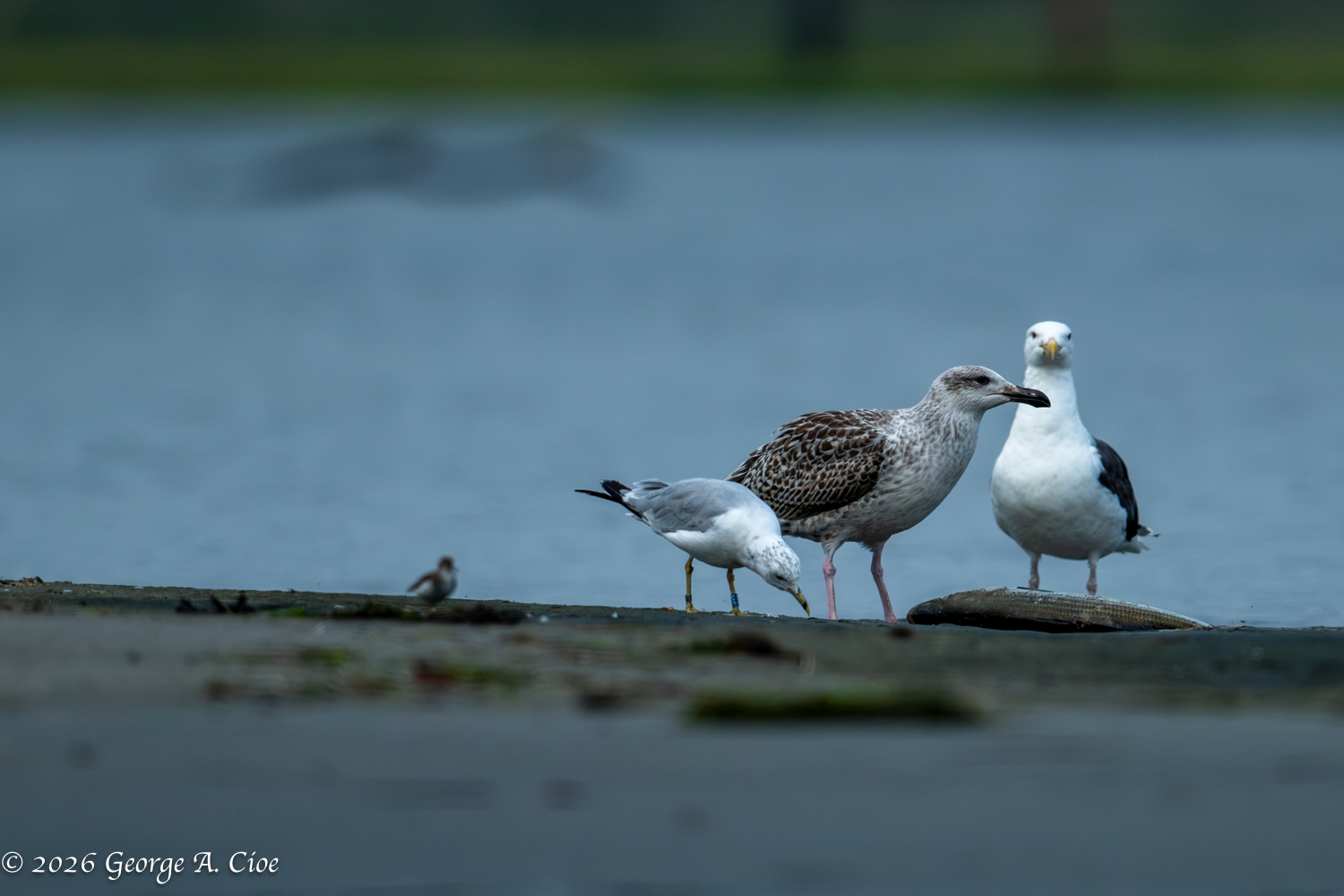
I looked through the lens.
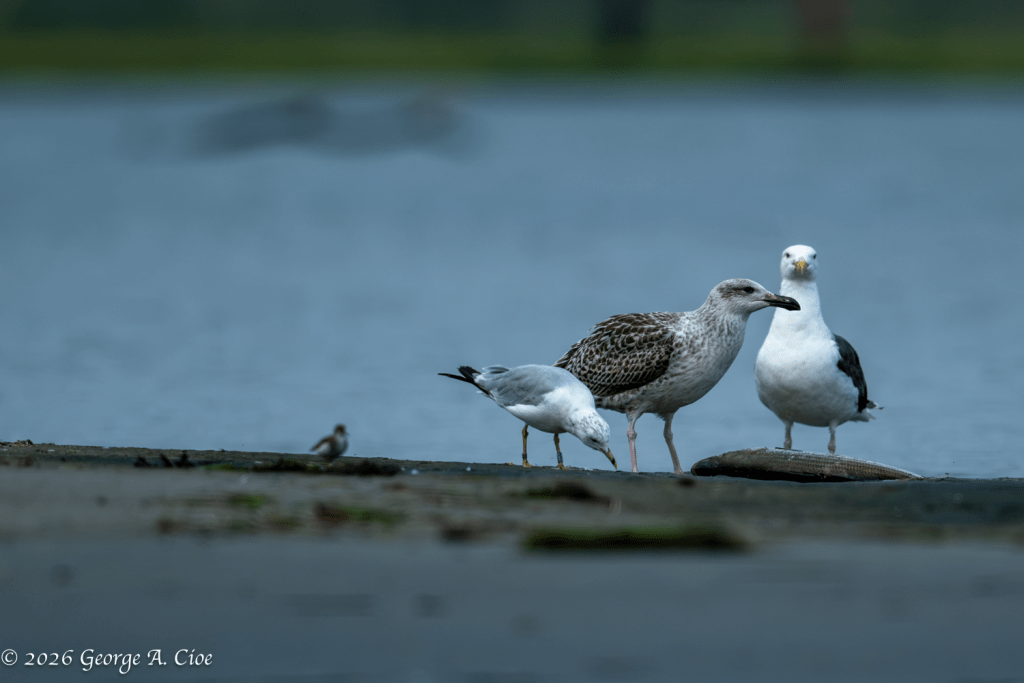
Adult Great Black-backed Gull.
Immature Great Black-backed Gull.
Ring-billed Gull.
Least Sandpiper.
Four birds.
Three species.
One dead Striped Bass.
And one photographer suddenly becoming ridiculously invested in where everybody decided to stand.
Because I wanted one photograph.
One frame that would show the extraordinary range of life sharing this little strip of sand.
The massive Great Black-backed Gull.
Its immature counterpart.
The considerably smaller Ring-billed Gull.
And finally, almost comically small beside them, the Least Sandpiper.
From one of the world’s largest gulls to one of the world’s smallest shorebirds.
All in the same photograph.
So I waited.
Move left.
Come on.
A little farther.
No, you stay there.
Naturally, none of them listened.
Wildlife photography occasionally consists of silently giving very specific instructions to animals who have absolutely no intention of following them.
Then…
For just a moment…
Everything came together.
Click.
I got it.
And I’m still smiling.
But There Was Something Bigger in That Photograph
Later, I realized the photograph wasn’t really about four birds.
It wasn’t even about the striper.
It was about the river.
A Striped Bass had died.
To us, that can look like an ending.
To the river, it was simply a transition.
The gulls were consuming what remained. Crabs and other scavengers would eventually take their turn. Smaller organisms would work on what was left. Nutrients would return to the water and sediment and become available to the living community around them.
Nothing had been scheduled.
Nothing had been organized.
Nobody rang a dinner bell.
Yet there it was.
Predator.
Scavenger.
Shorebird.
Fish.
Four very different species occupying one tiny patch of the Narrow River, each there because millions of years of evolution had equipped it to make a living in an entirely different way.
The striper had spent its life swimming through this aquatic world.
The Great Black-backed Gulls arrived with brute strength and opportunism.
The Ring-billed Gull found its place among the giants.
And a few yards away, the Least Sandpiper quietly worked the wet sand for tiny invertebrates almost beneath everyone’s notice.
Big.
Small.
Powerful.
Delicate.
Living.
Dead.
And absolutely nothing wasted.
That’s the circle of life stripped of sentimentality.
And somehow, because of that, made even more beautiful.
I had walked into the water that morning hoping to photograph wildlife.
Instead, the river gave me a photograph of life itself.
From the greatest…
to the least.
All I had to do was notice.
I’d love to share my posts with you. If you subscribe, they’ll come straight to your inbox—most days, like a little note from me to you. It means a lot to know you’re reading along.
Browse my complete art portfolio and shop for prints at imagesbygacioe.shop


Leave a Reply