






First you see ’em.
Then you don’t.
And then…
You can’t find the bird.
Game. Set. Match.
You’ve been outmaneuvered by a bird.
Again.
If I had a nickel for every magnificent wildlife photograph that never happened because my subject flew the coop, I’d own a publishing company.
Possibly two.
And I could afford to hire someone to carry my camera equipment. Just like the Big Shots. Pun intended.
Bird photography is a fascinating pursuit. Part science. Part art. Part adventure.
And a considerable amount of standing around wondering where the heck your subject went.
It requires patience, preparation, perseverance, an understanding of animal behavior, and the ability to remain perfectly still while a mosquito treats your forehead like an all-you-can-eat buffet.
But oh, the rewards!
Many of you who follow my Narragraphy® posts, whether directly on my blog or through Facebook, Instagram, and YouPic, have been extraordinarily generous with your compliments about my photography.
Thank you.
I genuinely appreciate them.
And since it’s October, I thought I’d share a few tricks of the trade.
No treats, unfortunately.
Unless you consider spending an hour in the cold waiting for a bird to turn its head a treat.
I do.
Which probably explains a great deal about me.
Meet Merlin. No Wand Required.
The star of today’s adventure is a Merlin.
Not the legendary wizard of King Arthur’s court.
Although, given this little falcon’s remarkable ability to disappear, I’m not entirely convinced there’s no magic involved.
The Merlin is a small, extraordinarily agile falcon, generally measuring about 9–13 inches long. Don’t let its size fool you.
This is a feathered fighter jet.
Unlike larger hawks that may soar gracefully overhead, Merlins are renowned for their fast, powerful flight and astonishing aerial pursuits.
They specialize in hunting small birds, sometimes capturing them in midair.
Imagine chasing your breakfast through the sky while your breakfast is actively trying not to become breakfast.
At speeds that can make a photographer’s autofocus system require a reset.
Merlins have relatively short, pointed wings, a longish tail, and a compact, muscular body. Their keen eyesight allows them to detect and track prey at considerable distances.
And they have absolutely no appreciation for the cost of professional photography equipment.
Trust me.
I’ve looked for signs.
Nothing.
My First Rule: Take the Picture!
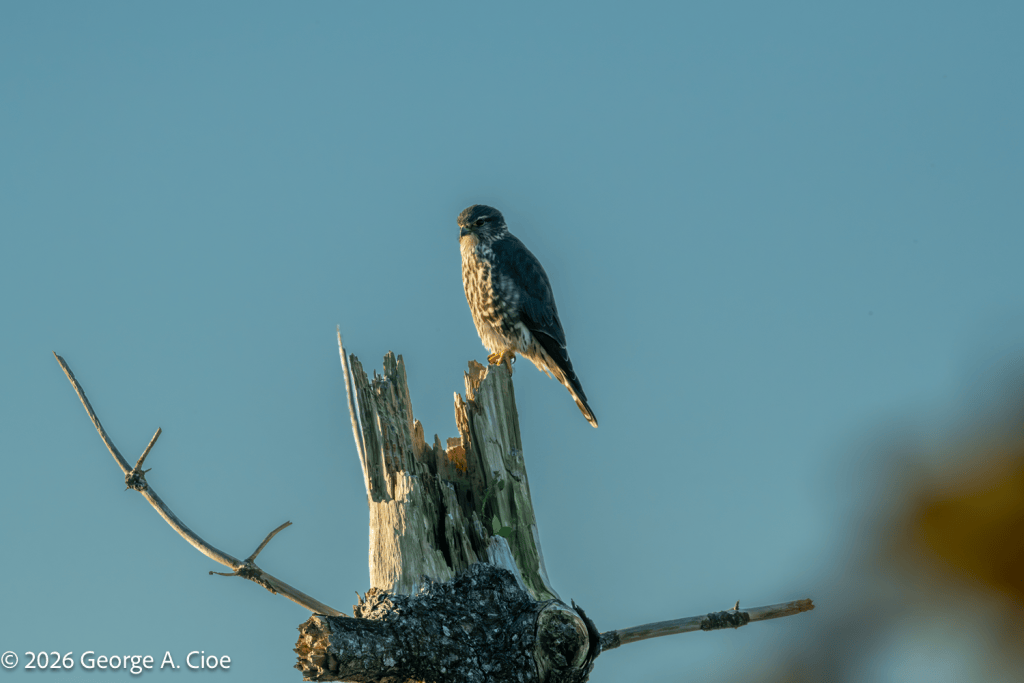
When I first spotted this Merlin, it was perched atop a weathered, broken tree.
A beautiful setting.
Bare branches reached into the sky like the fingers of an ancient sculpture, while the morning sunlight warmed the wood and the autumn vegetation below.
The Merlin was little more than a small silhouette against the sky.
But there it was.
And that was enough.
Click.
My first photograph.
Not the best photograph.
Not even close.
But an important one.
You see, when I first encounter a bird, I photograph it immediately.
Before moving closer.
Before adjusting my position.
Before entertaining grand artistic ambitions.
Because experience has taught me that wildlife operates under one fundamental rule:
It owes the photographer absolutely nothing.
That first image gives me an opportunity to enlarge the bird on my camera’s screen and identify it.
And identification matters.
Knowing what you’re photographing helps you anticipate what it might do next.
Different birds have different hunting strategies, preferred habitats, flight patterns, and tolerances for an approaching photographer.
A Great Blue Heron and a Merlin have about as much in common behaviorally as a ballerina and a caffeinated fighter pilot.
Understanding those differences can make the difference between capturing a remarkable image and photographing an empty branch.
I have an extensive collection of empty branches.
None are for sale.
Yet.
The Approach: A Game of Inches and Patience
Once I’ve identified my subject, I begin studying the surroundings.
Where is the sun?
What’s behind the bird?
Are there branches that will interfere with the composition?
Will the background complement the subject or compete with it?
And are there telephone poles, wires, water towers, or other photographers lurking in the frame?
Yes, other photographers.
We’re a friendly bunch.
Until someone walks directly into your shot.
Then we become considerably less friendly.
Smiles.
With the scene evaluated, I begin my approach.
Slowly.
A few steps.
Stop.
Photograph.
A few more steps.
Stop.
Photograph.
Every image is insurance against the possibility that my subject will suddenly decide it has somewhere more important to be.
And here’s something I’ve learned over the years.
Never assume you’ll get closer.
The bird determines the distance, not the photographer.
If I notice signs of agitation or discomfort, I stop. No photograph is worth unnecessarily disturbing wildlife.
And if the bird flies?
Well, that brings us to one of the great frustrations of bird photography.
Now You See Him. Now You Don’t.
Imagine this.
You’ve been watching a bird for several minutes.
You have your camera ready.
Your settings are perfect.
The light is magnificent.
Suddenly, the bird takes flight!
You track it beautifully.
Then, for one brief moment, you glance down at your camera.
Perhaps to check your exposure.
Perhaps to review an image.
Perhaps because you’re human.
When you look up…
Gone.
Completely gone.
You scan the sky.
Nothing.
The treetops.
Nothing.
The horizon.
Nothing.
And because I photograph wildlife alone about 99.9% of the time, there’s nobody standing beside me to ask:
“Where did he go?”
Now, the bird hasn’t necessarily disappeared.
It may simply have descended below the treeline.
Against an open sky, a flying bird is relatively easy to follow.
But against a background of trees, branches, shadows, and vegetation?
Good luck.
A Merlin’s plumage is beautifully adapted to blending into its surroundings.
Nature designed it that way.
Apparently without consulting Nikon.
So I stop.
Look.
Listen.
And begin searching again.
Sometimes I find the bird.
Sometimes I don’t.
And sometimes I discover that I’ve been staring at a pinecone for the better part of five minutes.
It happens.
The Light Is Everything
One of the most important elements of wildlife photography is something we cannot control.
Light.
Especially early in the morning.
As the sun rises and clouds move, the quality, direction, color, and intensity of the light can change dramatically.
What begins as a soft, muted scene can become a magnificent display of warm gold and brilliant blue within minutes.
And that is precisely what happened during my encounter with this Merlin.
Look at the photographs.
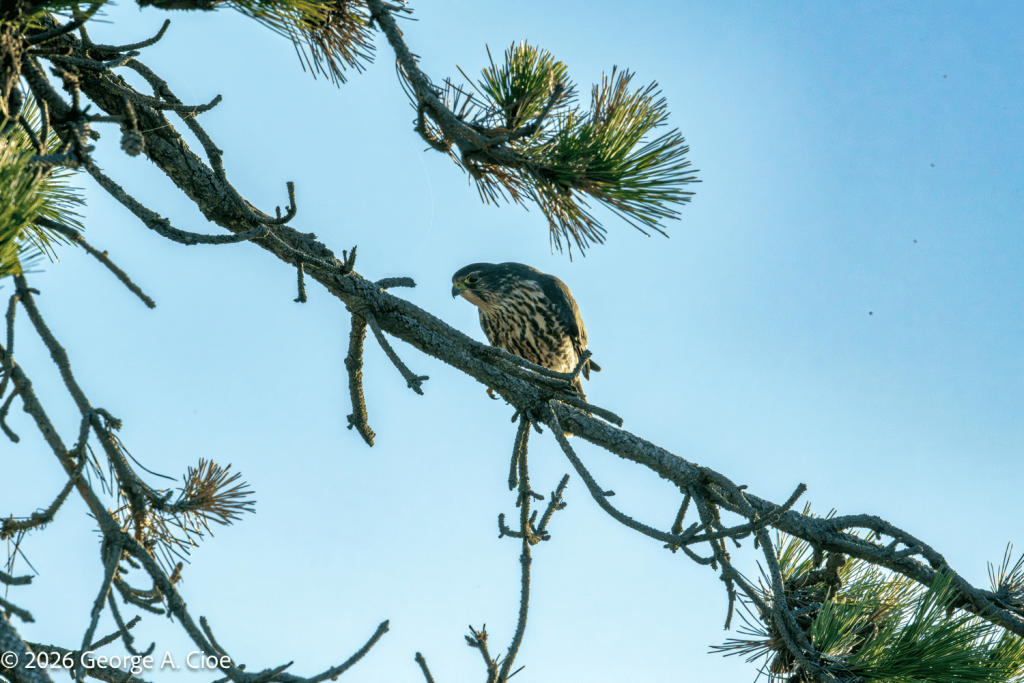
In the earliest image, the bird is relatively small in the composition, surrounded by the graceful architecture of the dead tree.
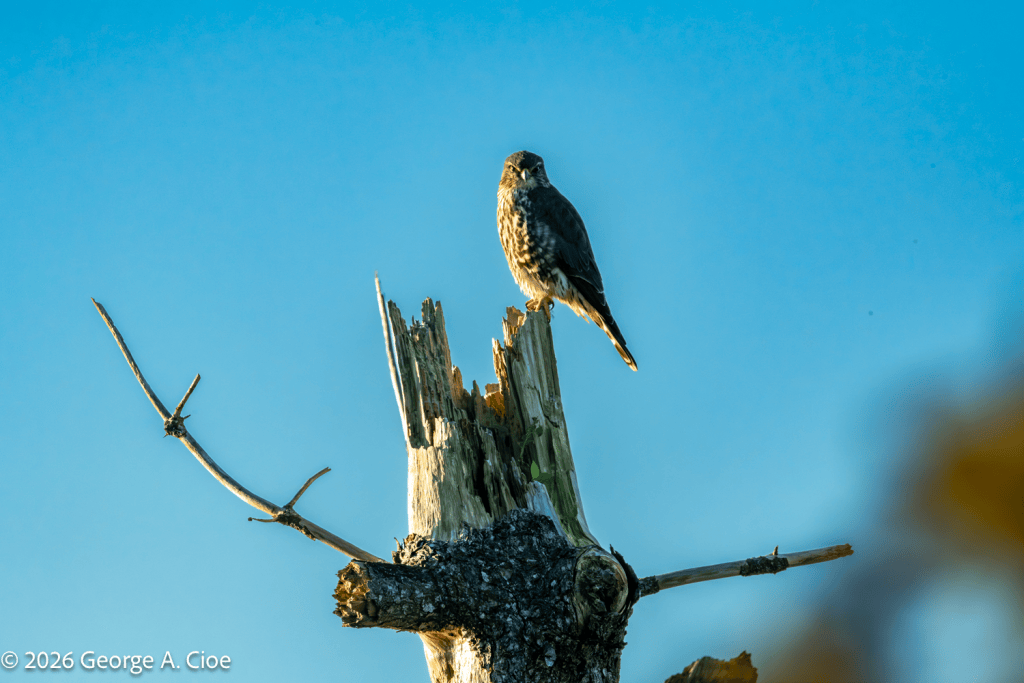
As I approached, the Merlin became more prominent.
The textures of its feathers emerged.
Its yellow feet became visible.
The streaking on its breast grew more distinct.
And the changing angle of sunlight transformed the entire scene.
For those interested in the technical side, here are my typical early-morning bird photography settings on my Nikon D850:
- Exposure mode: Shutter Priority.
- Shutter speed: 1/2500 second.
- ISO: Auto ISO.
- Aperture: Automatically selected by the camera.
These are my starting settings, not an inflexible formula. I adjust when conditions demand it, particularly if the light becomes too dim.
That fast shutter speed helps freeze the remarkable speed of birds in flight.
And Auto ISO allows me to concentrate on my subject while the camera compensates for changing light, within the limits of the lens and available illumination.
It’s a compromise.
Photography is full of them.
But there is one compromise I refuse to make.
I will not sacrifice the experience of witnessing something extraordinary simply because I’m too preoccupied with camera settings to enjoy it.
The Secret? Don’t Leave!
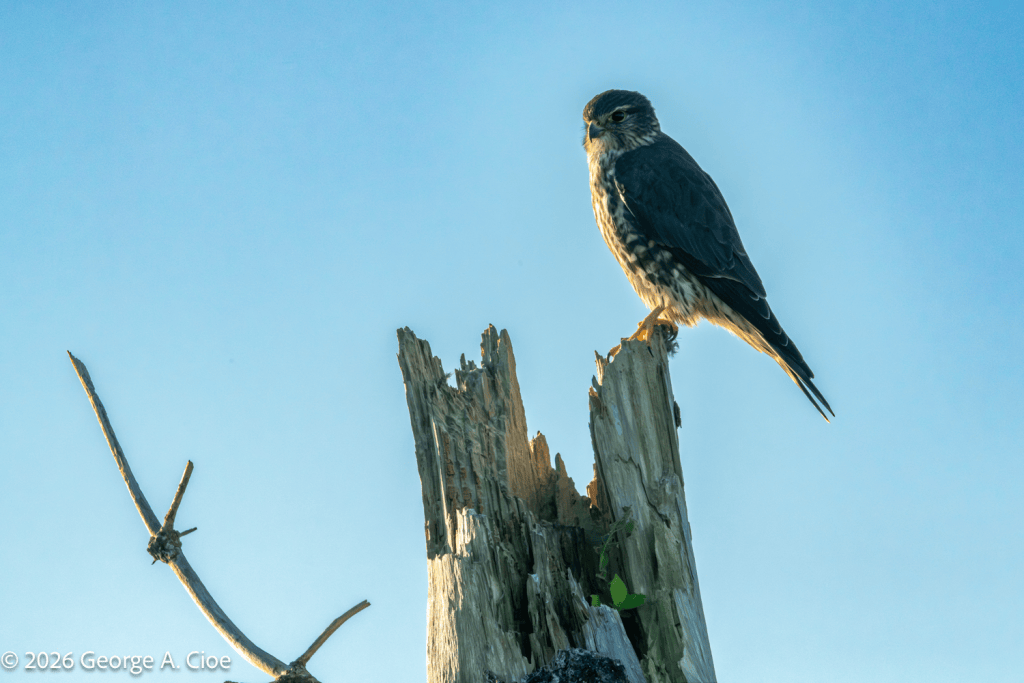
Eventually, I reached a position where the Merlin filled a much larger portion of my frame.
The light was beautiful.
The bird was cooperative.
And I had captured several images I was pleased with.
Time to move on?
Absolutely not.
This is where patience becomes particularly rewarding.
Because once I have the photograph I came for, I can relax and watch.
And watching is where the real education begins.
Birds reveal a great deal through their behavior.
They shift their weight.
Turn their heads.
Preen.
Stretch.
Respond to sounds.
Watch potential prey.
And occasionally, a gust of wind rearranges their feathers into something resembling a bad hair day.
During this encounter, the Merlin shifted its position and spread some of its feathers, giving me a wonderful glimpse of the intricate patterning on its wings and tail.
I also noticed what appeared to be loose feathers near its feet.
Possibly evidence of a recent meal.
Merlins frequently use exposed perches to survey their surroundings, and they may also pluck and consume captured prey on a snag.
This photograph confirms that this snag is a favorite for dining. It’s the second time I have photographed a Merlin perched there.
A wildlife photographer collects information as carefully as images.
And sometimes the information leads to the next great photograph.
A Change of Address
Then my little falcon relocated.
Not to another county.
Just to a nearby pine tree.
But what a difference!
The weathered, broken trunk had provided a wonderfully stark, almost sculptural setting.
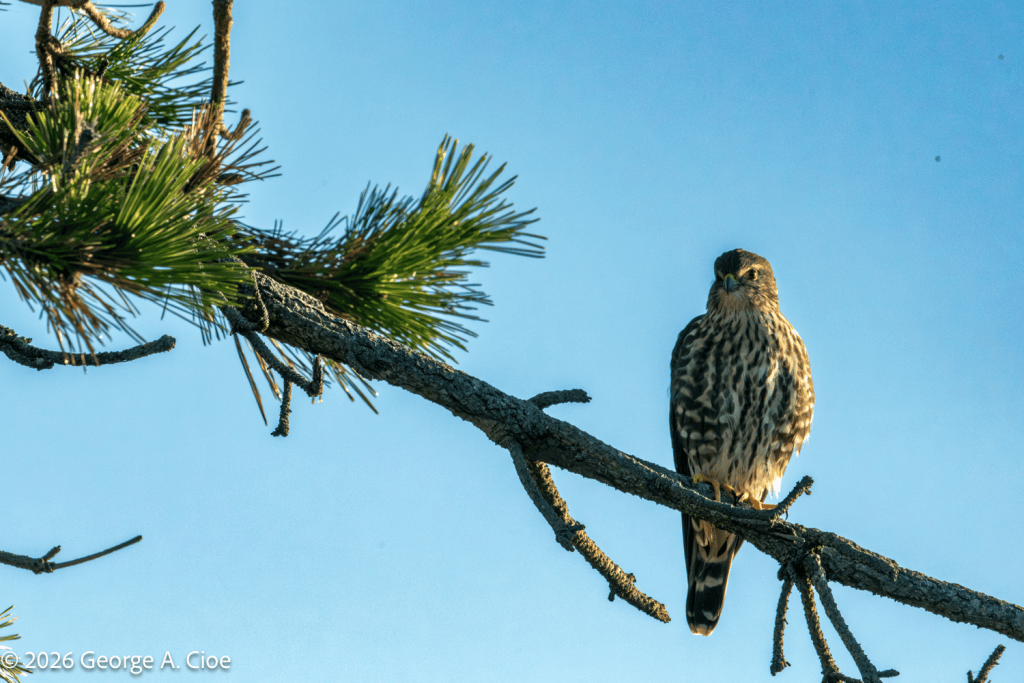
Now the Merlin was framed by pine branches.
The composition became softer.
More intimate.
The sunlight filtered through the needles, illuminating the bird’s streaked breast and outlining portions of its feathers.
Same bird.
Same morning.
A completely different photograph.
And that’s something I find endlessly fascinating about photography.
You don’t necessarily need a new subject to create a new image.
Sometimes all you need is a different perspective.
Or a few minutes.
Or a little patience.
Actually, make that a lot of patience.
The Look
There’s one final moment I always hope to capture.
The look.
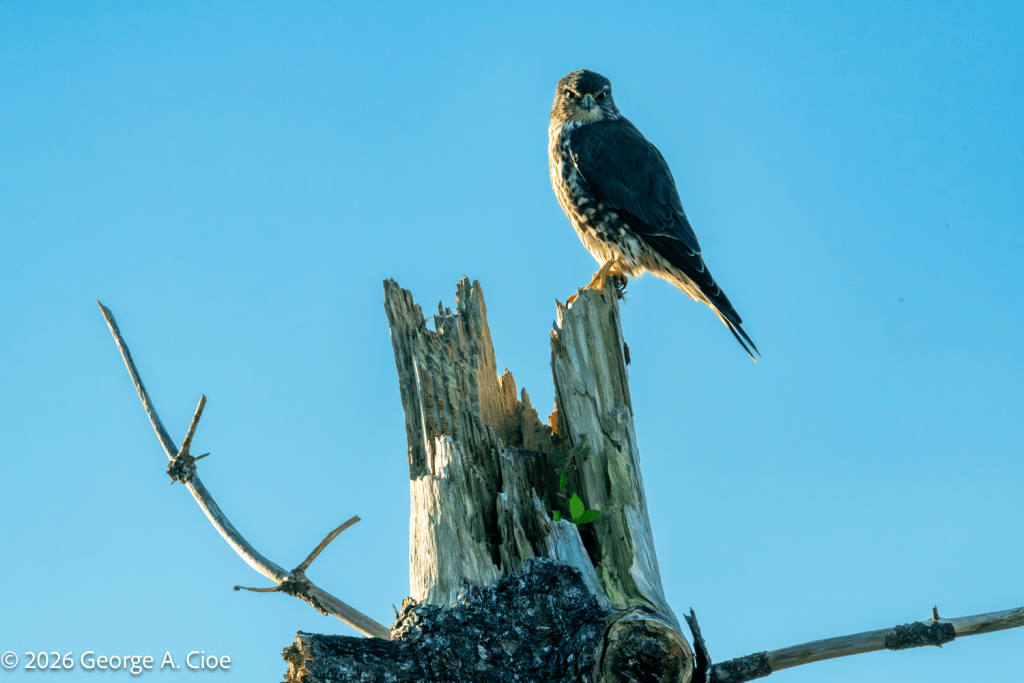
That wonderful instant when a wild creature turns its head and appears to stare directly into the camera.
I love it.
And here’s a little confession.
I still enjoy using my Nikon D850 DSLR.
Yes, it has a mirror.
Yes, it makes that familiar mechanical clicking sound.
And yes, there are newer cameras with remarkable electronic viewfinders and sophisticated autofocus systems that are virtually silent. And the big bonus – no vibration from mirror movement.
But I love looking directly through an optical viewfinder.
At the actual light.
Through the lens.
There’s something wonderfully immediate about it.
And occasionally, the sound of my camera shutter seems to catch a bird’s attention.
A turn of the head.
A curious glance.
A momentary connection.
Click.
Of course, I don’t deliberately disturb birds to get that reaction.
But when it happens naturally, I welcome it.
Because that little glance can transform a photograph from a record of an animal into something that feels almost like a portrait.
And when a Merlin looks directly at you, there is something wonderfully intense about those dark eyes.
Almost as though it’s thinking:
“That’s a very expensive camera.”
“Have you considered photographing pinecones?”
The Photograph You Never See
Most of the time, when I publish a Narragraphy®, you see the finished photographs.
The closest images.
The best light.
The most interesting poses.
The moments when preparation, patience, and a little luck came together.
What you don’t see are the hundreds of decisions that preceded them.
The waiting.
The walking.
The searching.
The repositioning.
The missed opportunities.
The moments when the bird flew away just as I pressed the shutter.
Or when the light was perfect, but the bird wasn’t.
Or when the bird was perfect, but the light wasn’t.
Or when everything was perfect, except for the branch that appeared to be growing directly out of the bird’s head.
Wildlife photography can be maddening.
And absolutely wonderful.
So today, I wanted to do something a little different.
Rather than show you only my favorite photographs of this Merlin, I’ve included the progression of our encounter.
From the first distant sighting to the closer portraits.
From the weathered stump to the pine tree.
From the softer early light to the brilliant blues and warm highlights of a beautiful October morning.
As you look through the images, notice how the light changes.
How the detail improves.
How the compositions evolve.
And how the Merlin’s personality seems to emerge.
Each photograph is part of the story.
And none would exist without the one that came before it.
The Greatest Reward
There’s a reason I keep getting up before sunrise.
Why I carry heavy equipment into marshes, along shorelines, and through the woods.
Why I stand quietly, sometimes for what seems like an eternity, waiting for a creature that may or may not cooperate.
It’s not simply about taking photographs.
It’s about discovery.
About witnessing the natural world going about its business.
About recognizing that extraordinary things are happening all around us, whether we’re there to see them or not.
And about experiencing that wonderful sense of anticipation when you venture outdoors without knowing what you might encounter.
A Merlin.
An eagle.
A fox.
A spectacular sunrise.
Or perhaps nothing more than a quiet morning and the sound of wind moving through the trees.
I’ve learned to appreciate all of them.
Because the real adventure isn’t knowing what you’ll find.
It’s going out to discover what’s there.
And if you happen to be outmaneuvered by a bird?
Well…
There’s always tomorrow.
And perhaps tomorrow I’ll win.
Although, based on my experience, I wouldn’t bet on it.
Love nature. Respect wildlife. And never underestimate a bird with wings.
Enjoy the photographs. And perhaps the next time you see a photographer standing motionless beside a marsh, staring intently at what appears to be an empty tree, you’ll have a better appreciation for what they’re doing.
Or at least why they’re doing it.
Game. Set. Match.
The bird wins.
Again.
Naturally.
I’d love to share my posts with you. If you subscribe, they’ll come straight to your inbox—most days, like a little note from me to you. It means a lot to know you’re reading along.
Browse my complete art portfolio and shop for prints at imagesbygacioe.shop


Leave a Reply