
There is something about November in New England that makes the world look as though someone has turned down the color.
Not all at once.
Gradually.
The brilliant reds and oranges of autumn surrender to muted browns.
The golden leaves that once danced in the sunshine now lie scattered across the ground.
And the wind?
Well, the wind has become considerably less polite.
It no longer whispers through the trees.
It announces itself.
Sometimes rather rudely.
And then there is the rain.
Cold.
Persistent.
The kind that reminds you that winter is no longer a distant possibility.
It’s an approaching certainty.
Welcome to November in Narragansett.
Where Mother Nature is redecorating.
And apparently, she’s developed a fondness for gray.
Gray skies.
Gray seas.
Gray rocks.
And occasionally, gray dispositions.
Unless, of course, that pure white stuff arrives.
Then everything changes again.
But that’s New England.
We wouldn’t have it any other way.
Well.
Most days.
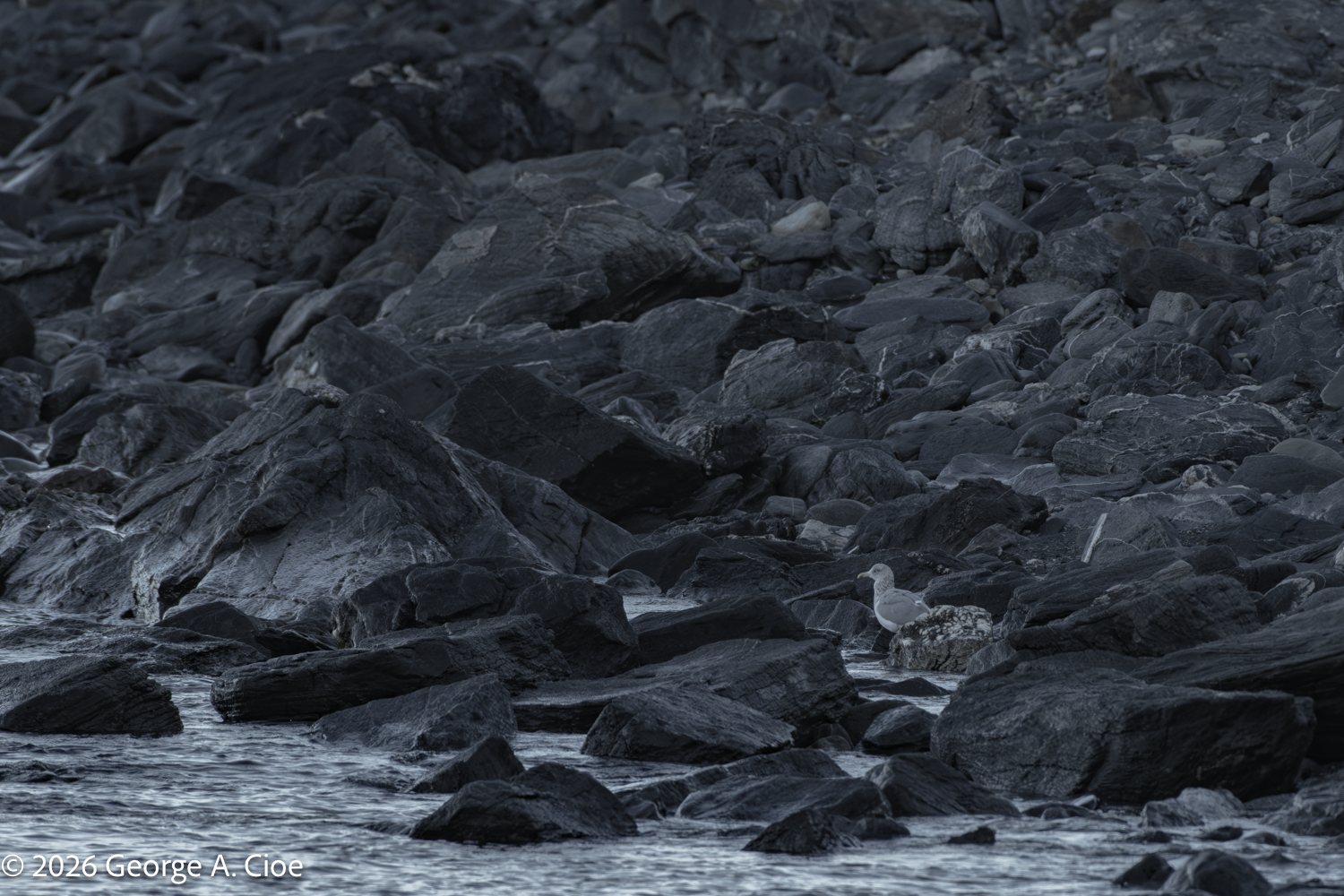
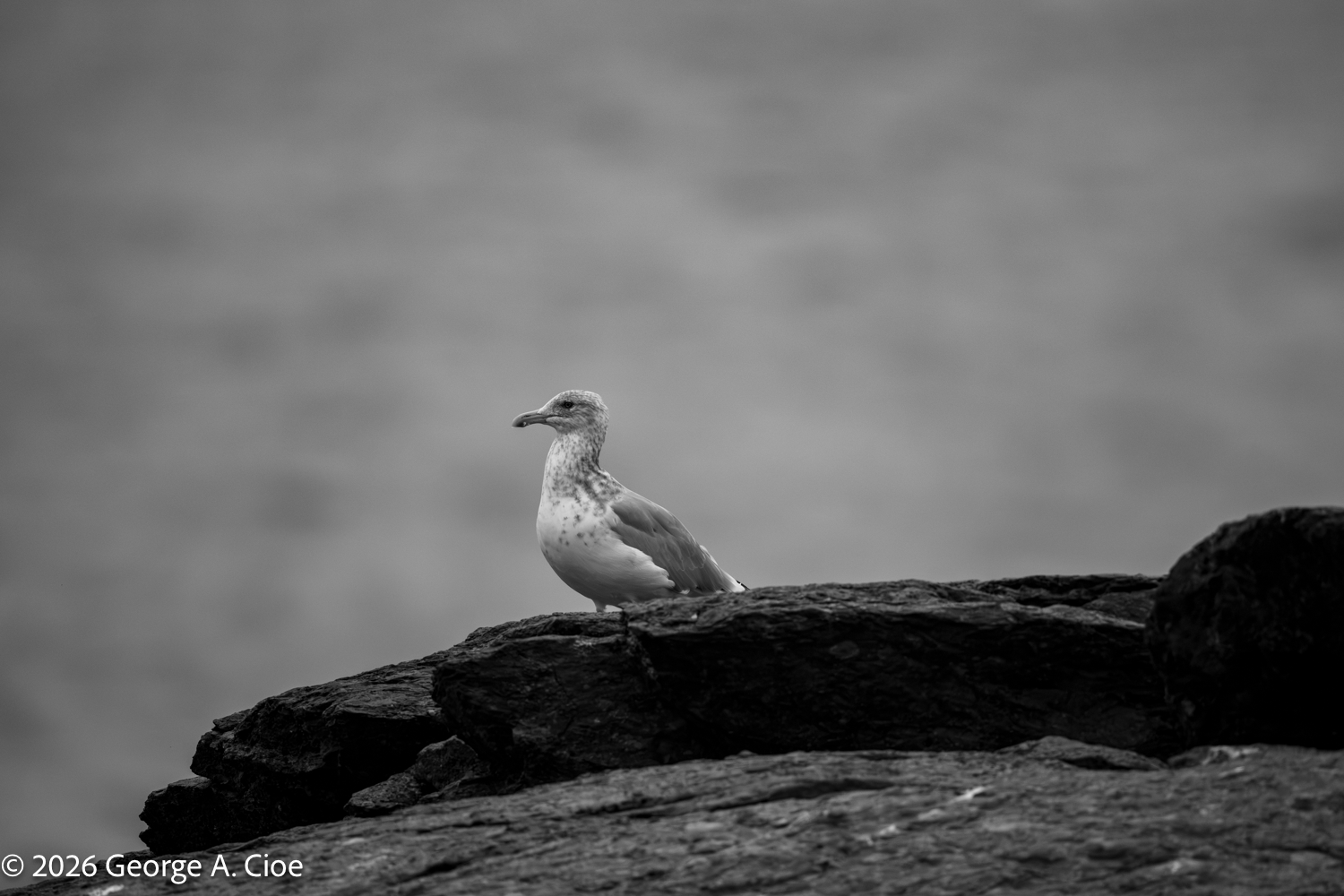
I was walking along a rocky shoreline when I noticed this Herring Gull perched on an outcrop.
There was nothing particularly extraordinary about the encounter.
Herring Gulls are familiar companions along our coast.
They’re hardy, adaptable, resourceful birds.
And, judging by their willingness to steal an unattended sandwich, not particularly burdened by modesty.
But this one caught my attention.
Perhaps it was the way it stood against the subdued background.
Perhaps it was the stillness.
Or perhaps it was simply that the entire scene seemed to be telling me something.
I raised my camera.
And saw a photograph that didn’t need color.
In fact, color might have diminished it.
The dark, weathered rocks.
The soft, almost featureless background.
The subtle variations in the gull’s feathers.
Everything belonged to a world of shadows, highlights, and shades of gray.
A portrait of the season.
And, in some ways, a portrait of life.
By November, many of the birds that entertained me throughout the warmer months have departed.
The Ospreys have headed south.
The terns are gone.
The songbirds that filled the mornings with music have largely surrendered their stages to the wind.
The trees stand increasingly naked against the sky.
Even the sunlight seems to be in a hurry, arriving later and leaving earlier.
Nature is changing.
Again.
And we New Englanders know the routine.
We put away the summer furniture.
Prepare our homes.
Check the heating systems.
Find the snow shovels.
And wonder whether the snowblower will start after sitting idle for eight months.
We prepare for the worst.
And hope for the best.
It’s practically a regional philosophy.
But there’s something deeper about our relationship with the seasons.
Living in New England teaches us that change is not an interruption of life. It is an essential part of it.
We cannot negotiate with November.
We cannot persuade the leaves to remain on their branches.
We cannot convince the sun to linger a little longer.
And we certainly cannot reason with a February nor’easter.
Believe me.
I’ve tried.
Nature doesn’t take requests.
So we learn to anticipate.
To adjust.
To respond.
And, perhaps most importantly, to appreciate what remains.
I looked at that Herring Gull and thought about its remarkable ability to survive.
It doesn’t have a heated home.
Or a closet full of winter clothing.
Or a weather app warning of an approaching storm.
Yet it is wonderfully equipped to endure the challenges of the coming months.
Its dense, waterproof plumage provides insulation.
Its ability to exploit a remarkable variety of food sources gives it options when conditions change.
And its instincts tell it when to seek shelter and when to venture out.
It doesn’t resist the changing seasons.
It lives through them.
There is a lesson in that.
We spend so much of our lives seeking stability.
We build routines.
Develop expectations.
Make plans.
And become comfortable with the familiar.
Then something changes.
Sometimes gradually, like the fading colors of autumn.
Sometimes suddenly, like a storm arriving ahead of its forecast.
And we find ourselves standing on unfamiliar ground.
Wondering what comes next.
But perhaps resilience isn’t about preventing change.
Perhaps it’s about developing the confidence that we can meet it.
That we can adapt without surrendering who we are.
That we can find beauty even when the colors have faded.
And recognize opportunity where we once saw only uncertainty.
As I studied this photograph, something else occurred to me.
Black-and-white photography doesn’t eliminate beauty.
It asks us to discover beauty differently.
Without the distraction of color, we begin noticing things we might otherwise overlook.
Texture.
Form.
Contrast.
Light.
The quiet relationships between objects and their surroundings.
Perhaps life is like that, too.
When circumstances strip away the familiar, we sometimes discover qualities we never fully appreciated.
Patience.
Resourcefulness.
Courage.
Gratitude.
And the extraordinary capacity to find meaning in ordinary moments.
I don’t know what this winter will bring.
Snowstorms?
Mild temperatures?
Weeks of gray skies?
Or one of those spectacular New England mornings when a fresh snowfall transforms the landscape into something so beautiful that even the most dedicated winter complainer stops to admire it?
Probably a little of everything.
That’s the beauty of living here.
We never really know.
But we know change is coming.
And we know we can meet it.
Because we’ve done it before.
I took one last look at the Herring Gull.
Standing quietly on its rocky perch.
Untroubled by the fading colors.
Unconcerned with the approaching winter.
Perfectly at home in a world of gray.
And I smiled.
Because perhaps the greatest lesson of the changing seasons isn’t that we must learn to endure them.
It’s that we can learn to appreciate each one for what it offers.
Even November.
Even the gray.
Even the uncertainty.
After all, resilience isn’t the ability to keep life from changing. It’s the ability to keep finding beauty, purpose, and joy as it does.
And sometimes, all it takes to remind us is a Herring Gull.
Standing on a rock.
On a gray November morning.
In Narragansett.
I’d love to share my posts with you. If you subscribe, they’ll come straight to your inbox—most days, like a little note from me to you. It means a lot to know you’re reading along.
Browse my complete art portfolio and shop for prints at imagesbygacioe.shop


Leave a Reply