

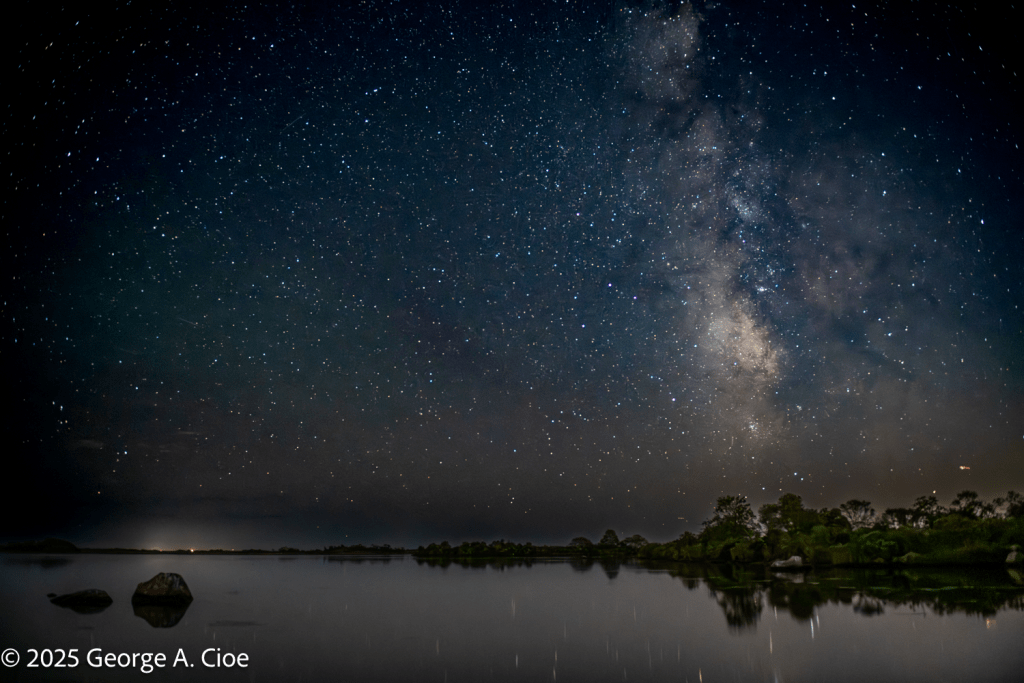
One night, under a moonless sky at Ninigret National Wildlife Refuge, I stood in awe, both humbled and exhilarated. There’s something quietly profound about being alone with the cosmos in a place as dark and undisturbed as this stretch of Rhode Island’s coast. Ninigret, shaped by ancient glaciers and more recent military history, has become a sanctuary—not only for migratory birds, but for those of us drawn to the stars.
I had come not just to look up, but to capture what I could of the Milky Way, that celestial river of stars, with my camera. It’s a thrilling paradox, really—this act of photographing something so impossibly vast and in motion, while standing perfectly still.
Think about it: while we gaze up at the stars, we’re hurtling through space. Earth spins on its axis at about 1,000 miles per hour—faster than a commercial jet—and orbits the sun at a mind-bending 67,000 miles per hour. Meanwhile, the entire solar system itself barrels through the galaxy at 448,000 miles per hour. And the Milky Way? It’s on a cosmic collision course with the Andromeda Galaxy, closing the distance between them at 70 miles per second.
Yet, in the middle of all that speed and motion, we can open a camera’s shutter for 20 seconds, and somehow freeze the stars in place.
But motion never really disappears. In night photography, it’s a constant adversary and muse. Too slow a shutter speed, and stars begin to blur—stretching like tiny grains of rice across the frame. Add a ripple in the water, and suddenly their reflections shimmer like threads of light being pulled apart.
That was part of the magic I found that night.
I chose a quiet spot at the water’s edge, far from the softly buzzing crowd at the Frosty Drew Observatory. I wanted stillness—a mirror of stars cast across a dark pond. And I found the perfect frame. Almost.
What I hadn’t accounted for were the flight paths between Boston and New York. The sky—so seemingly empty to the eye—was soon etched with the white and red light trails of passing planes. My usual 20-second exposures lit up with long, bright streaks that broke the spell. Light pollution in motion. I’m not well-versed in post-production software, so editing the image in Photoshop wasn’t an option. Removing the light trails digitally just wasn’t in my toolkit—I had to find a solution in the moment, behind the lens.
So I adjusted. Faster shutter, fewer planes. I adapted to the pace of the sky, balancing clarity with patience, light with time.
What I captured wasn’t perfect—but it was real. No edits. Just the quiet murmur of water, the cold blink of stars, and the faint rush of a universe forever in motion.
Subscribe below and get my daily (okay, most days—let’s not get crazy) post delivered straight to your inbox. Like magic. But with fewer rabbits. 🐇✉️
Browse my complete art portfolio and shop prints at imagesbygacioe.shop


Leave a Reply