

There are mornings on the Narrow River when you arrive with expectations.
This was supposed to be an osprey morning.
Maybe an eagle morning if the wildlife gods were feeling generous.
Instead?
I got cormorants.
At first, I felt a little cheated.
You know how it is. You mentally prepare yourself for majestic aerial predators soaring dramatically through golden light while inspirational music plays in your head.
Then reality arrives looking like an over-caffeinated underwater plumber with feathers.
Ah yes…
The cormorants.
And suddenly the mystery of the worm hatch deepens.
Because while the striped bass are feeding politely beneath the surface like refined guests sampling hors d’oeuvres at a vineyard brunch, the cormorants arrive like someone just announced free televisions at the marsh entrance.
All dignity immediately leaves the river.
Now here’s the fascinating part.
Double-crested Cormorants aren’t surface feeders like gulls, nor precision dive bombers like osprey.
These birds are underwater pursuit hunters.
And what I was seeing suddenly made perfect sense.
The “scurrying” behavior across the surface wasn’t random at all. It was tactical. Calculated. Purposeful.
They were searching for concentrations of feeding fish.
Beneath the surface, thousands of marine worms were emerging from the mud during the spring hatch. Striped bass and perch were vacuuming them up, creating subtle feeding zones throughout the cove.
And the cormorants knew exactly how to read the signs.
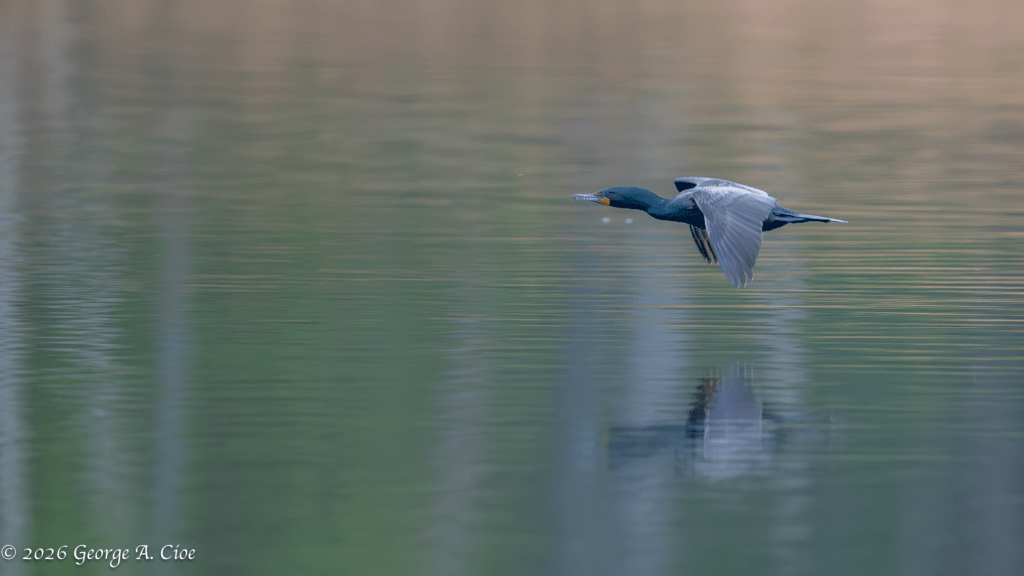
They raced low across the water, necks stretched forward, eyes scanning constantly like tiny feathered torpedoes looking for underwater traffic.
Then suddenly…
One would disappear.
Gone.
No splash. No drama.
Just gone beneath the surface.
And that’s where the real show begins.
Cormorants are astonishing underwater athletes. Using their powerful webbed feet, they “fly” beneath the water chasing fish, worms, or anything unlucky enough to get caught in the chaos.
What amazes me is how awkward they appear above water compared to how efficient they become below it.
On the surface they look vaguely anxious.
Low riding.
Paddling frantically.
Like little submarines that forgot where they parked.
But underwater?
Completely transformed.
Nature built them for this exact moment.
And here’s one of my favorite facts about cormorants.
Unlike ducks, their feathers are not fully waterproof. At first that sounds like a terrible design flaw for a water bird.
Until you realize partial wetting reduces buoyancy and helps them dive deeper and maneuver more effectively underwater.
In other words, Nature traded elegance for performance.
The downside?
After feeding they often stand on pilings or rocks with their wings fully spread, trying to dry themselves.
It’s one of the few moments in wildlife photography where a bird can simultaneously look majestic and like it just lost an argument with a leaf blower.
Meanwhile the entire river reorganizes around the hatch.
Worms emerge.
Fish concentrate.
Cormorants dive.
Terns begin aerial assaults.
Gulls patrol overhead.
And somewhere out there, every osprey and eagle in Washington County has apparently received the same group text announcing:
“Buffet now open. Multiple locations.”
Which explains why my expected stars never showed.
I was in the wrong dining room.
But honestly?
Standing there watching ripples move across glassy water while cormorants skimmed the surface like living periscopes, it no longer felt like the wrong place at all.
Because once again the Narrow River reminded me that even on mornings when the stars fail to appear…
the understudies can still steal the entire show.
Naturally.
I’d love to share my posts with you. If you subscribe, they’ll come straight to your inbox—most days, like a little note from me to you. It means a lot to know you’re reading along.
Browse my complete art portfolio and shop for prints at imagesbygacioe.shop



Leave a Reply