

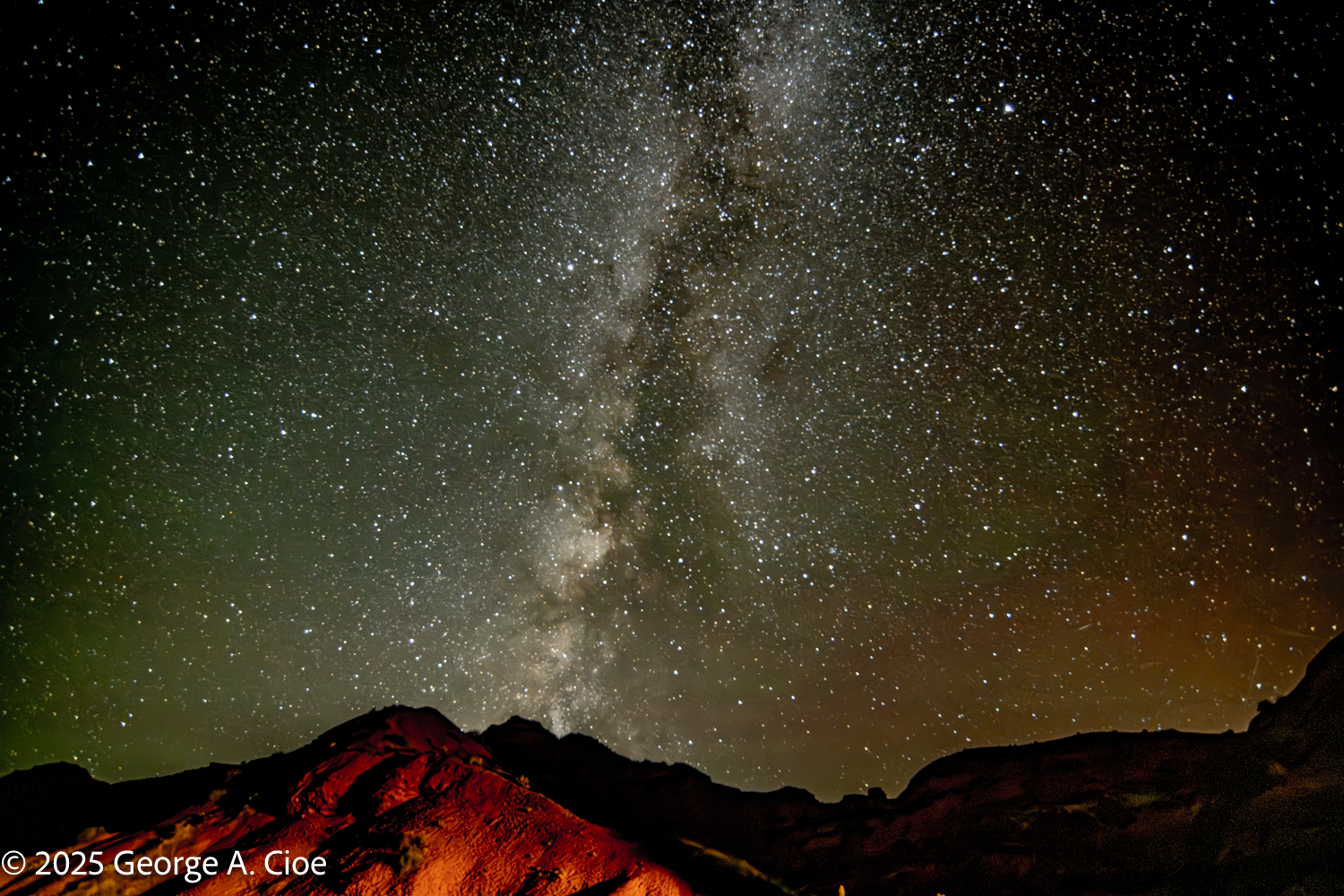
I’ve always been captivated by the cosmos, especially through the lens of astrophotography. The published images of the Milky Way’s galactic core—those shimmering swirls of light and dust billions of years old—never fail to mesmerize me. There’s something eternal and humbling about it. And somehow, no matter how often I see it, the Milky Way never loses its magic.
Before our trip to Moab, Utah, I dove deep into preparation. I studied night photography techniques, curated the right gear, downloaded star-tracking apps, and obsessed over weather forecasts and moon phases. October 20, 2023, was circled on my calendar. By late October, the galactic core has mostly slipped below the horizon, but the tail end still streaks across the sky—and Moab’s night skies are so incredibly dark, I knew I had to try.
I had a plan. I’d head out to Arches National Park and use a small light to illuminate the red rock formations in the foreground of my photo—just enough to give the scene depth without washing out the stars. But when we arrived, I quickly learned that using artificial light in Arches was a no-go. The park protects its darkness like a sacred relic, and rightly so. Still, that meant I had to pivot.
Back near the Red Cliffs Lodge where we were staying, I drove a few miles into the surrounding terrain, scanning for the darkest area I could find. Then, at a bend in the road, I saw it—a clear view of the heavens framed by jagged silhouettes of rock. I pulled over and began setting up.
That’s when the magic of chance stepped in.
As I positioned my tripod, a car rounded the bend. Its headlights spilled across the landscape, lighting up the red rocks in a soft, golden wash. For a brief second, I saw exactly the kind of foreground illumination I had hoped for—but without breaking any rules. That’s when it hit me: I could use passing cars as my light source.
I ran a few test shots to lock in my framing and exposure. Then I began watching for headlights, timing their approach to coincide with the final five seconds of a long exposure. It became a game of patience and precision. I’d stand in the dark, watching for the headlights to reach a specific spot in the road, then start the shot just in time for the light to sweep across the frame in the final seconds of the exposure.
That night, I captured my very first image of the Milky Way.
What began as a carefully researched plan turned into an on-the-fly improvisation, and the result was more meaningful than anything I could’ve anticipated. The galaxy stretched above me like a silent river of stars, and for a brief moment, I felt both infinitely small and profoundly connected to something vast and eternal.
And now? I’m hooked.
Subscribe below and get my daily (okay, most days—let’s not get crazy) post delivered straight to your inbox. Like magic. But with fewer rabbits. 🐇✉️
Browse my complete art portfolio and shop prints at imagesbygacioe.shop

Leave a Reply