
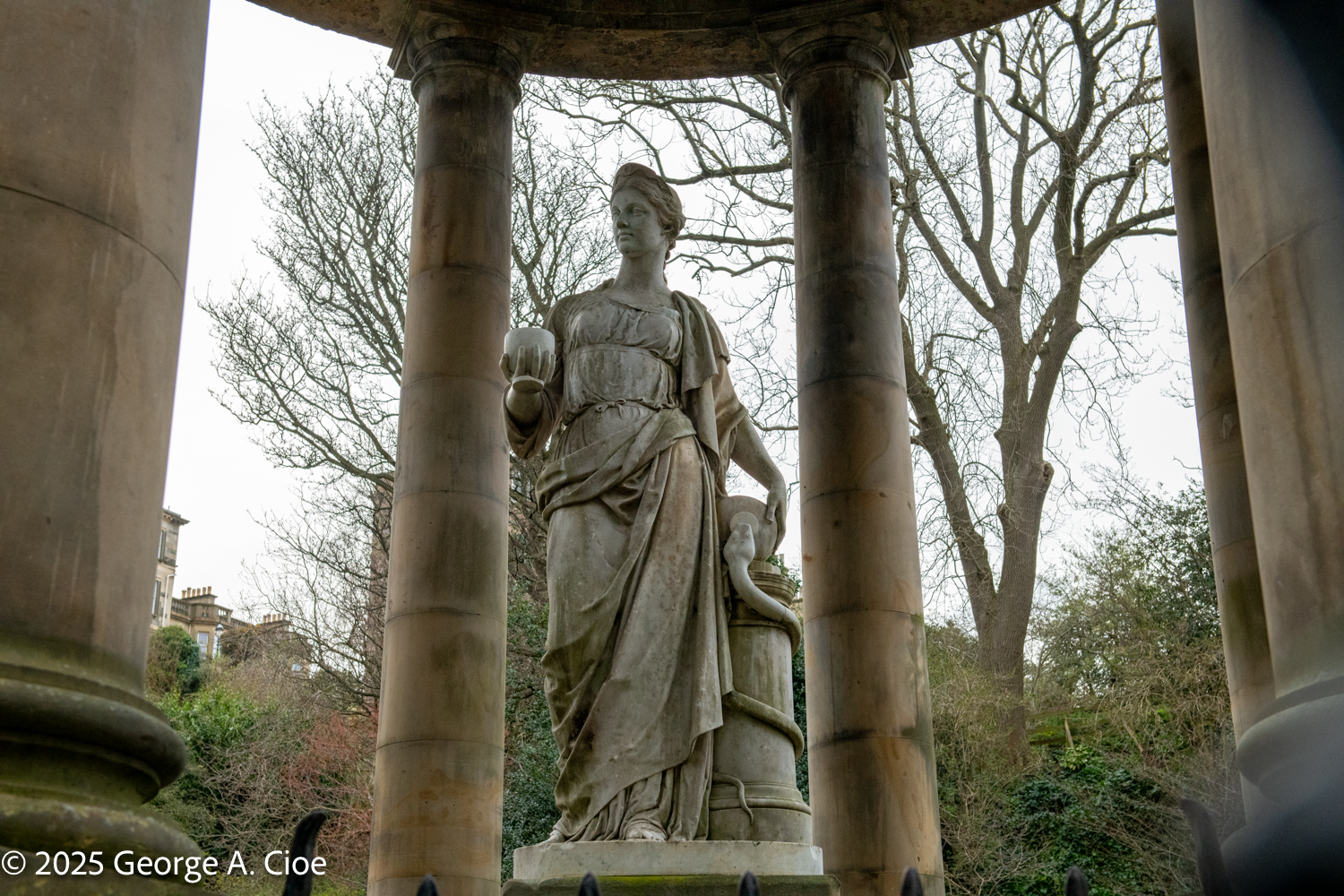
What’s this?
On a recent visit to Edinburgh, intrepid Aperture Tours photo guide Martin Smith and his client (that would be the narrator of this tale) stumbled upon the well via the Water of Leith walkway. Alas, the gates were locked—proof that beauty and bureaucracy often go hand in hand. So basically, this entire investigation was led by two guys killing time in the Disneyland parking lot—armed with iced coffee, two cameras, and absolutely no adult supervision.
Tucked along the leafy Water of Leith, just a gentle amble from the storybook Dean Village, stands a structure so grandiose, you might assume it was built to house ancient deities, or at the very least, Edinburgh’s finest philosophers. But no—it was constructed for something far more humble: a well. Yes, a glorified hole in the ground with a fancy hat.
The tale begins in the 1760s, when a group of schoolboys—possibly bunking off lessons—stumbled upon a spring while fishing. Hopes of trout were dashed, but what they found instead would launch a centuries-long health craze. The water was rumored to cure everything from stiff joints to blindness. Whether it cured schoolboy truancy remains undocumented.
Fast-forward to 1789, when the well caught the eye of Lord Gardenstone—a justice with a penchant for justice. A key player in the abolition of slavery and a man of refined tastes, he snapped up the spring and decided it needed a bit of chutzpah.
Enter Alexander Nasmyth: painter, romantic, and part-time architect. Nasmyth designed a stunning Greco-Roman temple fit for Hygieia, the Greek goddess of health, who now stands statue-still in the center. Doric columns lend it gravitas, a gilded pineapple tops the dome (a symbol of hospitality—or perhaps eccentricity), and above the door, a Latin inscription proclaims: “Bibendo Valeris,” or “Drink and you’ll be well.” (Spoiler alert: maybe don’t.)
For nearly two centuries, people came to “take the waters” of St. Bernard’s Well, convinced a few sips might soothe their ills. The well was named after St. Bernard of Clairvaux, a 12th-century monk supposedly fond of quiet contemplation in a nearby cave. Whether he ever downed a draught of the stuff is anyone’s guess.
Unfortunately, science eventually rained on this mineral miracle. By the 1940s, tests revealed the water to be laced with a cocktail of charmingly Victorian poisons—arsenic among them. Suddenly, “Drink and be well” had a very different ring.
These days, the water is off-limits, but the well itself remains a neoclassical gem. On select days, lucky visitors can step inside to admire the mosaic ceiling, Grecian pump, and even a fireplace once plumbed to dispense hot water. (Because why drink cold poison when you can have it warm?)
The well even made a cameo in literature. In Frankenstein, Mary Shelley’s melancholy monster meanders through Edinburgh and muses fondly on “Arthur’s Seat, St. Bernard’s Well, and the Pentland Hills.” A creature of refined tastes, clearly.
Want in? The well opens its doors during the Edinburgh Art Festival in August, Open Doors Days in September, and courtesy of the Dean Village Association, on the first Sunday of the month from April through August.
So, while the waters may no longer promise miracles, St. Bernard’s Well remains a monument to Edinburgh’s flair for drama, design, and the enduring hope that a better life might be just one sip away.
Subscribe below and get my daily (okay, most days—let’s not get crazy) post delivered straight to your inbox. Like magic. But with fewer rabbits. 🐇✉️
Browse my complete art portfolio and shop prints at imagesbygacioe.shop




Leave a Reply