
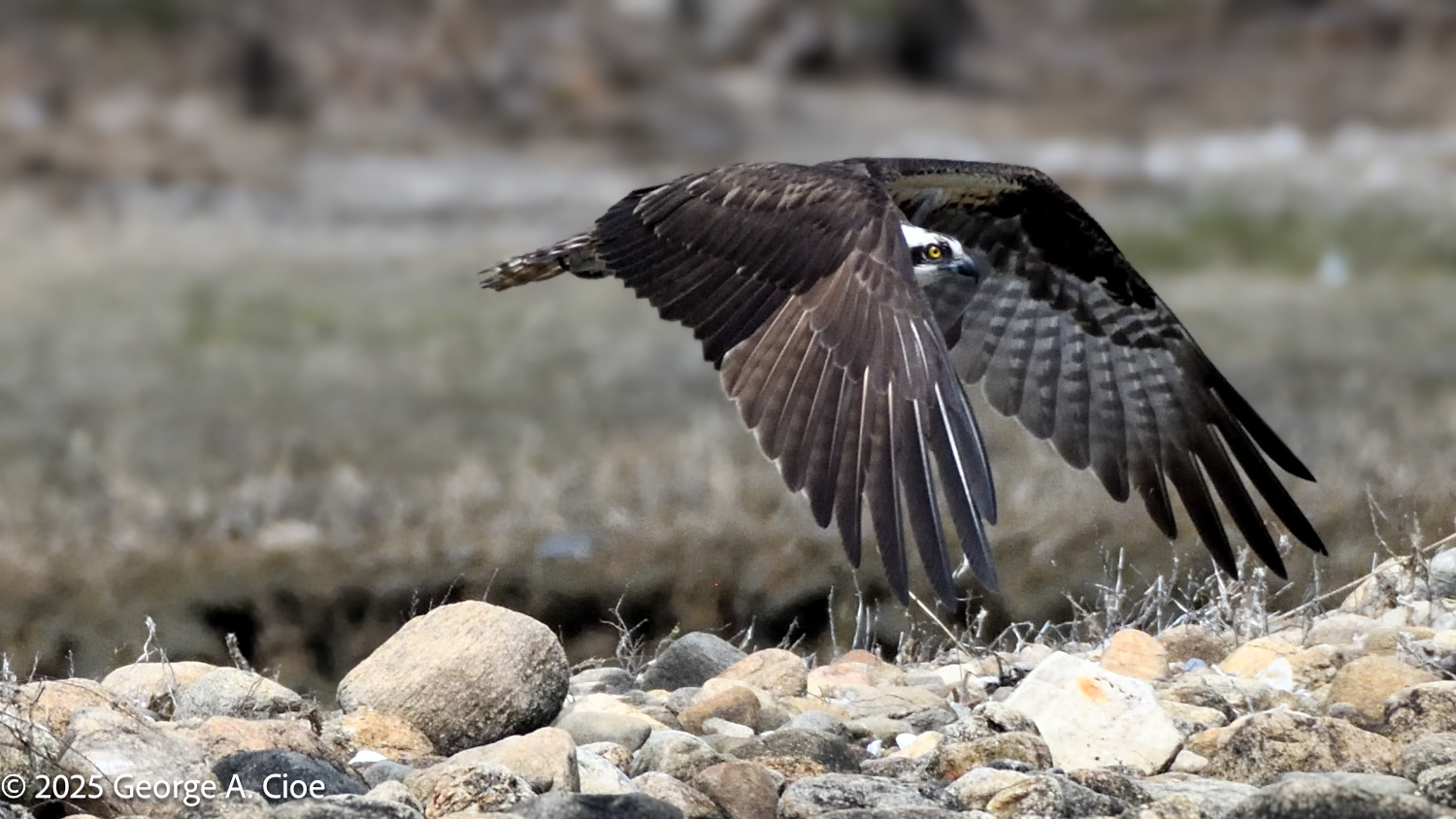

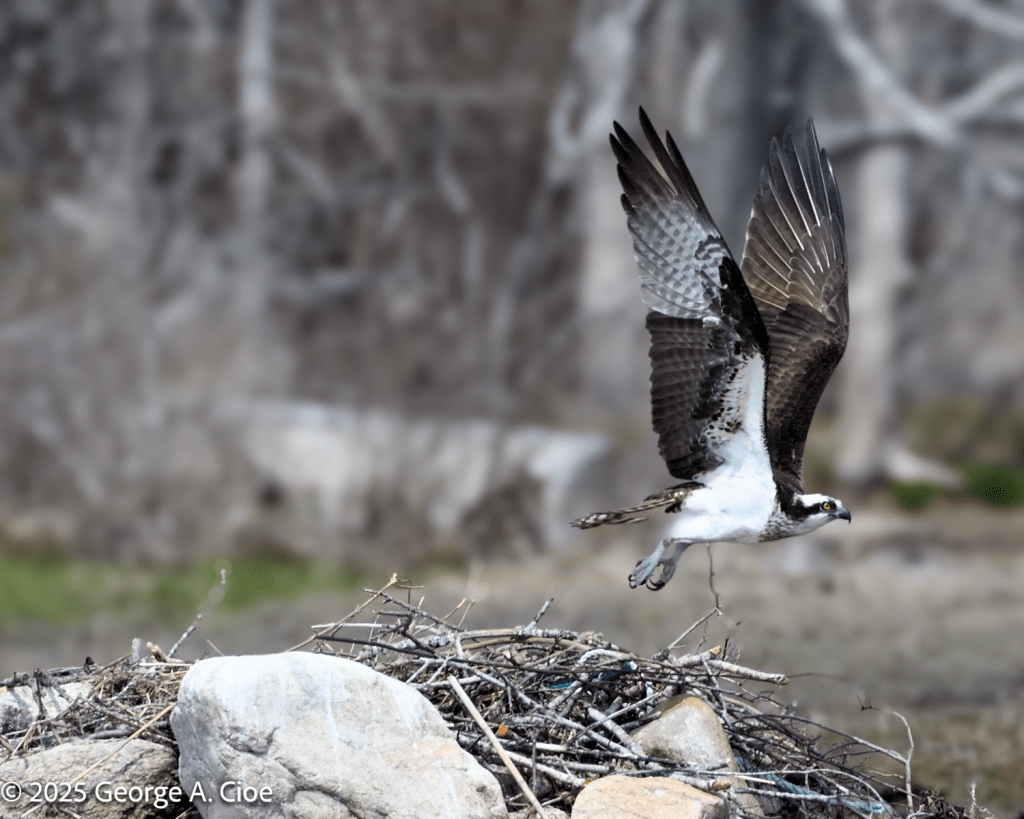

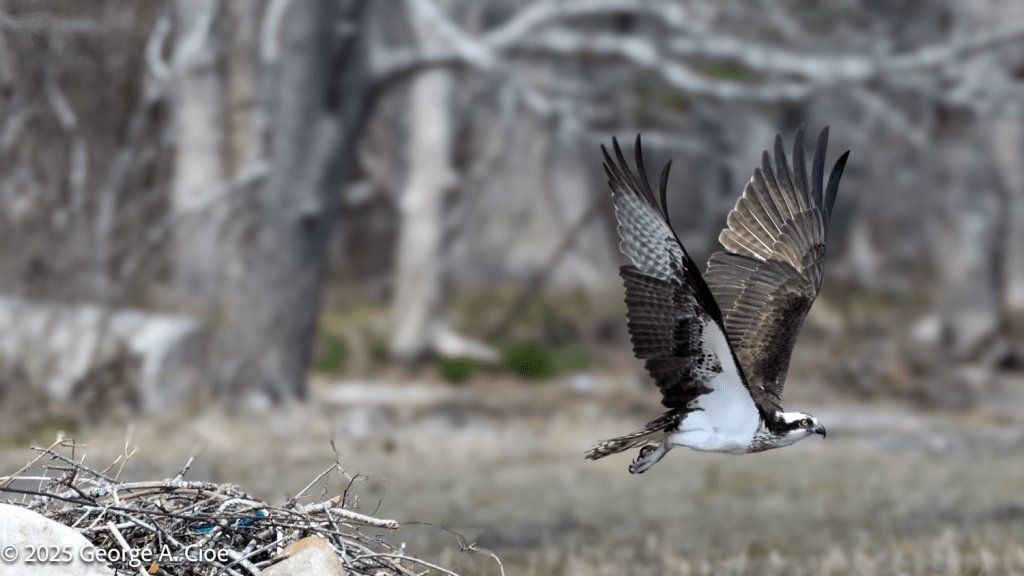
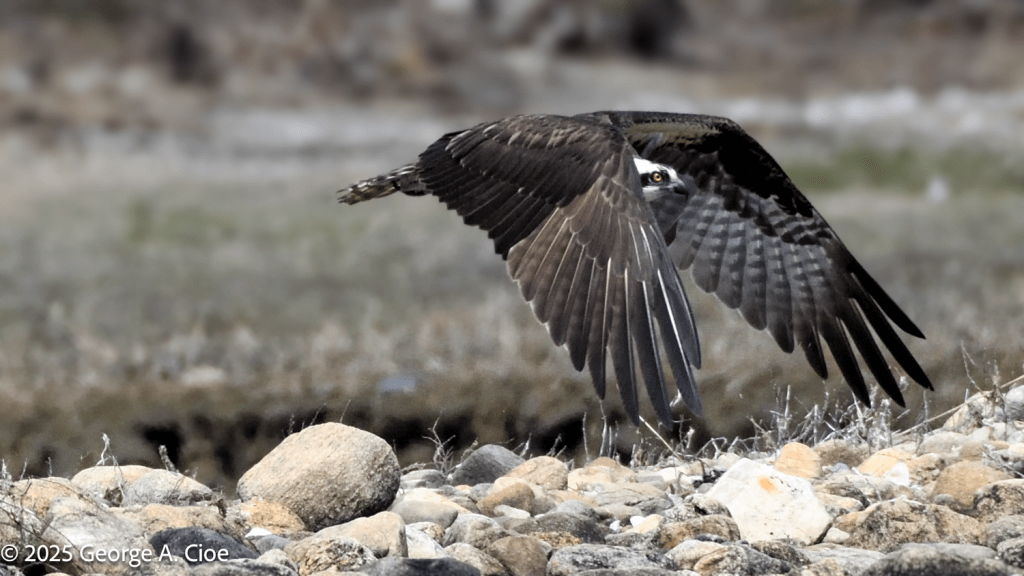
It’s an uncommon sight to witness an osprey nesting on the ground—a striking deviation from their usual high-rise preferences. Yet here, at the edge of a rocky peninsula on Great Salt Pond in Narragansett, Rhode Island, a pair has chosen sea-level living. Why this spot? We may never know. Across town, natural and man-made platforms stand tall and waiting, but perhaps this was a first-season bird arriving late, only to find the penthouses already claimed. Like many of us just starting out, it made do with what it could find—a ground-level nest with a spectacular view.
And what a view it gave in return.
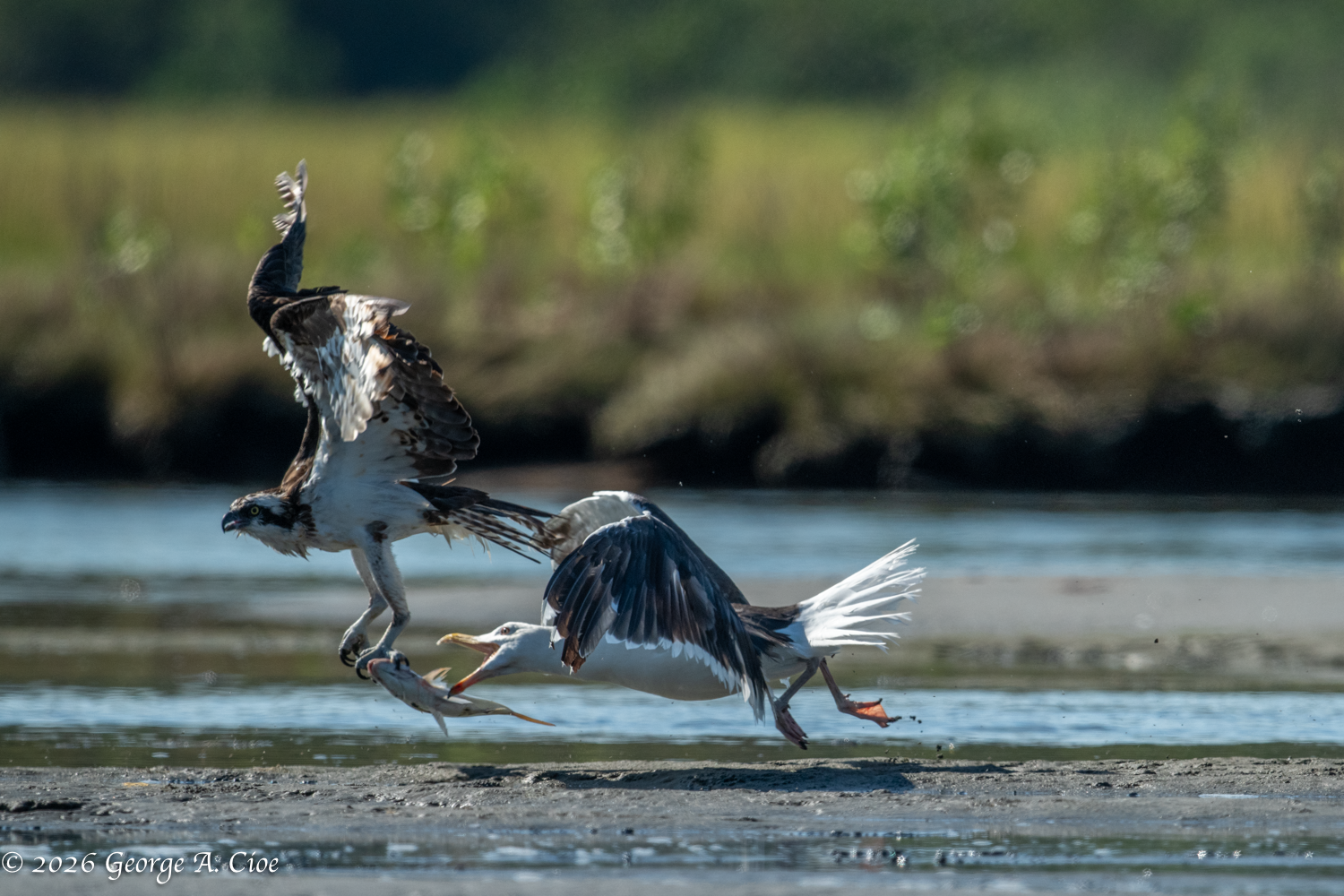
From the deck of my Montauk 190 Boston Whaler, camera ready, I waited. The osprey—majestic, focused, unknowingly poetic—prepared for flight. And when it launched, the moment was pure wonder.
Ospreys are raptors engineered by millions of years of evolution for one thing: power in motion. Their wings are long and narrow with a signature M-shape when seen from below—an aerodynamic marvel that allows them to lift fish weighing nearly half their body weight. This is no small feat; they are one of the few raptors capable of such a haul.
Their takeoff is a study in physics. With a steep angle of attack, the first wingbeats generate a surge of lift and drag that together defy gravity. Research has shown that up to 40% of their vertical support in those initial beats comes not just from lift—but from drag. Even the upstroke, usually less involved in vertical movement, contributes meaningful forward thrust. It’s a perfect synchrony of muscle, feather, and instinct.
Though their lift-to-drag ratio isn’t as high as some birds, ospreys compensate with sheer power. Their wings create high instantaneous lift coefficients and impressive power factors, possibly thanks to a leading-edge vortex—a swirling current of air that boosts lift in just the right moment.
This moment of flight is more than a mechanical act. It is the living embodiment of evolutionary success. Ospreys can plunge up to four feet beneath the water’s surface to capture prey like flounder. They are precision hunters, often seen around Narragansett, wheeling in the sky with purpose and grace.
And every time I see one—perched on a channel marker, circling above the marsh, or rising from an improbable nest—I feel the same awe. Their power. Their adaptability. Their singular beauty.
I’ll never tire of watching them.
Subscribe below and get my daily (okay, most days—let’s not get crazy) post delivered straight to your inbox. Like magic. But with fewer rabbits. 🐇✉️
Browse my complete art portfolio and shop prints at imagesbygacioe.shop


Leave a Reply