


(Majesty, Music, Steam… and a Slightly Inappropriate Tongue)
Our Hunt’s Photo Adventure in Yellowstone National Park with Don Toothaker
There is nothing in Yellowstone quite like a bull elk in the rut.
Photographs capture the moment, yes — but they never fully capture the presence.
The quiet command.
The effortless authority.
The way a 900-pound animal can move with a grace that contradicts its size, as if each step were predetermined by some ancient choreography.
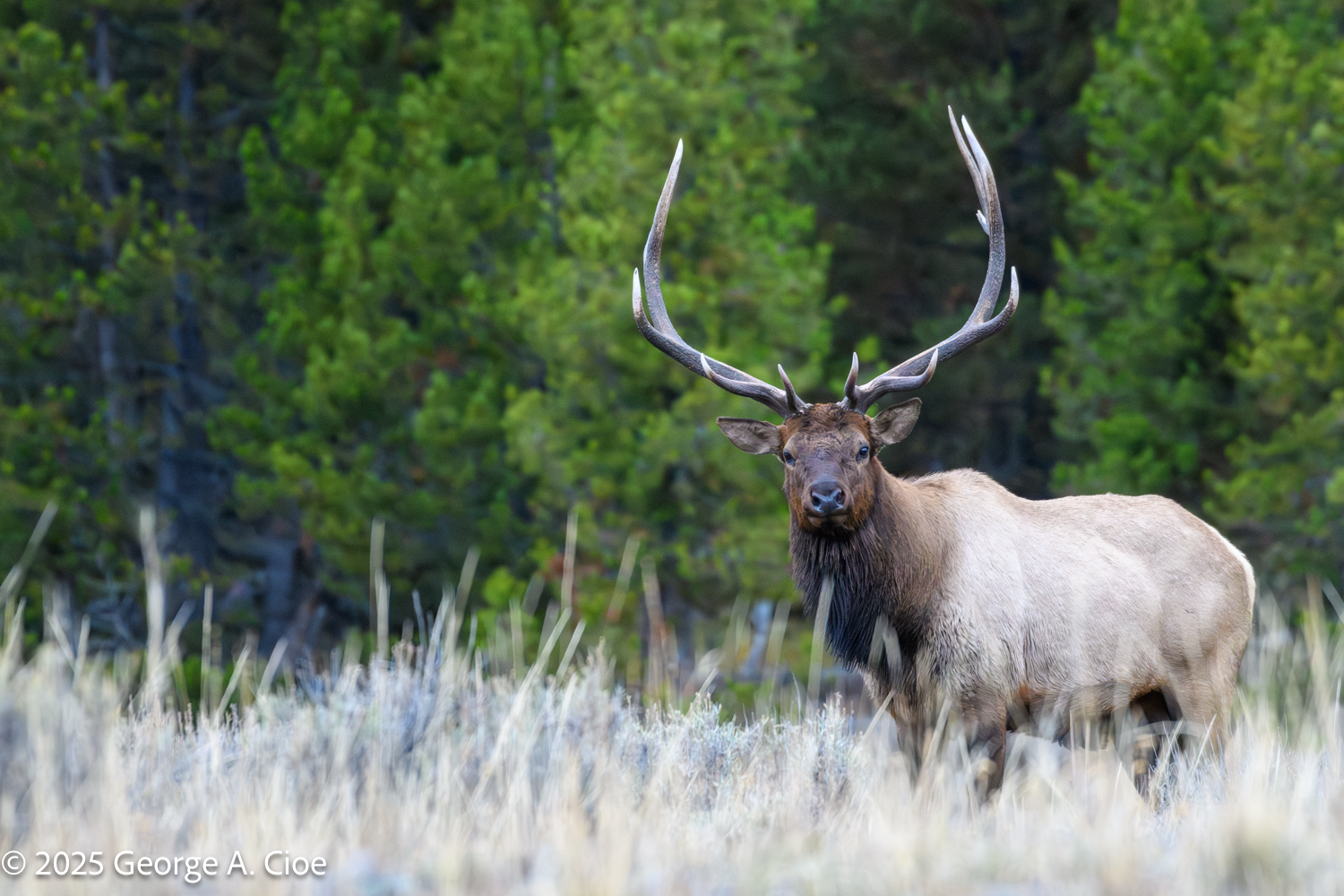
Our bull stepped out of the Hayden Valley mist exactly like that.
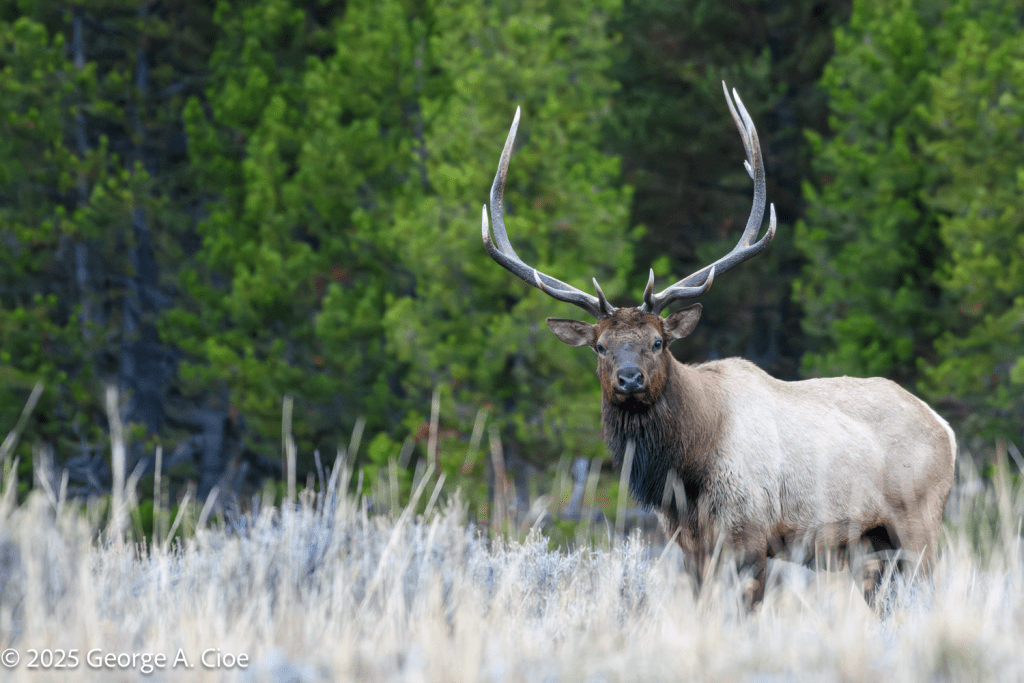
His breath rose in thick, silver clouds in the cold morning air, drifting upward like the smoke from an altar. His antlers — massive, sweeping, branching crowns — were polished at the tips, gleaming like sharpened blades. Whether they were worn smooth from battle or meticulously honed for the next one, I could not say. But they told a story:
This was a fighter —
and also a king.
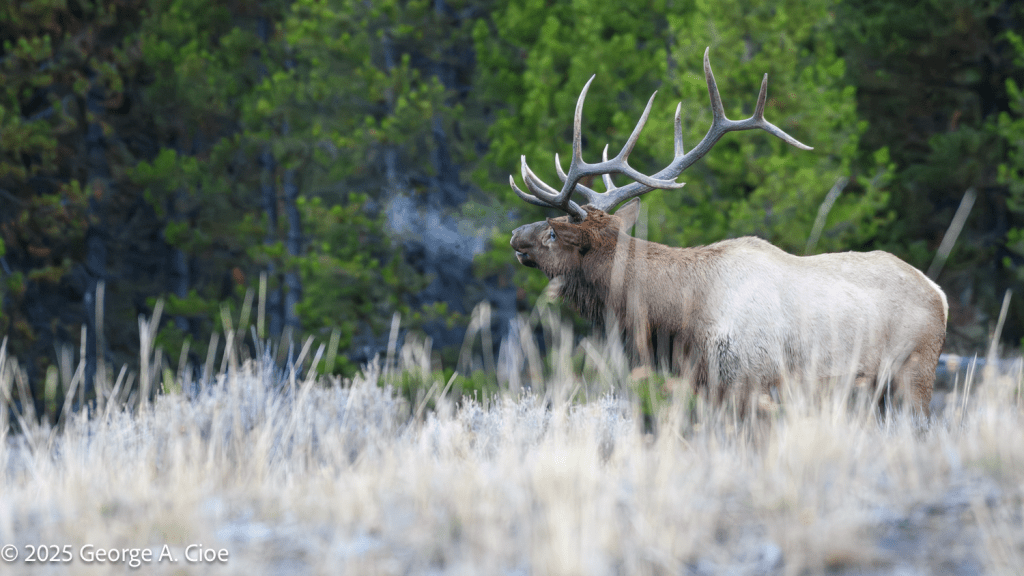
Then he tilted his head and bugled.
A note so high, sharp, and commanding that it sliced through the valley.
A sound both wild and ancient — a declaration of power, a warning to rivals, and a summons to any cow elk within earshot.
This is why bulls bugle.
To proclaim: I am here. I am strong. I am worthy.
But even in the middle of this primal opera, Yellowstone reminded us she has a sense of humor.
Because just after delivering a magnificent, chest-rattling bugle…
our regal monarch stuck his tongue out.
Not in defiance.
Not in mockery.
But in biology.
He lowered his head, curled his lip, and extended his tongue in what scientists call the Flehmen response—a courtship behavior where he gathers pheromones and transfers them to the vomeronasal organ in the roof of his mouth.
It’s noble.
It’s ancient.
It’s important.
And in practice?
It looks like someone surprised him with really bad soup.
Even so, the dignity remained. Somehow, even with his tongue hanging out, he radiated the gravitas of an emperor surveying his empire.
Then came the moment none of us expected.
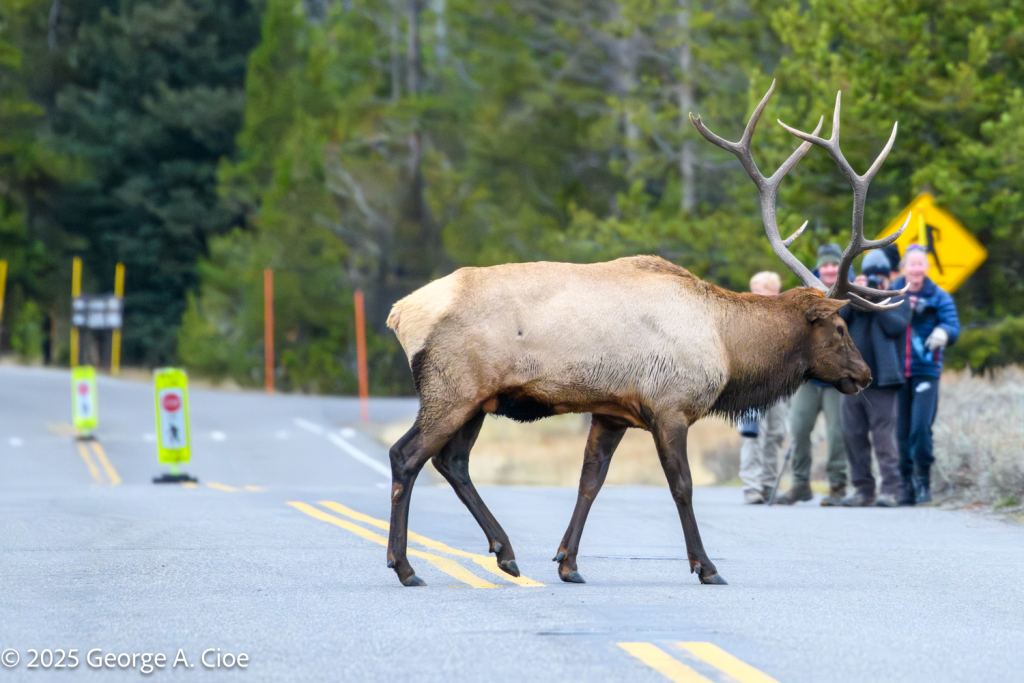
With all the regal confidence of a monarch passing through his loyal subjects, this magnificent bull walked directly between our group to cross the road.
No fear.
No hesitation.
Just that purposeful, powerful stride — silent, smooth, almost floating despite the weight of his antlers.
We photographed him from every angle — a true crossfire of shutters — but none of us moved.
None of us spoke.
We simply stood in reverent awe as he passed so close you could feel the vibration of his breath in the cold air.
He paused only once, turning his head slightly so the morning sun lit those polished antler tips. They glowed like the points of a crown forged in fire.
Was it a warning?
A flex?
A quiet statement of supremacy?
Or just an elk making sure we all got his good side?
I honestly don’t know.
But I do know this:
When he lifted his head one last time and bugled — steam erupting like smoke from a great cathedral censer — we witnessed something unforgettable.
A creature both warrior and monarch.
A presence both wild and sacred.
And then, with a final head-on glance that said,
“Remember me, humans.”
he moved up to higher ground.
Even the Andrews Sisters would have had to rewrite their song for him:
“He was the bugle-woogie, battle-scarred, steam-breathing bull from Yellowstone B…”
And he absolutely deserved the spotlight.
I’d love to share my posts with you. If you subscribe, they’ll come straight to your inbox—most days, like a little note from me to you. It means a lot to know you’re reading along.
Browse my complete art portfolio and shop for prints at imagesbygacioe.shop



Leave a Reply