
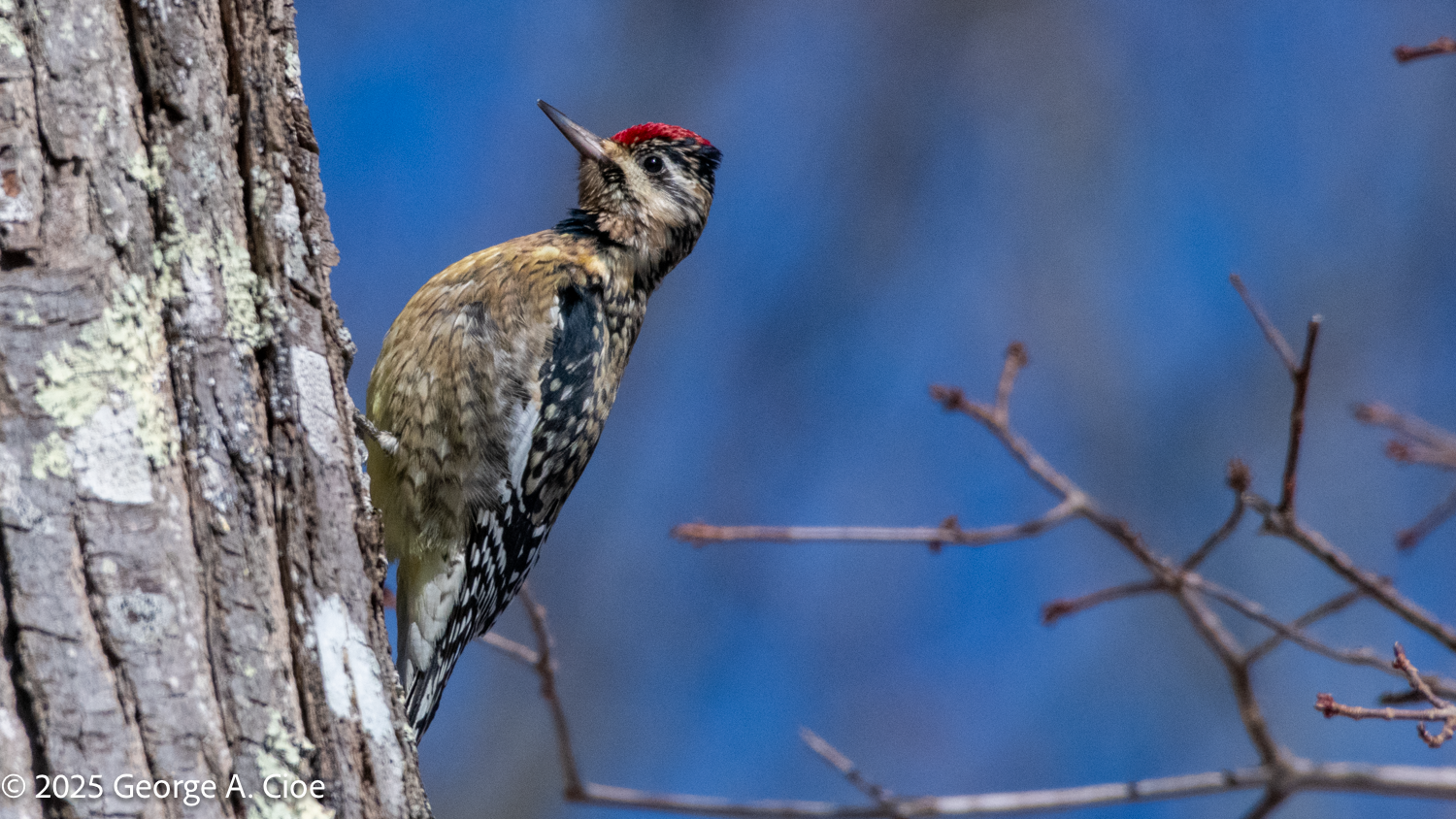
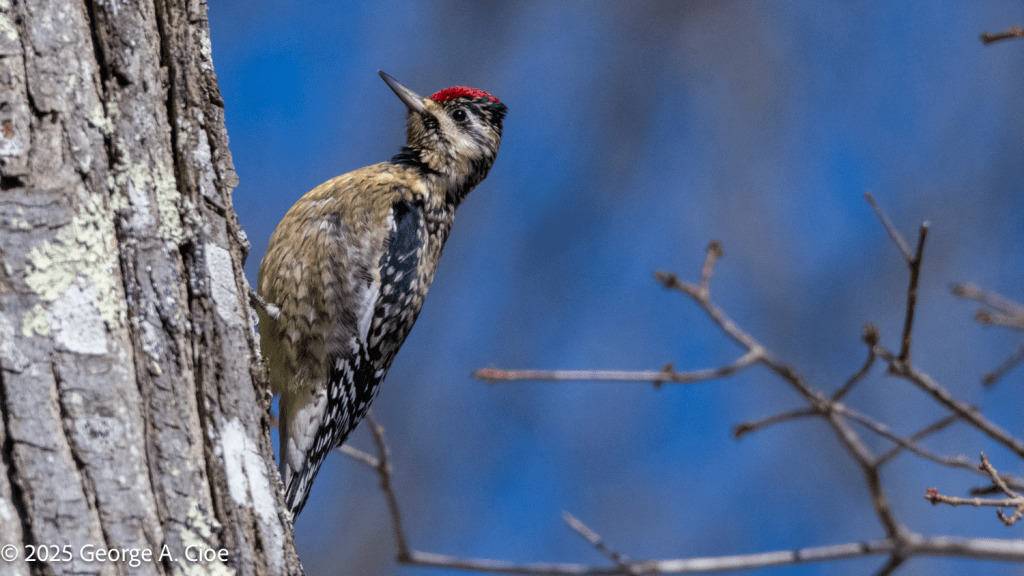
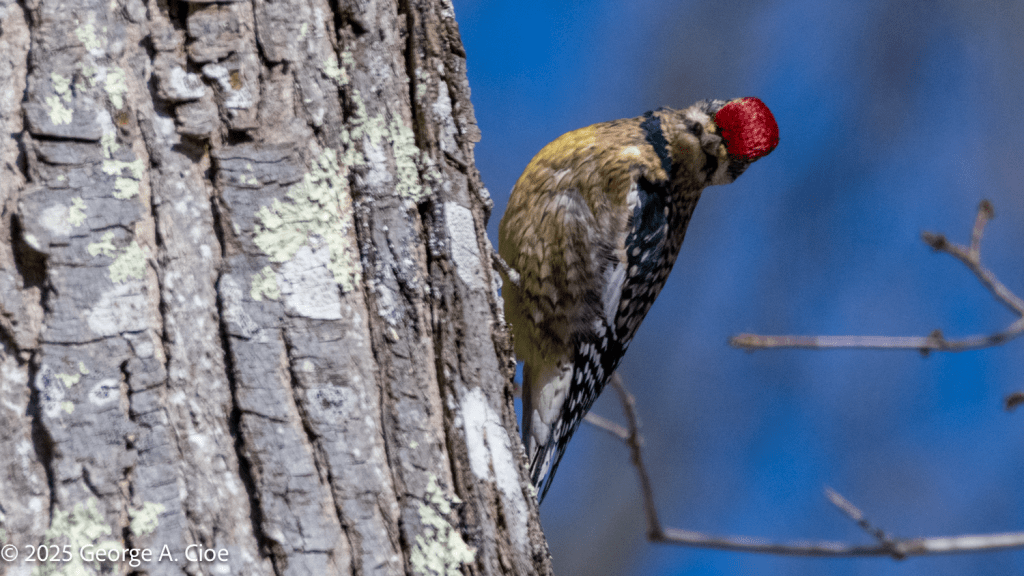
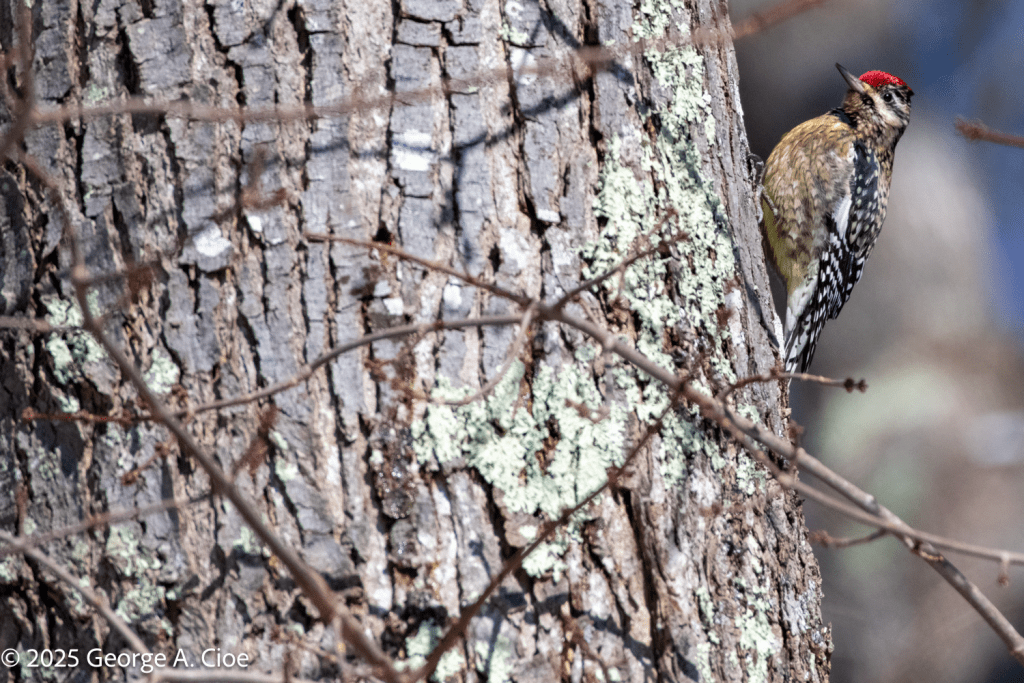
I’ll admit it right up front: I was absolutely certain I was looking at a hairy woodpecker.
Confident. Assured. Borderline cocky.
The kind of cocky you earn only after leafing through a bird guide once and declaring yourself an honorary ornithologist.
She was perched on the side of a big old maple—hammering away with the gusto of someone who takes her tree-tapping job very seriously. Bold patterns, crisp posture… everything screamed “hairy woodpecker.”
Then she moved.
Just a slight slide sideways. A dainty little shimmy.
And suddenly I saw it.
The tree was perforated—decorated—bedazzled, really—with rows of tiny holes. Rows upon rows, the kind of precision drilling that would make any engineer nod with respect.
And those holes?
They were weeping sap.
Little droplets shimmering in the light like nature had decided to try moisturizing.
My “hairy woodpecker” was not merely feeding—she was feasting. Sampling sap like a sommelier evaluating a 2025 vintage maple reduction.
That’s when the lightbulb went off:
“George, you fool… that is a Yellow-bellied Sapsucker—and a female at that.”
Suddenly, the world snapped into focus.
Ladies and Gentlemen, Meet the Queen of Sap Engineering
Sapsuckers don’t peck randomly.
No, no—this is craftsmanship.
They create two kinds of sapwells, and yes, this lady had both on display:
- Round holes:
Deep. Clean. Never enlarged. These are the “insert bill, probe delicately for sap” holes. Very classy. Very understated. - Rectangular holes:
Shallow, high-maintenance, and designed for optimal sap flow. These require regular upkeep—because even among woodpeckers, the women do most of the work.
She arranged them in tidy horizontal lines—new holes just above old ones—a sugary staircase for her personal dining pleasure.
And She Wasn’t Working Just for Herself
Yellow-bellied Sapsucker sapwells are basically the wildlife equivalent of a pop-up food truck.
Hummingbirds, especially Ruby-throated, show up like loyal customers.
In fact, in parts of Canada, hummingbirds literally time their spring migration to coincide with sapsucker arrival, because these sapwells are their first fuel stop of the season.
Add to that a revolving door of warblers, bats, porcupines, and other opportunists, and suddenly this one female sapsucker was running the most popular sugar bar in the forest.
Her Taste? Refined. Very Refined.
Sapsuckers have drilled sapwells in over 1,000 species of trees and woody plants.
Yet she—being properly selective—chose a maple, one of their absolute favorites.
And Her Drumming Talent? Let’s Just Say… Versatile
Yellow-bellied Sapsuckers love using man-made objects to amplify their territorial beats.
Street signs. Metal chimney flashing. Aluminum gutters.
Probably your cousin’s rusty mailbox.
They suffer zero ill effects.
They just return day after day to pound out their Morse-code announcement:
“This tree is mine, thank you very much.”
A True Migratory Marvel
She was also a traveler—because the Yellow-bellied Sapsucker is the only fully migratory woodpecker in the eastern U.S.
Most of them head south for the winter—some all the way to Panama.
And yes, scientifically speaking, females tend to migrate farther than males, which tracks with just about every woman I know who has ever said, “I need a break from this nonsense.”
Longevity? They’ve Got It.
The oldest known Yellow-bellied Sapsucker was a male, at least 7 years, 9 months old, banded in New Jersey and recaptured in South Carolina.
I have no doubt his mate probably had to remind him where South Carolina was.
Once I realized she wasn’t hairy but sappy, everything changed.
I wasn’t witnessing a random woodpecker lunch break.
I was watching a highly skilled, highly organized, highly industrious female architect, chef, chemist, and entrepreneur all rolled into one.
She glanced back at me—one of those sideways looks only birds can pull off that says:
“Yes, human. Behold my sugar empire.”
And she returned to her work, licking sap, nibbling cambium, and enjoying the literal fruit of her labors.
I stood there longer than I expected — far longer than I ever would have if I’d just snapped a few photos, muttered “hairy woodpecker,” and moved on with my day.
But something in her rhythm, her intention, her whole sap-engineering enterprise pulled me in. And the more I watched, the more I realized I wasn’t just photographing a bird… I was being taught by one.
All because I slowed down.
All because I paid attention.
By the time she flitted to the next line of sapwells, I had a memory card full of images — but more importantly, a mind full of wonder.
I had discovered an entirely new species by noticing what was right in front of me. I had learned about round holes and rectangular holes, tree chemistry, hummingbird migration, birch versus maple preferences, and the fact that some birds choose to drum on street signs like tiny feathered construction workers.
But the real lesson?
Sometimes the magic happens when you stop assuming you already know what you’re looking at —
and instead take a moment to really see.
That’s when the forest reveals her secrets.
And on that day, she revealed a beautiful, industrious, sugar-loving female Yellow-bellied Sapsucker…
who taught me far more than I ever expected.
I’d love to share my posts with you. If you subscribe, they’ll come straight to your inbox—most days, like a little note from me to you. It means a lot to know you’re reading along.
Browse my complete art portfolio and shop for prints at imagesbygacioe.shop



Leave a Reply