

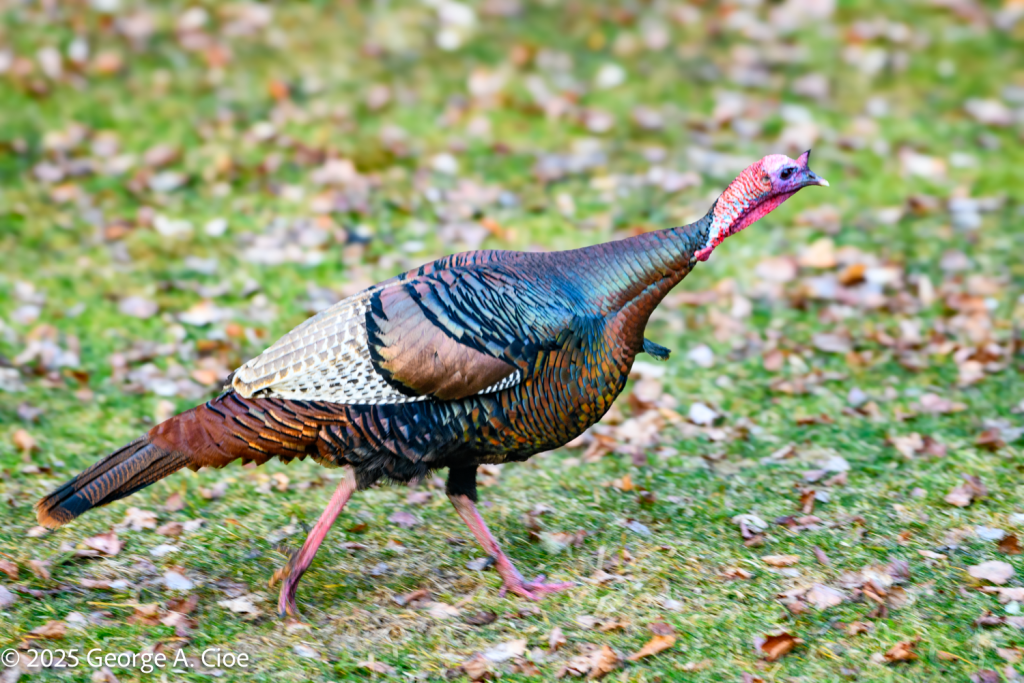
It’s that time of year when Gobble Gobble has a double meaning.
First, of course, the bird—the honored Thanksgiving centerpiece.
Second, the way we behave at the dinner table… where the humans turn into turkeys and gobble everything in sight.
In my house, we follow a sacred Thanksgiving ritual:
- Eat far too much
- Walk it off
- Take a nap
(Though I admit, sometimes Step 3 happens before Step 2.)
But before we carve the turkey, I figured we should give the turkey his due.
Turkeys in Narragansett: A Comeback Story
Around here, we see wild turkeys a couple of times a week. They strut across lawns like they own the place. And in a way, they do—their comeback in Rhode Island is no accident.
The Rhode Island Department of Environmental Management (DEM) has spent decades restoring the state’s wild turkey population through reintroduction efforts and sustainable hunting seasons. They even partner with URI to track health and movement of the flocks.
A quick history, summarized for those trying to impress guests between forkfuls:
- Restoration (1980): DEM brought in wild turkeys from Vermont—successfully reestablishing them in Rhode Island.
- Current Status: They’re now found in most areas of the state, delighting birdwatchers and hunters.
- Research: DEM + URI are studying how these birds move, live, and thrive across the state.
It’s a comeback story worthy of a Netflix documentary—“The Gobble Strikes Back.”
My Wild Turkey Experience (Spoiler: Not Delicious)
A few years ago, I shot a turkey… the old-fashioned way. Field dressed it. Cooked it. Served it proudly at a family meal.
I can say, with complete certainty, it was the toughest turkey ever to walk (and then stop walking) on this Earth.
Family consensus:
“We never, ever, EVER need to try wild turkey again.”
So now I shoot them with my Nikon D850 instead of a shotgun. Much safer. Much tastier (for everyone involved). And when you get close, they really are striking birds—their feathers shimmer with iridescent greens and bronzes.
The face? Well… let’s just say it’s an acquired taste. Probably only a mother hen could love it.
Fun Turkey Facts for the Dinner Table
Arm yourself with trivia to sound intelligent before the tryptophan knocks you out:
- Only two domesticated birds are native to the New World: The Wild Turkey and the Muscovy Duck.
- Turkeys were domesticated in Mexico long before Europeans showed up, then brought to Europe in the 1500s—where they became a staple.
- The word “turkey” may come from trade routes through the country of Turkey, which confused everyone involved.
- Male wild turkeys don’t help raise the kids. The hens do all the work—shocking, I know.
- Early attempts to repopulate turkeys failed when farm-raised birds couldn’t survive in the wild. Transplanting wild birds finally worked in the 1940s—eventually restoring populations across the lower 48 and into southern Canada.
- Turkeys have an impressive fossil record—some remains date back 5 million years.
- They can swim by tucking their wings and kicking like toddlers in a YMCA pool.
Happy Thanksgiving!
May your day be filled with gratitude, family, laughter, and just the right amount of gobbling—no matter which side of the feast you’re on.
Gobble Gobble! 🦃
I’d love to share my posts with you. If you subscribe, they’ll come straight to your inbox—most days, like a little note from me to you. It means a lot to know you’re reading along.
Browse my complete art portfolio and shop for prints at imagesbygacioe.shop

Leave a Reply