
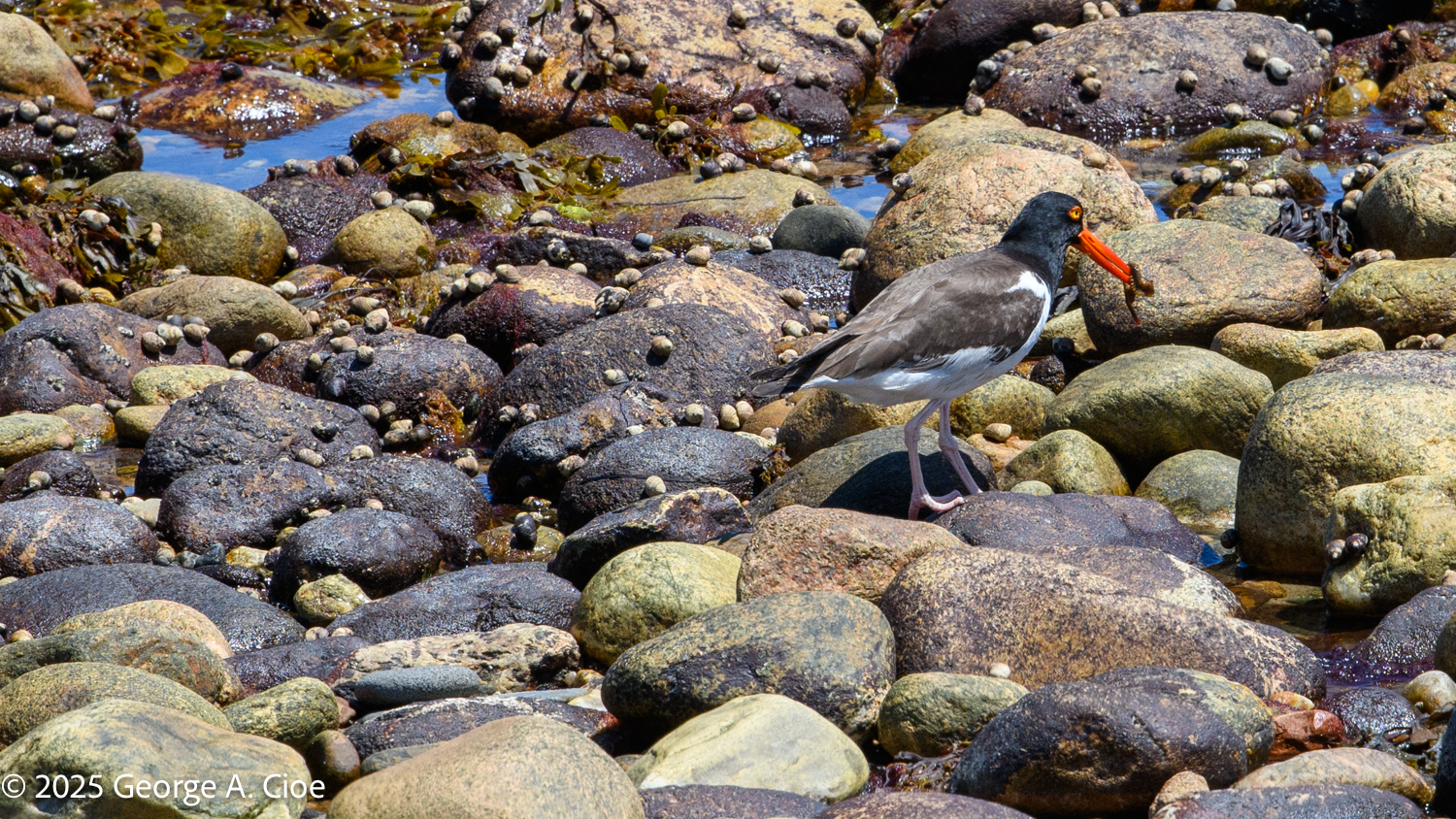



My first sighting of an American Oystercatcher did not unfold like a dignified entry in a field guide. There was no hushed reverence, no whispered “Ah yes, Haematopus palliatus.”
No.
It unfolded like a Marx Brothers audition that wandered onto the beach uninvited.
If Groucho Marx were reincarnated, I am almost certain he’d come back as an American Oystercatcher. And not subtly, either. Full costume. No understudy.
Think about Groucho for a moment. What comes to mind? The eyebrows. The mustache. The cigar. The expression that says, “I’m smarter than you and I’m enjoying that fact.”
Now replace the cigar with a traffic-cone-orange bill, the mustache with a black mask, and the eyebrows with two laser-yellow eyes that could interrogate a clam into confession.
Ladies and gentlemen, I give you the American Oystercatcher.
There he was on the north shore of Block Island, strolling along the tide line like he owned the place—and possibly the beach club next door. Black head, white chest: a perfectly tailored tuxedo, minus the jacket and any concern for social norms. He looked like he’d just wandered out of a black-and-white comedy reel, paused mid-step, and was waiting for the laugh track to catch up.
That bill though… that bill. It’s not a beak. It’s a prop. A vaudeville cigar permanently clenched between the jaws of a bird who absolutely has opinions. Every time he turned his head sideways, I half-expected him to mutter, “I refuse to eat any oyster that would have me as a member.”
And the attitude—oh, the attitude. He wore it proudly. A casual slouch. A sideways glance. The unmistakable posture of someone about to deliver a one-liner to an unsuspecting bivalve. Every step screamed sarcasm. Every pause felt like comedic timing.
Then came the feeding routine, which is less nature documentary and more slapstick masterpiece. American Oystercatchers dine primarily on saltwater bivalves—clams, oysters, mussels—though they’ll occasionally mix things up with limpets, jellyfish, starfish, sea urchins, worms, or the unfortunate crab who zigged when he should have zagged.
They patrol oyster reefs slowly, deliberately, like a detective looking for a suspect dumb enough to leave the door cracked open. The moment they spot a shell slightly ajar—bam!—that bill snaps inside to sever the adductor muscle holding the shell shut. Some go for finesse. Others just smash first and ask questions later. It’s technique. It’s preference. It’s Groucho choosing whether the joke needs wit… or a pie to the face.
Even better? Adult oystercatchers teach their young whether to snip or smash during their first year. That’s right—this is a family act. A legacy routine passed down through generations. Comedy school, shorebird edition.
As I watched him work, completely confident, noisy, bold, and unapologetically theatrical, it became clear: this bird was not hunting. He was performing. And he knew the routine had killed before.
If Groucho Marx ever reincarnated as a shorebird, he wouldn’t need the mustache.
He’d just need a tide line, a shellfish, and that bill.
I’d love to share my posts with you. If you subscribe, they’ll come straight to your inbox—most days, like a little note from me to you. It means a lot to know you’re reading along.
Browse my complete art portfolio and shop for prints at imagesbygacioe.shop





Leave a Reply