


Photographing owls is not about speed, reflexes, or luck. It’s about restraint. About learning how to stand still long enough for the woods to forget you’re there. Owls reward patience the way mountains reward hikers and tides reward fishermen. Eventually. On their terms. 🦉
The morning began with a modest plan. I’d return to the woods where I’d heard a Great Horned Owl calling for days. I’d photographed him the week before, but the light had been miserable. Flat. Dim. The kind of light that turns feathers into shadows and eyes into rumors. This time I waited for the sun to climb a little higher, aiming for around 9:00 a.m., when shadows stop carving animals into zebra-like abstractions.
It was 20 degrees. The kind of cold that makes camera batteries nervous and fingers forget what buttons do. I layered up, grabbed my usual bird kit, an 800mm for reach and a 200–500mm for flexibility, and stepped into the trees.
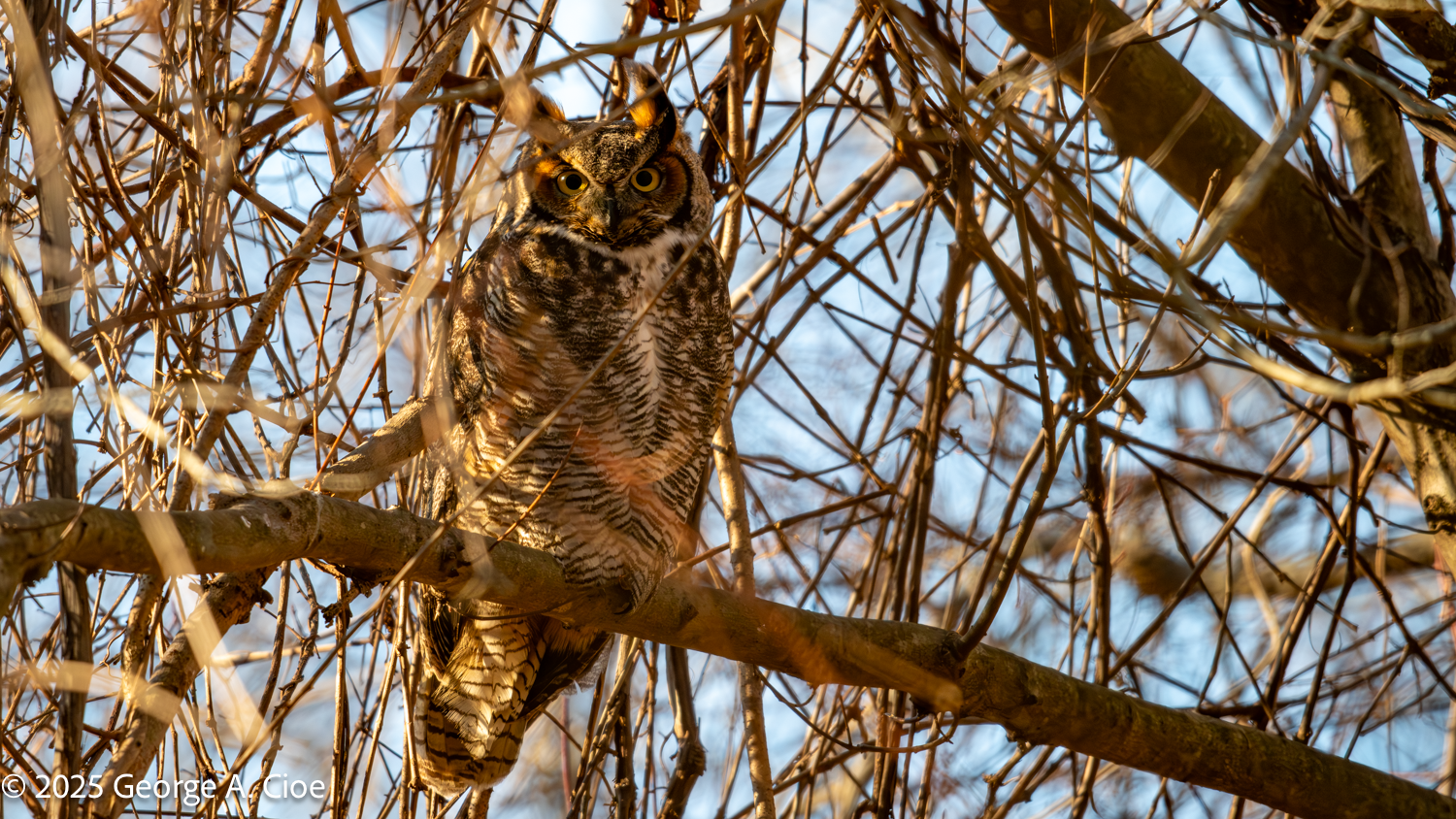
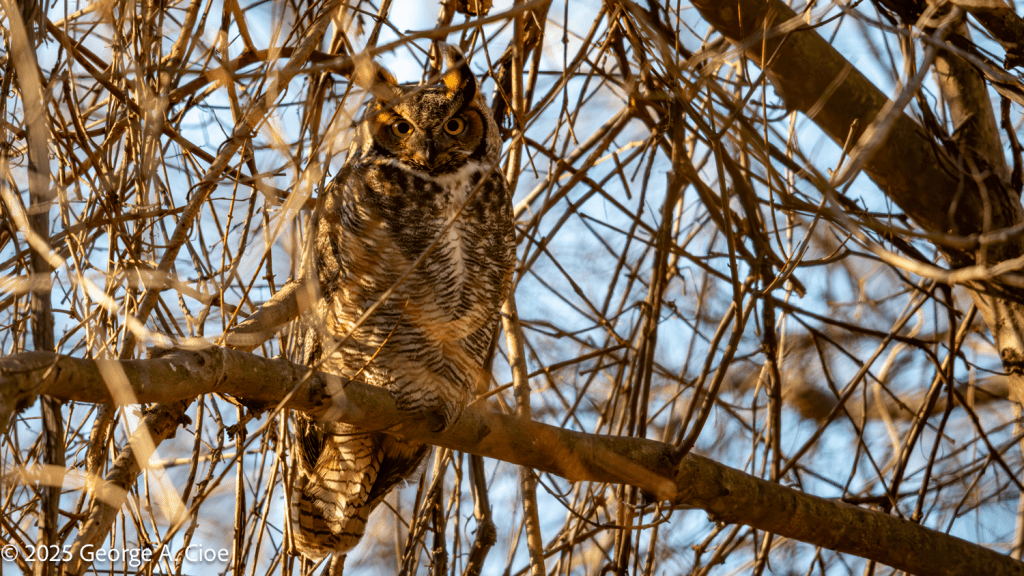
Owls are masters of invisibility. Great Horned Owls in particular wear the forest like camouflage couture. Bark. Lichen. Shadow. They don’t hide behind the woods. They become the woods. The image of the back of the owl is a case in point. Against the open sky, he’s easy to spot, his outline clean and unmistakable. Now imagine that same owl on a branch, pressed up against the trunk of a tree. No outline. No contrast. Just texture dissolving into texture. That’s how they vanish, not by leaving, but by staying perfectly still.
So I waited.
I have a personal rule in the field. Twenty minutes. I noticed years ago that hummingbirds return to a food source about every twenty minutes, the time it takes a flower to replenish nectar. It’s not a peer-reviewed paper, but it’s been a surprisingly reliable clock for wildlife behavior. If nothing happens in twenty minutes, something often happens in the twenty-first.
And right on cue, it did.
A shape dropped into a tree. Just a shadow. I fired a quick frame to zoom in. Ear tufts. There they were. Great Horned Owl. Found.
I moved slowly. Never staring too hard. Never rushing. Shot. Branch in front of the face. Shot again. Branch in front of the eyes. Move. Shoot. Adjust. Repeat.
Wash.
Dry.
Repeat.
On the eighth reposition, I felt it. That quiet internal click photographers know well. The sense that this one might be it. Still, I kept shooting. Owls teach you humility. Confidence is always premature.
Then the owl lifted off.
I didn’t see where he landed, only the direction. As I eased forward, scanning the trees, I glanced left.
And there she was.
Another Great Horned Owl. Perfect silhouette. Bigger. Broader. Almost certainly the female. I was standing between a pair.
Great Horned Owls are monogamous and often mate for life. Pairs defend territories year-round and are already nesting by late winter, long before most birds are thinking about romance. Their deep hooting calls, that classic hoo-h’HOO-hoo-hoo, are not just haunting, they’re declarations. Ownership. Partnership. Presence.
This female was perched among briars and grapevine, classic Narragansett chaos. I waited again. Inches at a time. Letting her decide I wasn’t worth worrying about. Eventually, she did.
Click.
What makes Great Horned Owls so compelling is not just their presence but their capability. They are apex predators of the night, with a grip strength estimated at over 300 pounds per square inch. Their flight feathers are serrated, breaking up airflow so completely that they fly in near total silence. They can rotate their heads up to 270 degrees, not because they’re spooky, but because their eyes are fixed in their sockets. And those eyes? They see in light levels that would leave us blind.
They don’t tolerate impatience. They don’t reward chasing. They offer themselves only to those willing to slow down enough to notice a shadow behaving differently than the wind.
That morning, I didn’t just photograph two Great Horned Owls.
I earned them.
And that’s the quiet magic of owls. They don’t pose. They don’t perform. They simply allow you, briefly, into their world if you prove you can wait long enough to belong there.
Gotta love Narragansett.



Leave a Reply