

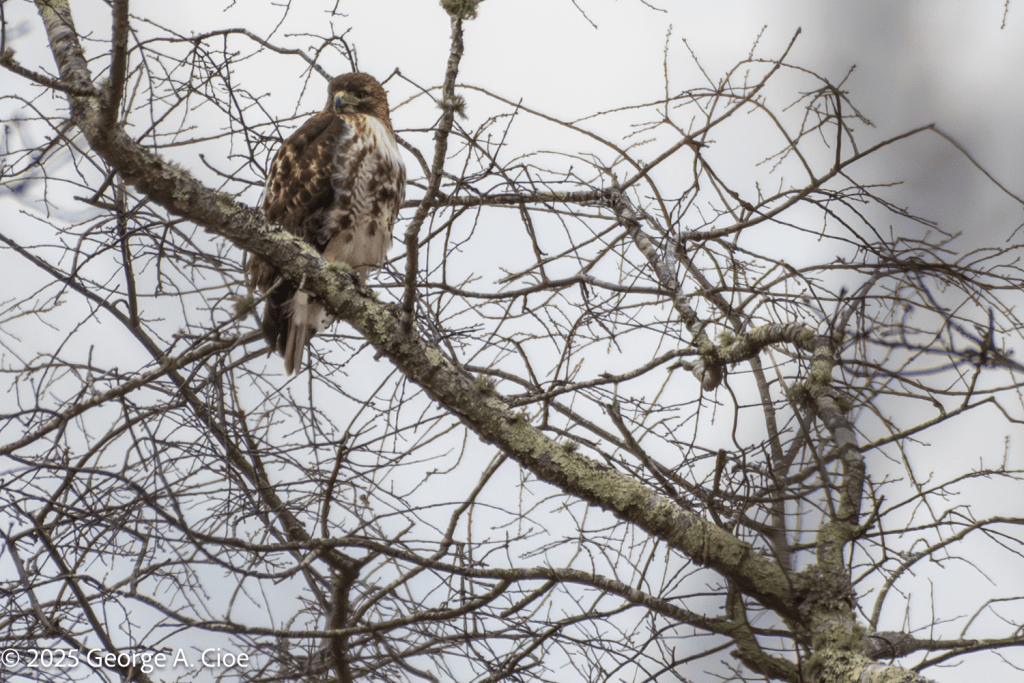


I’ve developed a soft spot—bordering on full-blown admiration—for the Red-tailed Hawk. I think it’s because it was the first raptor I ever really saw. Not a blur. Not a silhouette. A proper look. The kind that stops you mid-step and makes you say, Whoa.
No, it’s not an eagle. But let’s be clear—this is still a big, powerful, unapologetically impressive bird.
I was actually on the Narrow River looking for a pair of eagles when I noticed the outline of a predator perched ahead. I knew immediately it wasn’t an eagle, but I also knew it wasn’t small. As I got closer, all doubt disappeared. Broad chest. Confident posture. That look that says, I belong here.
Red-tailed Hawk.
This is probably the most common hawk in North America, which somehow makes it even more remarkable. My wife—who has hawk eyes of her own—spots them everywhere. If a car ride lasts more than twenty minutes, odds are she’ll point and say, “Red-tail.” And she’s usually right.
They soar over open fields, lazily tracing wide circles on broad, rounded wings. Or they perch on telephone poles, eyes locked on the ground, waiting for the slightest twitch of a vole or rabbit. Sometimes they’re just biding their time on a cold day, waiting for a thermal to carry them effortlessly skyward. Patience, perfected.
And then there’s the scream. That sharp, raspy, unmistakable cry that sounds exactly like a raptor should sound. Hollywood agrees. Any time a hawk—or even an eagle—appears on screen, that dramatic shriek you hear? Almost always a Red-tailed Hawk doing the voice work. They are the voice actors of the raptor world.
Birds are marvels of engineering, and the Red-tail is no exception. It’s one of the largest hawks you’ll see in North America, yet even the biggest females weigh only about three pounds. A small dog of similar size might weigh ten times that. Nature, once again, shows off.
Their courtship displays are nothing short of aerial theater. High above, the pair circle together. The male dives steeply, then rockets back up at a sharp angle, repeating the move again and again. Eventually, he approaches from above, extends his legs, and briefly touches the female. Sometimes they lock talons and spiral toward the ground together, separating at the last moment like they’ve rehearsed it for weeks.
They’re also strategic hunters. Red-tailed Hawks have been observed working as a team, guarding opposite sides of the same tree to flush and catch squirrels. Divide, conquer, dine.
Longevity? One wild Red-tailed Hawk was found to be at least 30 years and 8 months old when it was discovered in Michigan in 2011—banded in that same state back in 1981. Not bad for a three-pound bird.
This particular hawk was perched above a salt marsh at the end of the river, calmly surveying its kingdom. I was photographing it when a woman stopped and asked what I was shooting.
“Red-tailed Hawk,” I said.
“Oh.” She shrugged and walked back into her house.
I suppose to her, there was nothing particularly special about a Red-tailed Hawk.
Well, I beg to differ.
But then again—as they say—that’s why they make chocolate and vanilla.
I’d love to share my posts with you. If you subscribe, they’ll come straight to your inbox—most days, like a little note from me to you. It means a lot to know you’re reading along.
Browse my complete art portfolio and shop for prints at imagesbygacioe.shop





Leave a Reply