

Turtles and submarines have a lot in common.
You never quite know where they are when submerged.
And as logic will bear, you certainly never know where—or when—they’ll show up.
Case in point.
There I was at Little Neck Pond, locked in on my mission.
Camera ready.
Settings dialed in.
Mind focused on… birds.
I had done everything right.
Positioned myself for optimal light.
Picked out perches that would make any self-respecting songbird look like it had hired a professional photographer.
Left-to-right flight path? Covered.
Background blur? Gorgeous.
Anticipation? High.
So I wait.
And like any seasoned photographer, I begin doing what we all do while waiting…
Thinking about stuff.
The kind of stuff that solves absolutely nothing but feels important at the time.
Enjoying the air.
The quiet.
That early warmth that suggests—just maybe—spring has finally decided to show up for work.
And then…
Something happens.
Not a hawk.
Not a heron.
Not even a gull with a questionable attitude.
Nope.
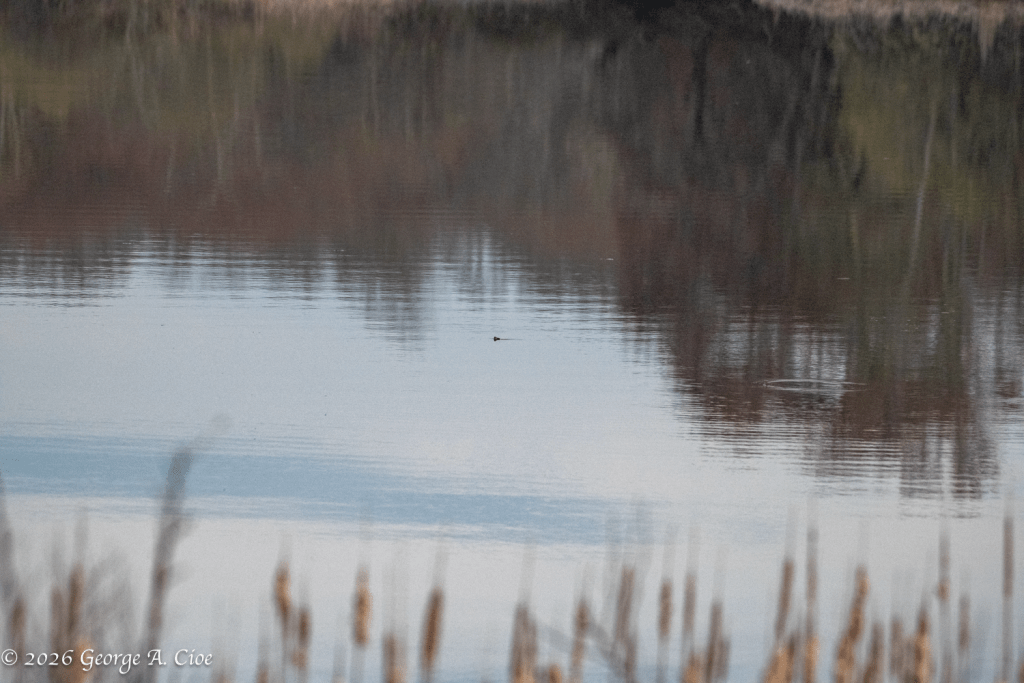
Something breaks the surface in complete silence.
No splash.
No warning.
Just… there.
If not for the subtle ripple—what I’ll call a “tactical disturbance”—I might have missed it entirely.
But I saw it.
And now I’m invested.
Because when something surfaces like that, your brain does a quick roll call:
Fish?
Muskrat?
Loch Ness Monster (Narragansett edition)?
And then…
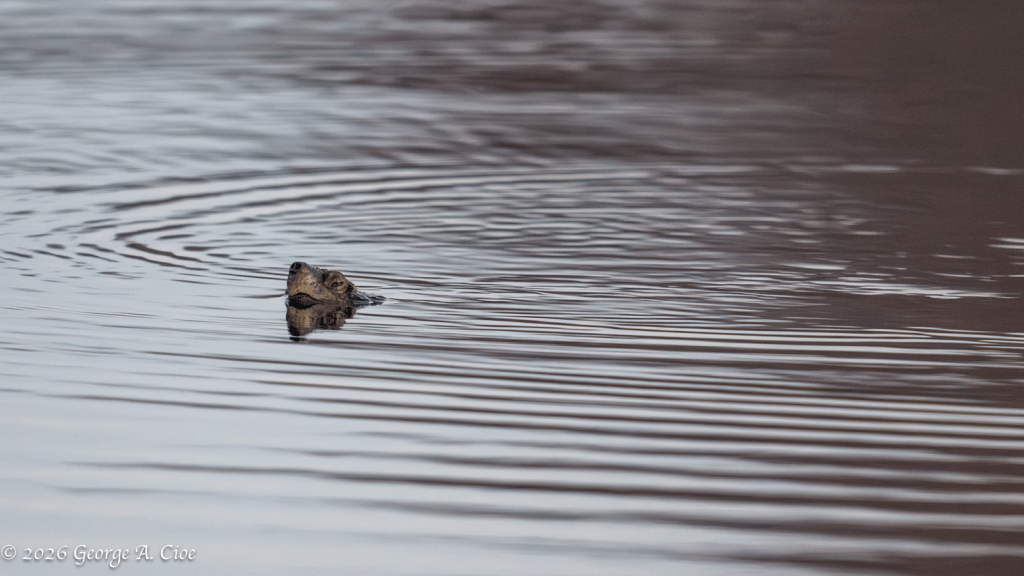
Up comes a head.
A turtle.
Now here’s where things get interesting.
Because turtles—particularly the Eastern Painted Turtles and Snapping Turtles common to Little Neck Pond—are, in fact, nature’s original stealth submarines.
They can sit underwater for hours.
Not minutes. Hours.
In colder water, their metabolism slows so dramatically they can absorb oxygen through specialized tissues—yes, including areas that would make polite conversation uncomfortable. Let’s just say… evolution got creative.
Which means while I’m standing there thinking I’ve got a quiet pond…
This place is basically Grand Central Station.
Underwater.
And I’m the only one without a ticket.
The turtle surfaces again.
Now I’m watching the wake.
And here’s the part most people don’t realize—
That V-shaped ripple moving across the water?
That’s what we call a turtle line.
It’s the giveaway.
Much like a periscope trail from a submarine, it tells you exactly where the animal is moving… and exactly how fast it doesn’t want you to notice.
They cruise just below the surface, eyes barely breaking the waterline, scanning their surroundings.
Looking for food.
Looking for danger.
Looking, I suspect, for photographers who think they’re in charge of the situation.
Spoiler alert: we are not.
And then my brain does something unexpected.
It goes back in time.
Because turtles and submarines don’t just feel similar—history actually agrees.
In 1775, during the American Revolutionary War, a man named David Bushnell built the world’s first military submarine.
He called it… the Turtle.
One person inside.
Hand-cranked propulsion.
A mission to sneak beneath British ships and attach explosives.
Let that sink in.
A lone operator… underwater… in the dark… pedaling and cranking his way toward history.
The vessel itself? Shaped like two turtle shells joined together.
Slow.
Deliberate.
Quiet.
And when it approached the surface?
It left a subtle disturbance.
A line.
A turtle line.
So here I am, standing at Little Neck Pond in Narragansett, watching a modern-day version of a 250-year-old idea glide just beneath the surface.
No explosives.
No revolution.
Just quiet efficiency.
I start tracking it with the lens.
Slowly.
Carefully.
Because if there’s one thing turtles excel at, it’s vanishing mid-performance.
One second they’re there…
The next?
Gone.
No curtain call.
No encore.
Just a few expanding ripples that say, “You had your chance.”
And I can’t help but laugh.
Because I came here for birds.
Planned for birds.
Waited for birds.
And instead, I got outmaneuvered by a creature whose primary life strategy is… doing almost nothing, very efficiently.
But that’s the lesson, isn’t it?
Nature doesn’t care what you showed up for.
It rewards the ones who pay attention.
Even when the star of the show is a slow-moving, ripple-making, oxygen-absorbing, part-time submarine with a shell…
…that helped inspire one of the boldest ideas in naval history.
And somewhere beneath the surface of Little Neck Pond…
I guarantee you this—
There are more of them.
Watching.
Waiting.
Probably wondering why I keep pointing that big lens at the wrong thing.
I’d love to share my posts with you. If you subscribe, they’ll come straight to your inbox—most days, like a little note from me to you. It means a lot to know you’re reading along.
Browse my complete art portfolio and shop for prints at this link: imagesbygacioe.shop



Leave a Reply