
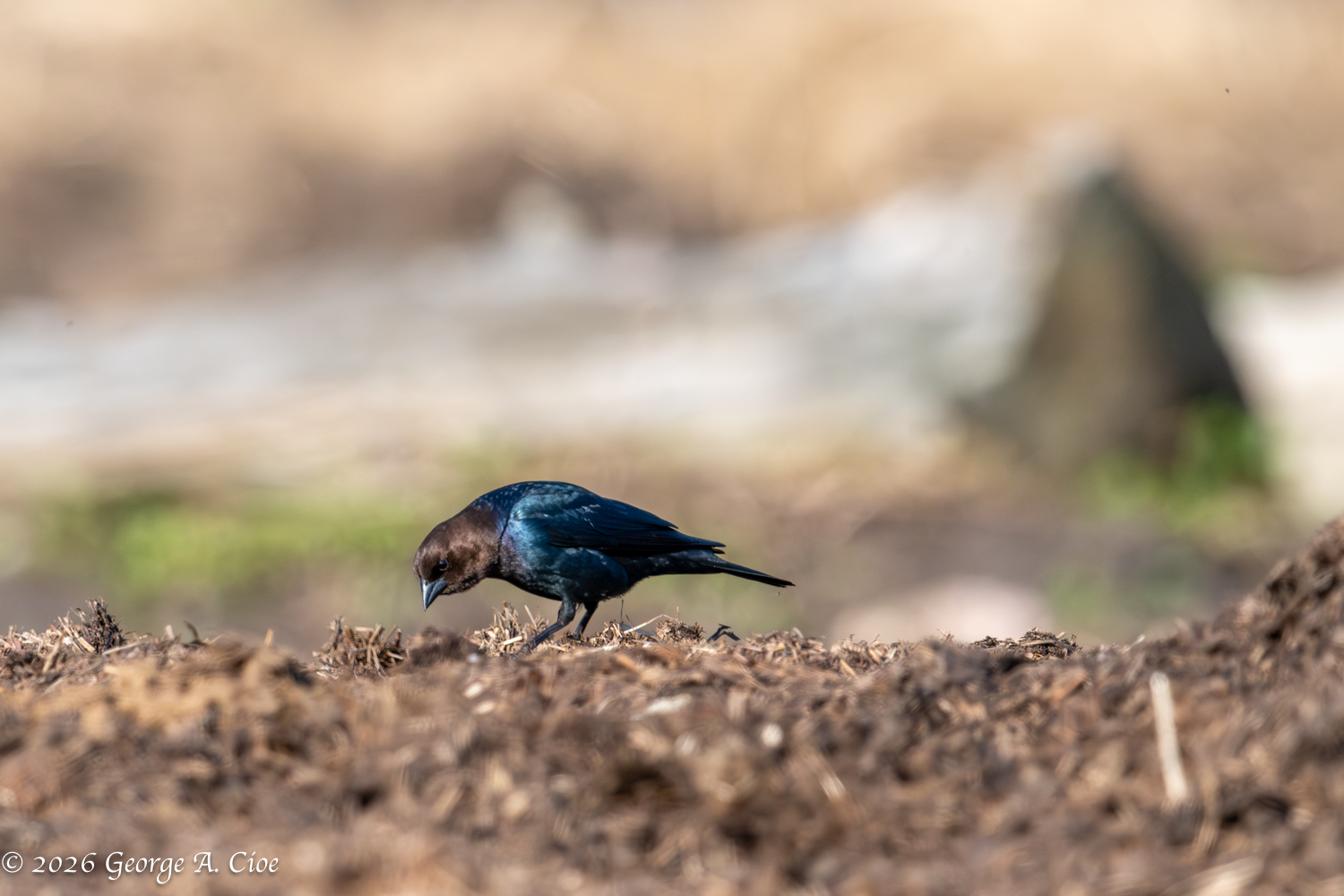


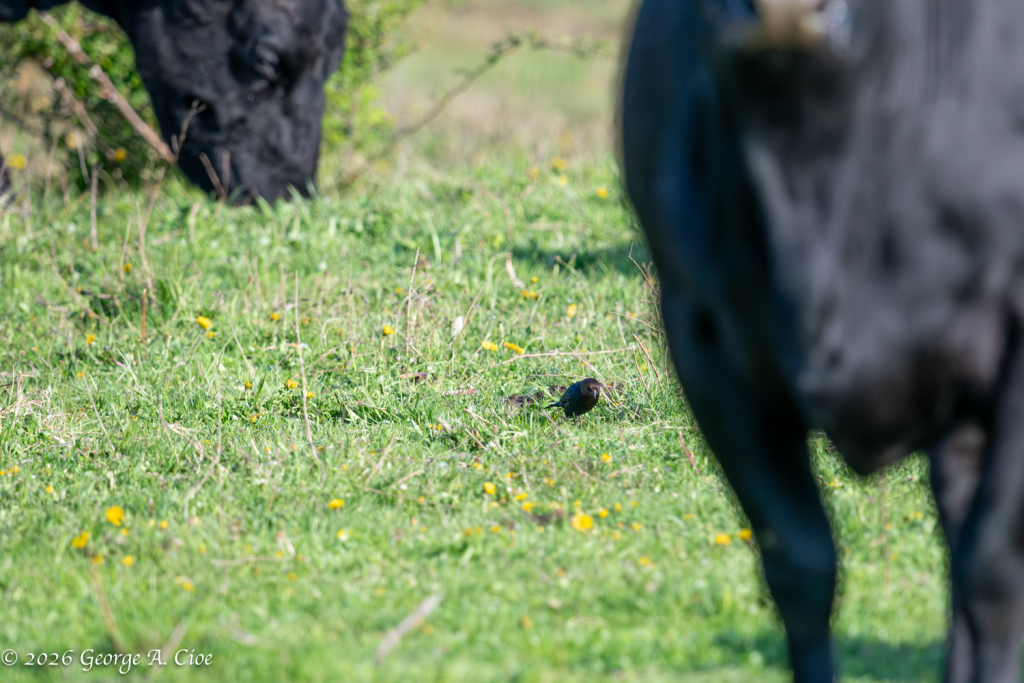
I have a theory about who named the Brown-headed Cowbird.
And I’d like the record to show right up front that absolutely none of it is supported by science, history, ornithology, anthropology, or common sense.
Picture this.
Two self-appointed naturalists sitting in an old pickup truck somewhere out on the Great Plains in 1933.
No shirtsleeves.
One suspiciously bent fishing hat.
A dashboard full of jerky wrappers.
And a six-pack of Schlitz is working harder than the scientific method.
They’re slouched so far down in the seat they look medically retired.
Then suddenly…
THUMP.
A bird lands on the hood.
Now because they’ve been staring at cattle for six straight hours, the scale of things has become compromised.
“Wilbur…” says Bubba slowly, “…I think a cow just landed on the truck.”
Wilbur squints.
“Naaah… too small fer a cow.”
The bird hops once.
“Wait. Maybe it’s a goat.”
The bird flutters its wings.
Both men freeze.
Long silence.
“Bubba…”
“Yeah?”
“I think that there might be a bird.”
“Well I’ll be damned.”
Now at this point, any formally trained scientist might have taken notes.
Measured wingspan.
Observed feeding behavior.
Documented habitat.
But not these two.
No sir.
These men were operating entirely on instinct and fermented confidence.
Wilbur points dramatically.
“Well… its head’s brown.”
“Yep.”
“And it keeps followin’ cows.”
“Yep.”
Another long silence.
Then Bubba delivers one of the greatest underachievements in scientific history:
“Let’s call it a Brown-headed Cowbird.”
And apparently nobody in the room fought for better branding.
Now obviously, none of that happened.
At least I don’t think it did.
The real story is far less cinematic, but somehow equally hilarious.
The Brown-headed Cowbird earned its name the same way many birds were named in the 1700s and 1800s:
A bunch of naturalists looked at an animal for three seconds and said:
“Well… there it is.”
Brown head?
Check.
Hangs around cows?
Check.
Meeting adjourned.
Its scientific name is Molothrus ater, first formally described by Pieter Boddaert in 1783.
The “cowbird” part came from their habit of following bison herds across the Great Plains. Later, when settlers brought cattle westward, the birds simply pivoted like tiny feathery entrepreneurs and started following cows instead, feeding on insects stirred up by hooves.
Honestly, from an evolutionary standpoint, it’s brilliant.
From a public relations standpoint?
Not great.
Because once you really study these birds, you realize “Brown-headed Cowbird” sounds way too wholesome.
These things are less:
- cheerful pasture companion
And more:
- avian con artist
- feathered mob associate
- tiny flying tax evader
Especially once you learn their signature parenting strategy.
They lay their eggs in OTHER birds’ nests.
That’s right.
The Brown-headed Cowbird looked at parenting and said:
“You know what?
I’m gonna outsource this.”
Imagine the meeting.
Robin:
“Wait… whose baby is this?”
Cowbird:
“Listen, Brenda, I’m swamped right now.”
Meanwhile the unsuspecting foster parents spend weeks feeding a baby twice their size while the actual cowbird mother is probably somewhere near a grazing cow sipping margaritas and avoiding responsibility.
And the craziest part?
Nature lets this happen.
Every single year.
Which is why I’ve come to believe something very important:
Mother Nature is not only intelligent…
She’s hysterically funny.
And occasionally a little savage.
Naturally.
I’d love to share my posts with you. If you subscribe, they’ll come straight to your inbox—most days, like a little note from me to you. It means a lot to know you’re reading along.
Browse my complete art portfolio and shop for prints at imagesbygacioe.shop


Leave a Reply