



Some birds announce their arrival.
Ospreys dive.
Terns chatter.
Gulls argue about absolutely everything.
But the Great Blue Heron?
The Great Blue Heron simply appears.
One moment the shoreline is empty.
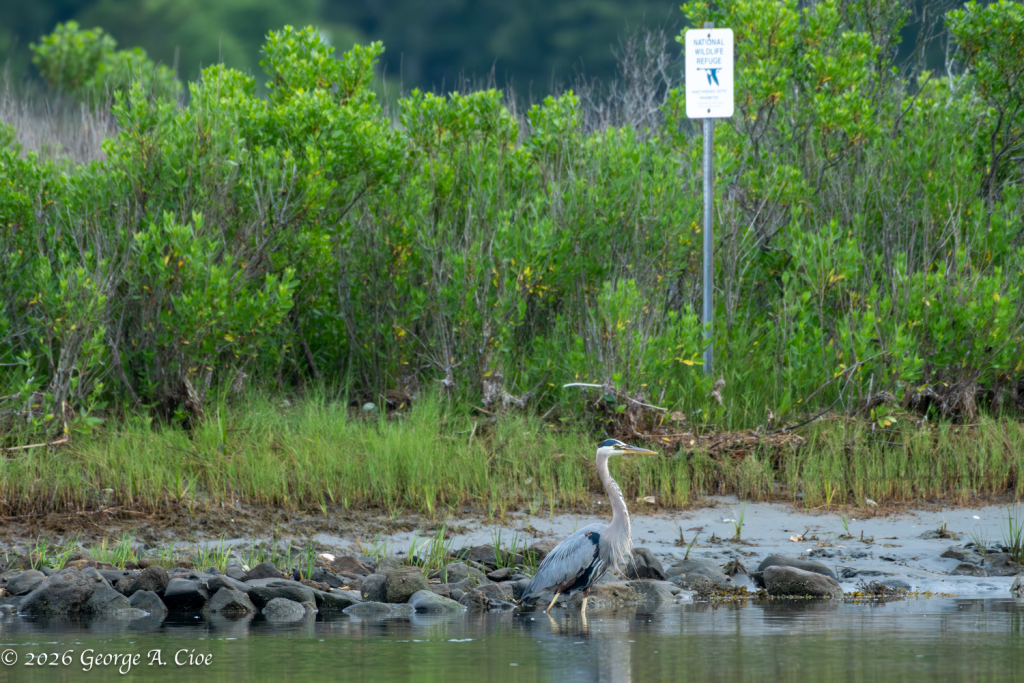
The next, there is a six-foot-tall silhouette standing motionless along the edge of the Narrow River, as though it has always been there and you’ve only just noticed.
And what a bird it is.
Not fast.
Not noisy.
Not flashy.
Just magnificent.
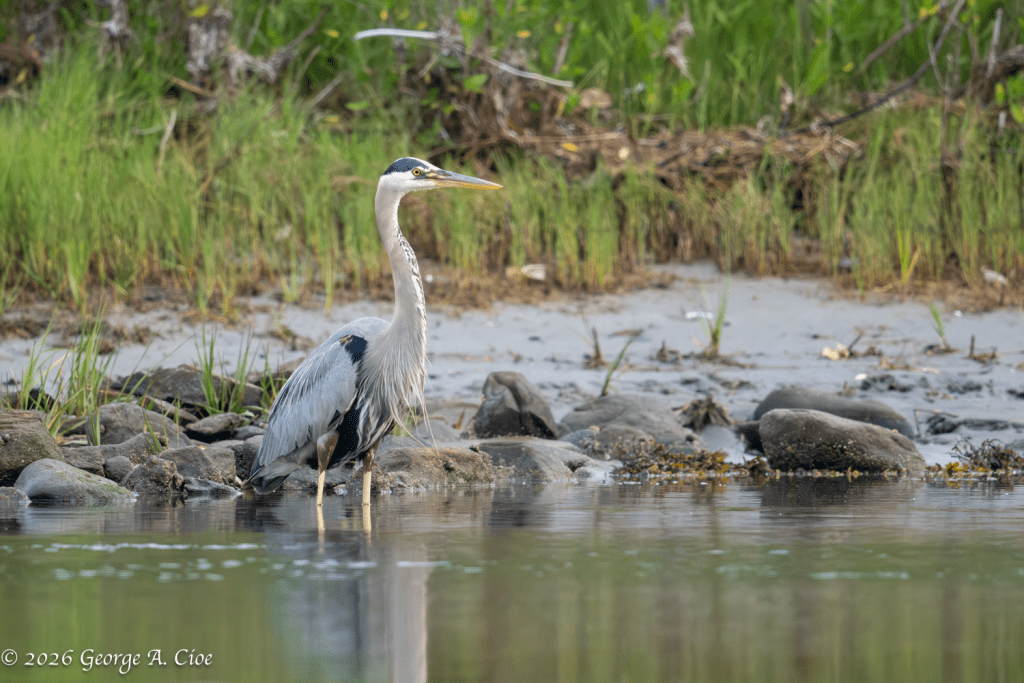
Standing nearly four feet tall with a wingspan that can exceed six feet, the Great Blue Heron is the largest wading bird most of us will ever encounter on the Narrow River. Yet despite its size, it moves with astonishing restraint. Every step is deliberate. Every glance measured. Every movement purposeful.
Patience isn’t something this bird practices.
Patience is what this bird is.
I found this heron along the shoreline of the John H. Chafee National Wildlife Refuge on an overcast morning that seemed tailor-made for photography. The light was soft. The river was calm. The marsh grasses glowed with summer green.
And there he stood.
Watching.
Waiting.
Calculating.
The Narrow River is an ideal home for a hunter like this. The shallow coves, mudflats, salt marshes, and winding channels provide an endless buffet of fish, crabs, frogs, eels, and whatever else might make the mistake of becoming distracted for a moment.
Because while the heron appears slow, the truth is quite different.
Hidden beneath that calm exterior is one of nature’s most effective predators.
Specially designed neck vertebrae allow the Great Blue Heron to launch its spear-like bill with lightning speed. A fish swimming peacefully one second may become lunch the next. Scientists have found that herons can hunt both day and night thanks to exceptional night vision, allowing them to work shifts that many other birds simply cannot.
They are masters of efficiency.
Masters of timing.
Masters of waiting for exactly the right moment.
In many ways, the recovery of the Great Blue Heron is also a story about nature’s resilience. Throughout the Northeast, expanding beaver populations have created wetlands, ponds, and marshes that provide excellent feeding and nesting habitat. The result is a landscape where herons continue to thrive, reminding us that when ecosystems heal, wildlife often follows.
And what remarkable creatures they are.
They possess specialized feathers that continuously fray into a fine powder. Using a comb-like claw on their middle toe, they spread this powder through their plumage to remove fish slime and oils. Nature, it seems, invented dry cleaning long before humans did.
Some Great Blue Herons live more than two decades. One documented bird in Texas reached at least twenty-four and a half years old.
Imagine all it had seen.
The storms.
The migrations.
The changing shorelines.
The countless sunrises reflected in quiet water.
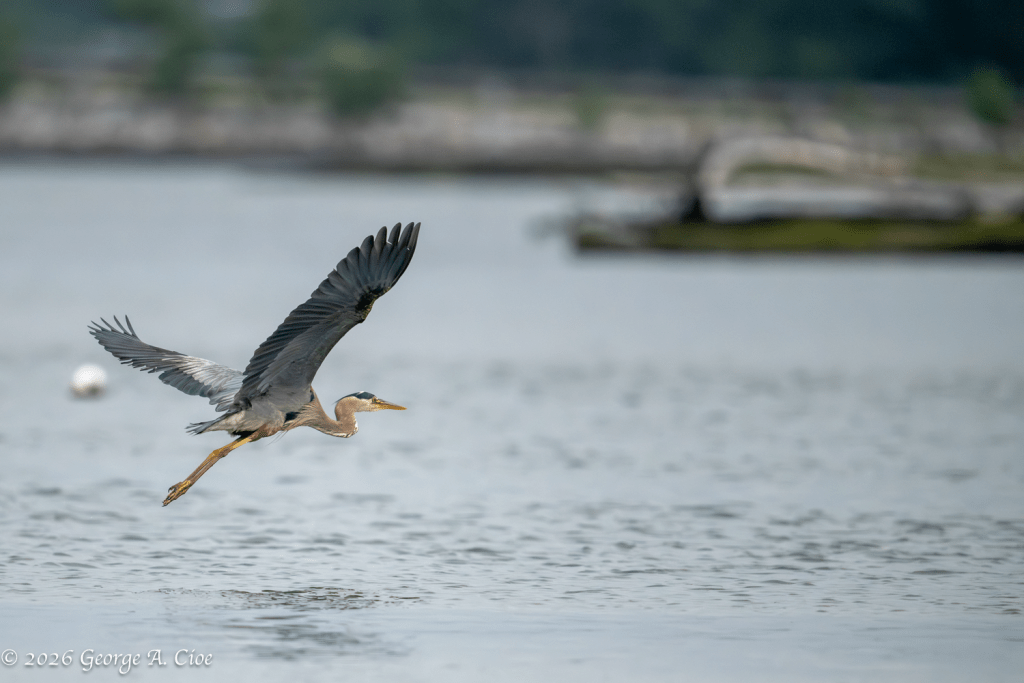
As I watched this heron take flight, skimming inches above the river’s surface, I was struck by something.
Most birds fly.
A Great Blue Heron seems to glide through time itself.
Its neck folded neatly into an S.
Its long legs trailing behind.
Its massive wings rising and falling with slow, powerful strokes.
No rush.
No panic.
No wasted energy.
Just confidence.
Maybe that’s why I enjoy photographing them so much.
The older I get, the more I admire creatures that understand the value of patience.
The world encourages us to move faster.
The heron suggests something different.
Stand still.
Pay attention.
Wait for the right opportunity.
And when it arrives…
Move with purpose.
The Great Blue Heron has been teaching that lesson along the Narrow River long before any of us arrived.
Fortunately for us, it’s still willing to share it.
Naturally.
I’d love to share my posts with you. If you subscribe, they’ll come straight to your inbox—most days, like a little note from me to you. It means a lot to know you’re reading along.
Browse my complete art portfolio and shop for prints at imagesbygacioe.shop


Leave a Reply