




A Lesson in Harmony from the Narrow River
Yesterday, I confessed to jumping to conclusions.
I saw what I thought was a mother Great Egret teaching her youngster how to fish. It turned out to be a Great Egret and a Snowy Egret simply sharing the same buffet.
I had projected a story onto nature.
Nature politely corrected me.
Apparently, that wasn’t enough.
Mother Nature must have looked down at me and thought, George is a slow learner. We need another demonstration.
So, ten minutes later she arranged a second lesson.
This one was impossible to miss.
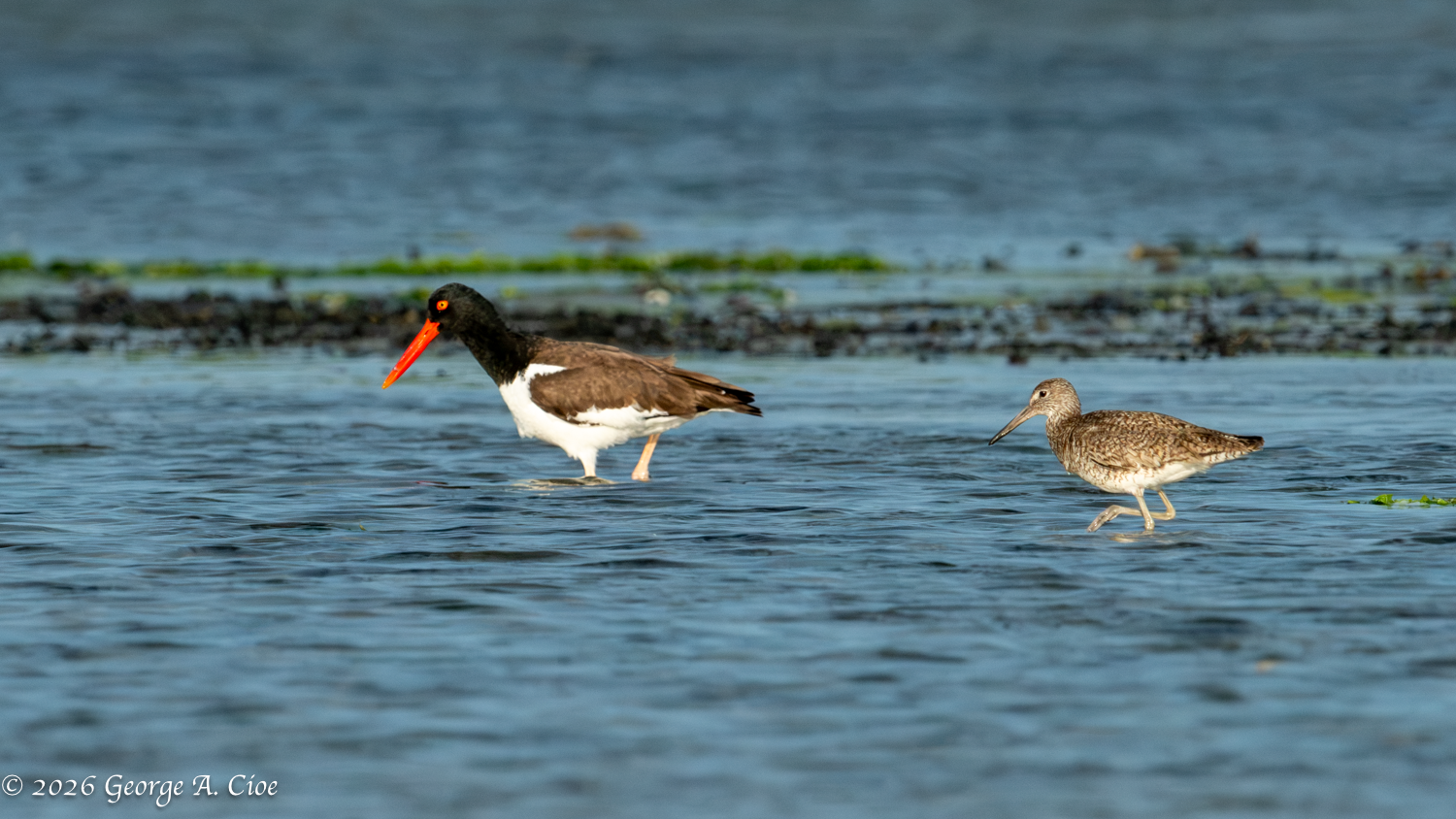
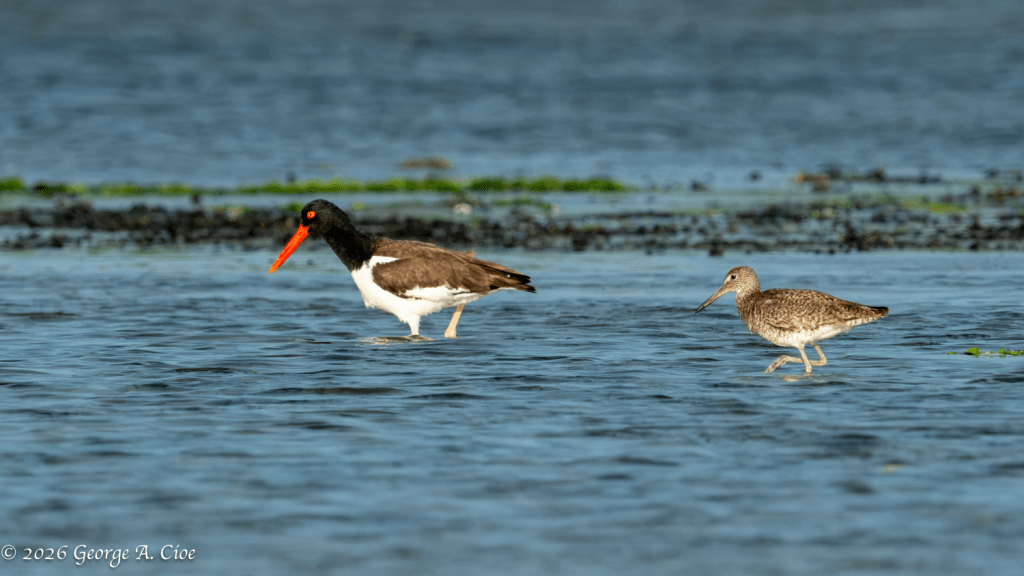
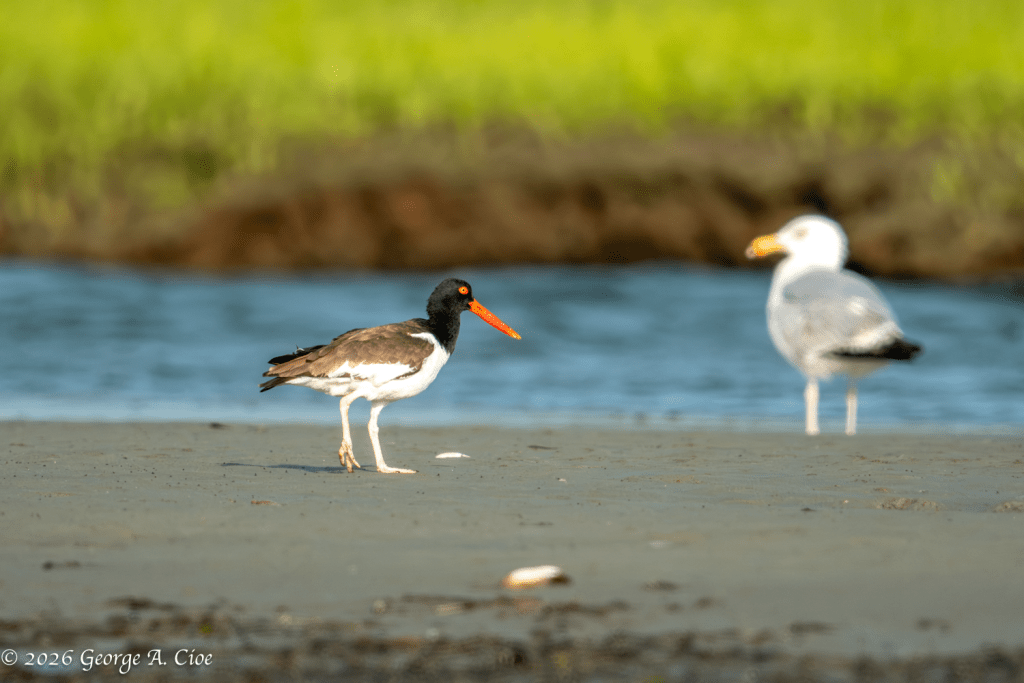
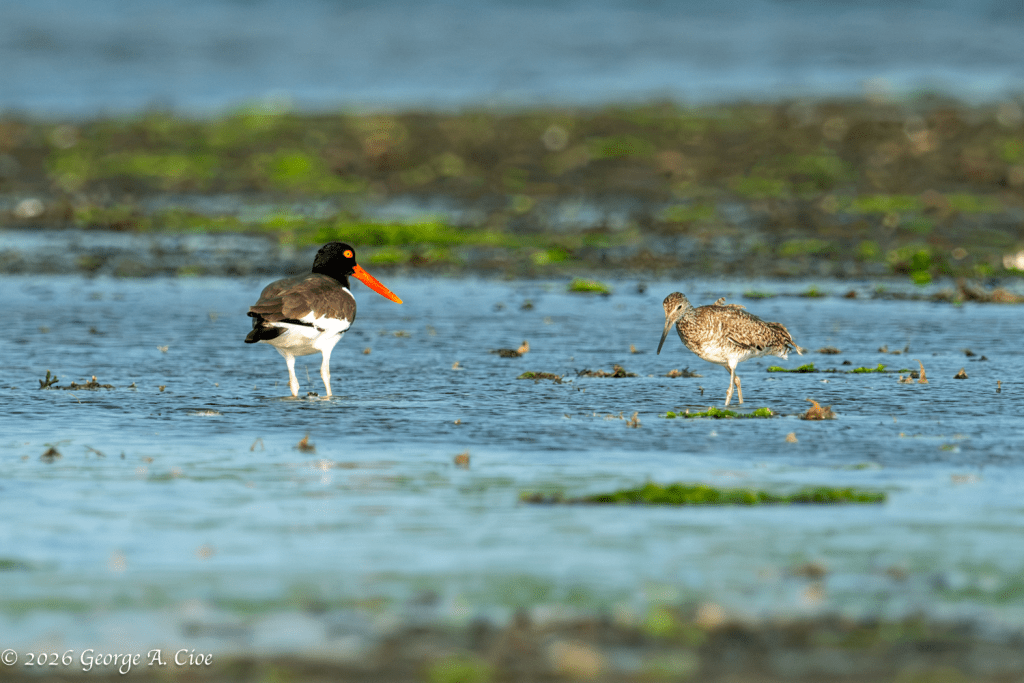
When a bird with a glowing orange bill the size of a carrot, a jet-black head, chocolate back, crisp white belly, and eyes that look like molten gold lands in the middle of a marsh full of muted browns and grays…your attention is immediately hijacked.
The American Oystercatcher had arrived.
And he landed beside…
A Willet.
Now if there were ever two birds that looked as though they belonged in different chapters of the field guide, these were them.
One appeared to have dressed for a black-tie gala.
The other looked as though he had chosen camouflage from the “Earth Tone Collection.”
Yet there they were.
Side by side.
Working the very same stretch of mudflat.
For several minutes I simply watched.
No squabbling.
No chasing.
No arguments over territory.
No “Get off my lawn!”
Just two professionals quietly going about their business.
Then I noticed something remarkable.
They weren’t eating the same meal.
The Willet was probing delicately into the soft mud with its slender bill, searching for marine worms, tiny shrimp, small crabs, insects, and little fish.
The Oystercatcher barely acknowledged the mud.
Instead, that magnificent orange bill became a precision tool—less a beak than a crowbar designed by an engineer. It slipped beneath shells, pried open clams and mussels, and severed the powerful muscle that keeps them tightly closed.
Same shoreline.
Different restaurants.
Nature had solved the problem long before anyone invented the phrase resource management.
Their bills told the entire story.
The Willet’s bill says, “I’ll search beneath the surface.”
The Oystercatcher’s bill says, “Stand back. I’ve brought the heavy equipment.”
Neither bird was competing.
They had evolved into different ecological niches, allowing each to thrive in the very same habitat without taking food from the other.
In fact, they actually benefit from each other’s company.
More eyes mean earlier warnings when a Peregrine Falcon or Merlin streaks overhead.
One bird’s movements can stir prey that the other notices.
Neither wastes precious energy defending food the other doesn’t even want.
It’s cooperation without negotiation.
Efficiency without meetings.
Harmony without anyone trying to be in charge.
As photographers, we’re naturally drawn to contrast.
The Willet whispers.
The Oystercatcher shouts.
One is understated elegance.
The other is impossible to ignore.
Together, they create a composition that almost seems impossible—as though two birds from different continents accidentally wandered into the same frame.
Except they didn’t.
They belong together.
Not because they are the same.
But because they are different.
That may be the greatest lesson of all.
Kneeling in the Narrow River this morning, camera balanced on my tripod, I wasn’t simply photographing birds.
I was photographing a healthy estuary.
A place rich enough to provide worms, crustaceans, shellfish, and small fish.
A place where different species don’t have to compete because there is enough for everyone.
I counted 12 Great Egrets, four Snowy Egrets, 9 Rock Pigeons, a flock of Northern Rough-winged Swallows, Barn Swallows (too fast to count), two Great Blue Herons, a Belted Kingfisher, and too many Heron Gulls to count.
The Narrow River wasn’t teaching biology.
It was quietly demonstrating something many of us humans still struggle to learn.
You don’t have to be alike to live together.
You don’t have to want the same things to share the same place.
Sometimes the healthiest communities aren’t built on everyone being identical.
They’re built on everyone finding their own purpose.
Nature rarely argues over abundance.
It simply finds room for everyone.
Naturally.
I’d love to share my posts with you. If you subscribe, they’ll come straight to your inbox—most days, like a little note from me to you. It means a lot to know you’re reading along.
Browse my complete art portfolio and shop for prints at imagesbygacioe.shop


Leave a Reply