
There is an old saying among photographers that a camera records what it sees.
That isn’t entirely true.
A camera records what the photographer tells it to see.
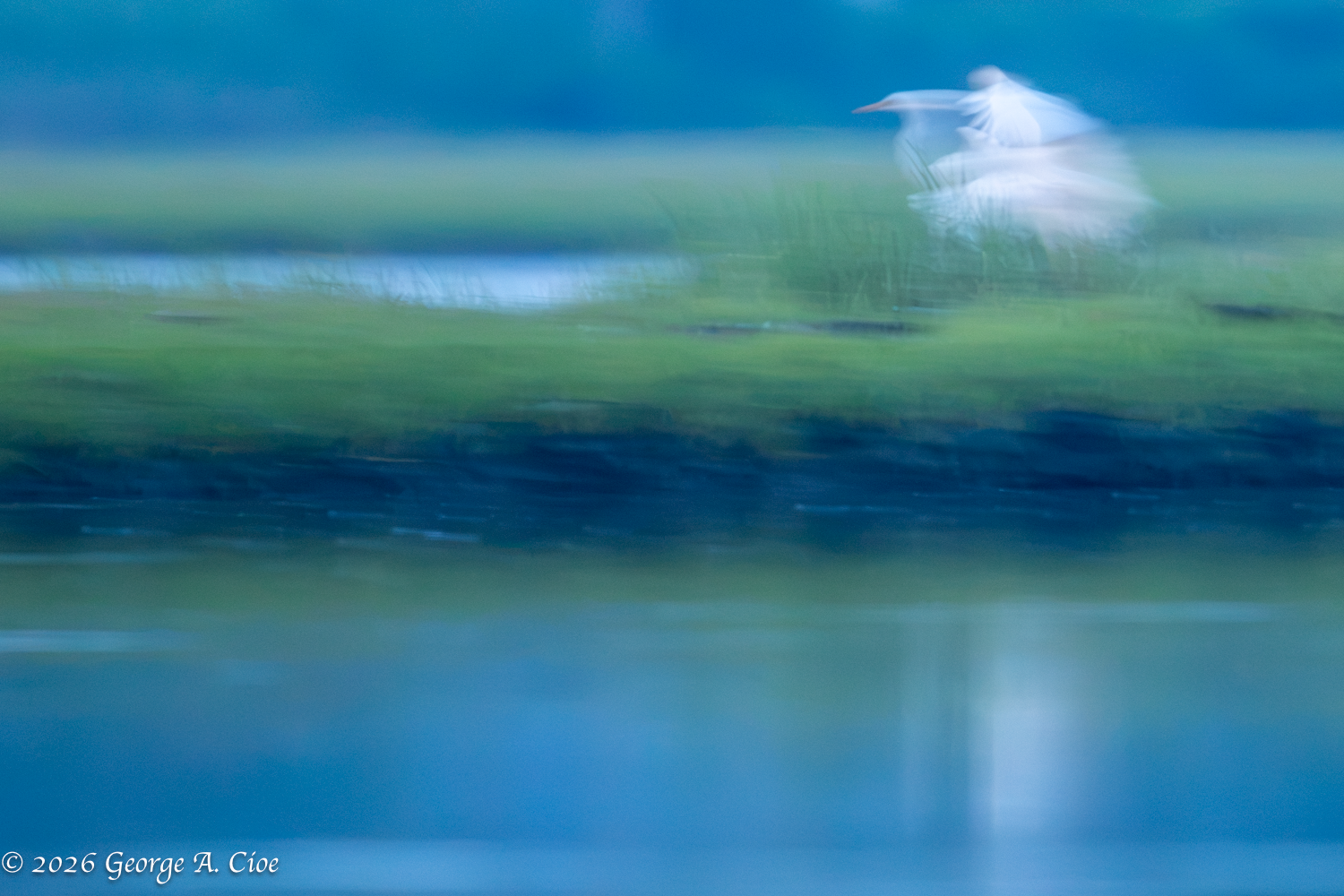
This image was never intended to document a Great Egret.
It was intended to document grace.
There is an important difference.
We live in a world obsessed with sharpness. Pixels. Resolution. Feather detail. Eye autofocus. We zoom to 200 percent searching for microscopic imperfections, as though technical perfection alone defines artistic success.
It doesn’t.
Sometimes the highest form of technical proficiency is knowing precisely when not to pursue technical perfection.
That was the objective here.
Long before this egret lifted from the marsh on the Narrow River, I already knew the photograph I wanted to make. I wasn’t chasing opportunity. I was waiting for an idea to arrive.
Twilight provided the palette.
The marsh supplied the brushstrokes.
The egret would become the paint.
The challenge wasn’t simply slowing the shutter.
Anyone can dial in a long exposure.
The challenge was balancing motion with recognition.
Too little motion and the image becomes an ordinary wildlife photograph.
Too much motion and the bird dissolves into an anonymous white blur.
Somewhere between those two extremes lies a narrow artistic window where movement remains believable, the subject remains identifiable, and the viewer instinctively feels what happened rather than merely seeing it.
That window lasts only fractions of a second.
This photograph lives there.
The blurred wings aren’t a compromise.
They’re the subject.
The softened edges aren’t evidence of missed focus.
They’re evidence of intention.
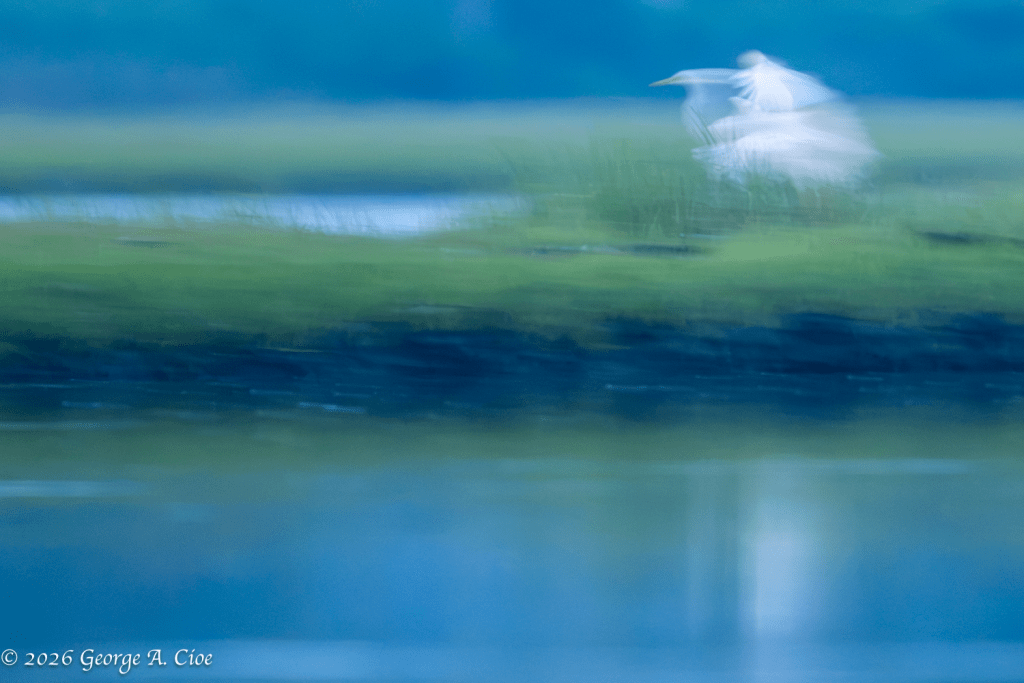
Notice how the marsh melts into horizontal ribbons of green and blue while the egret retains just enough structure for your mind to complete the story. Your eye doesn’t stop to inspect feathers.
It experiences lift.
It hears silence.
It feels the stillness of dawn interrupted by one elegant departure.
That is exactly what I hoped would happen.
Photography has always fascinated me because it allows us to photograph things that cannot actually be seen.
Time.
Motion.
Stillness.
Emotion.
Memory.
None of these have physical form.
Yet all of them can exist inside a single frame when technique serves imagination instead of dominating it.
For me, this image represents something larger than a bird taking flight.
It represents a moment when vision and execution became one.
The photograph I imagined before sunrise is the photograph I carried home.
That doesn’t happen often.
When it does, you don’t simply appreciate the result.
You smile.
Every single time you look at it.
For My Fellow Photographers
This image was created—not captured—through deliberate technical choices.
The goal was never sharpness. The goal was controlled motion that preserved the egret’s unmistakable elegance while allowing the surrounding marsh to dissolve into an impressionistic wash of color.
Equipment and Settings:
- Nikon D850
- NIKKOR 800mm lens
- ISO 5000
- f/5.6
- 1/13 second
- Benro Induro Hydra 2 Tripod
- Gitzo Gimble Head GHFG1
At 800mm, a shutter speed of 1/13 second leaves virtually no margin for error. Success depends on anticipating the bird’s takeoff, maintaining a remarkably smooth pan, and allowing just enough subject movement to suggest flight without sacrificing its identity.
In other words, the photograph wasn’t an accident.
It was the realization of an idea.
I’d love to share my posts with you. If you subscribe, they’ll come straight to your inbox—most days, like a little note from me to you. It means a lot to know you’re reading along.
Browse my complete art portfolio and shop for prints at imagesbygacioe.shop


Leave a Reply