

I’ll let you in on a secret.
When I’m in the field, I spend almost as much time looking for perch real estate as I do looking for birds.
Dead trees.
Broken limbs.
Fence posts.
Old pilings.
Even a half-dead bush standing a few feet above the marsh.
To a bird of prey…
That’s oceanfront property.
The marsh is mostly flat grassland.
Beautiful.
But from ground level, visibility is measured in inches.
Raise yourself six or eight feet above the marsh…
Now you own the neighborhood.
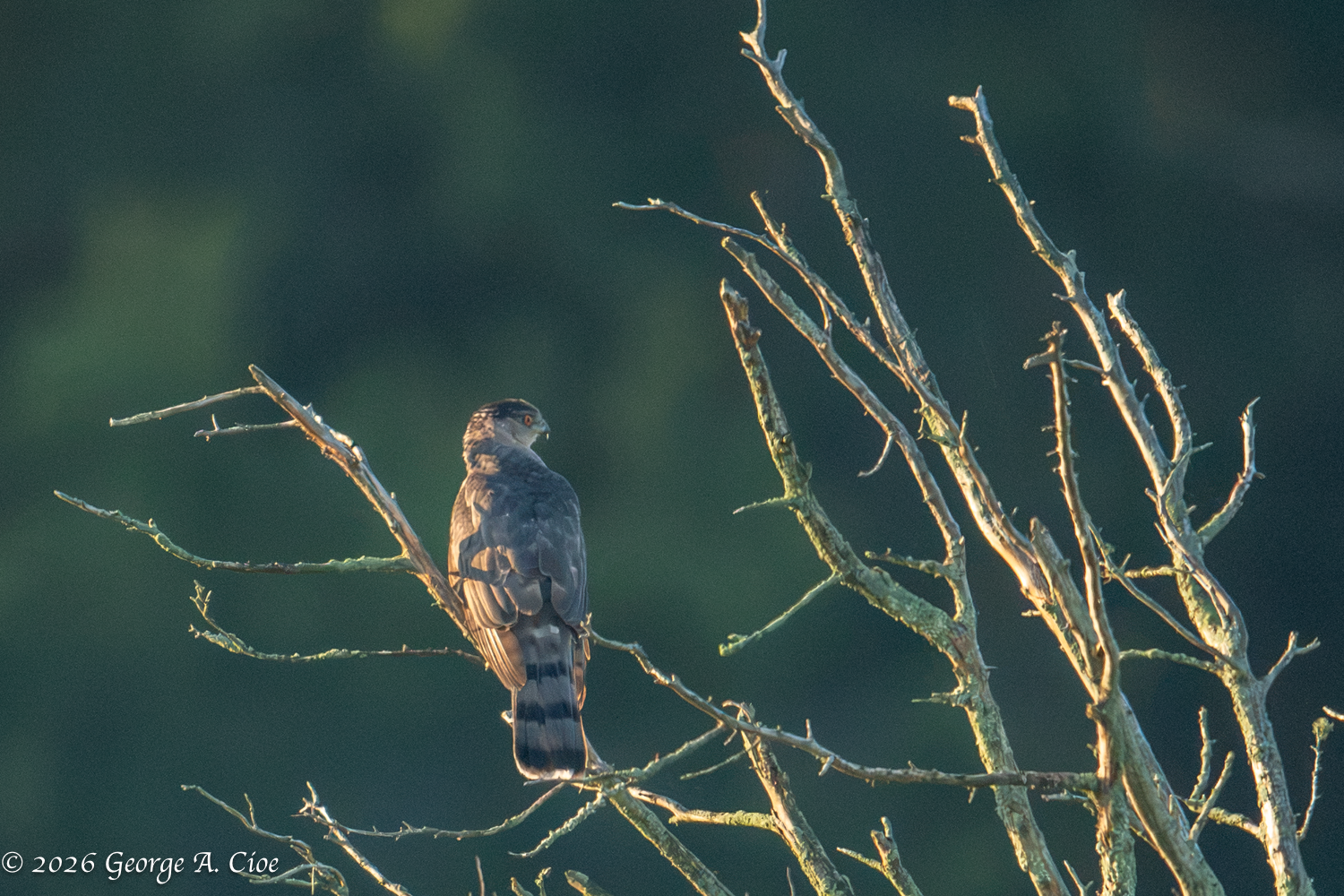
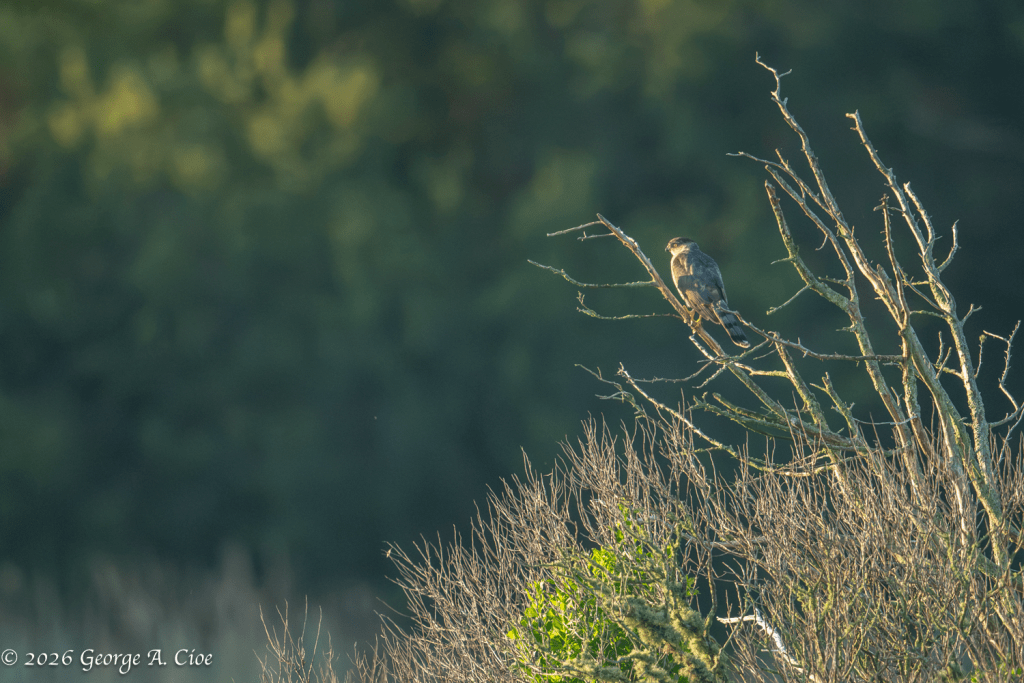
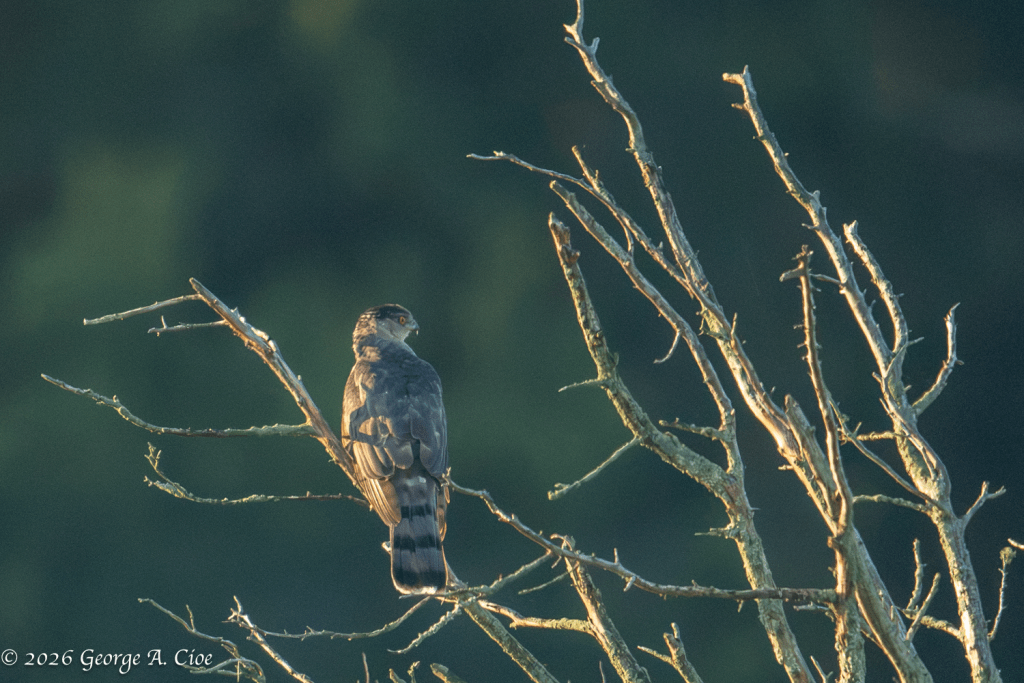
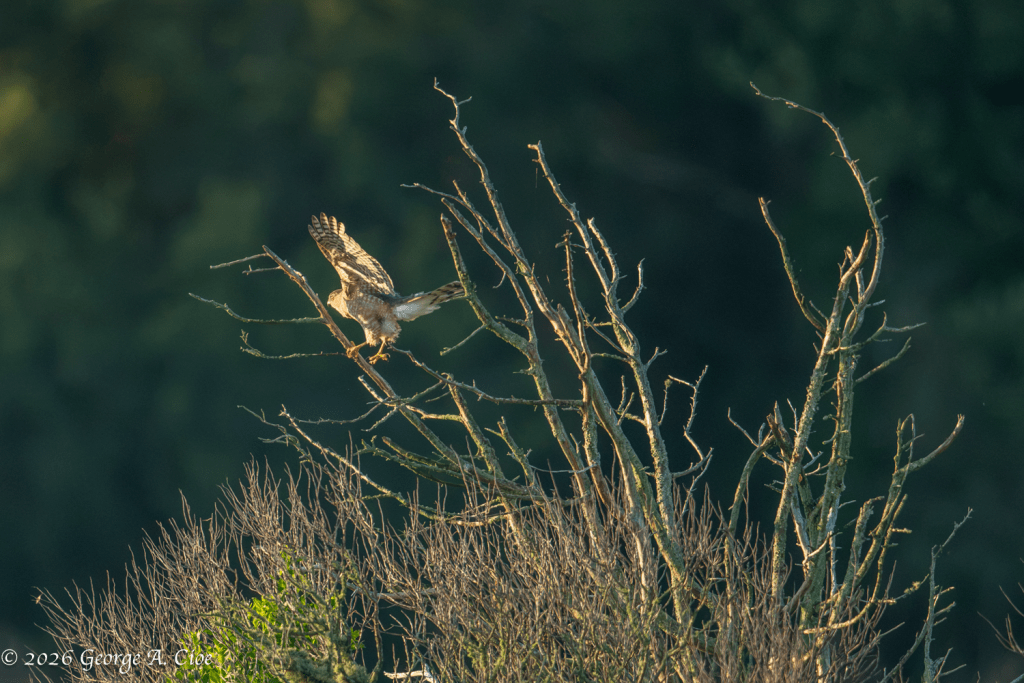
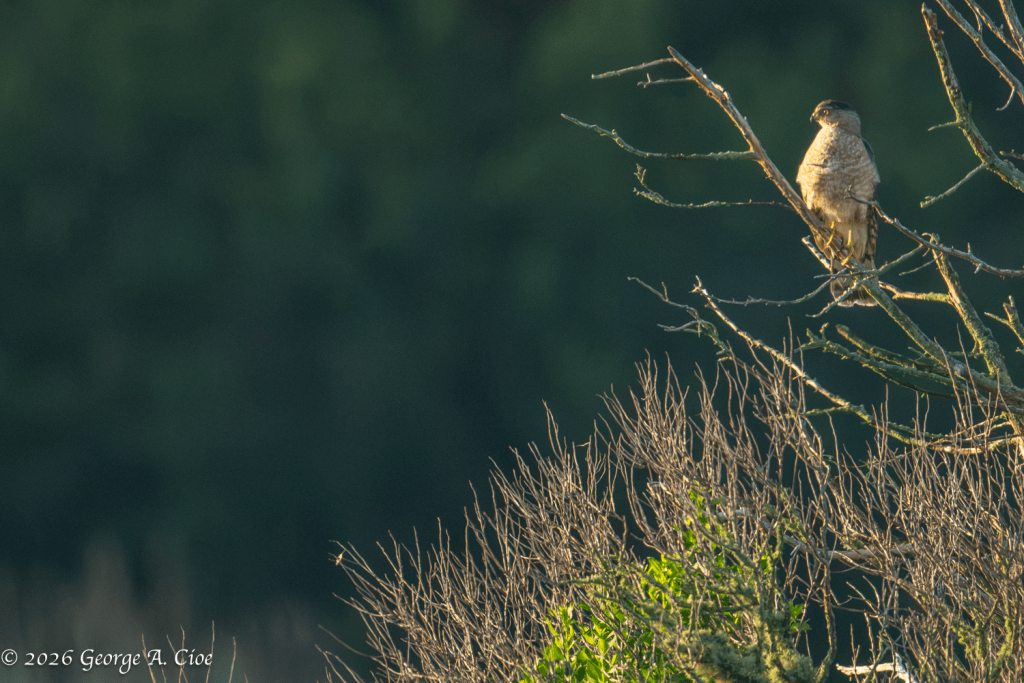
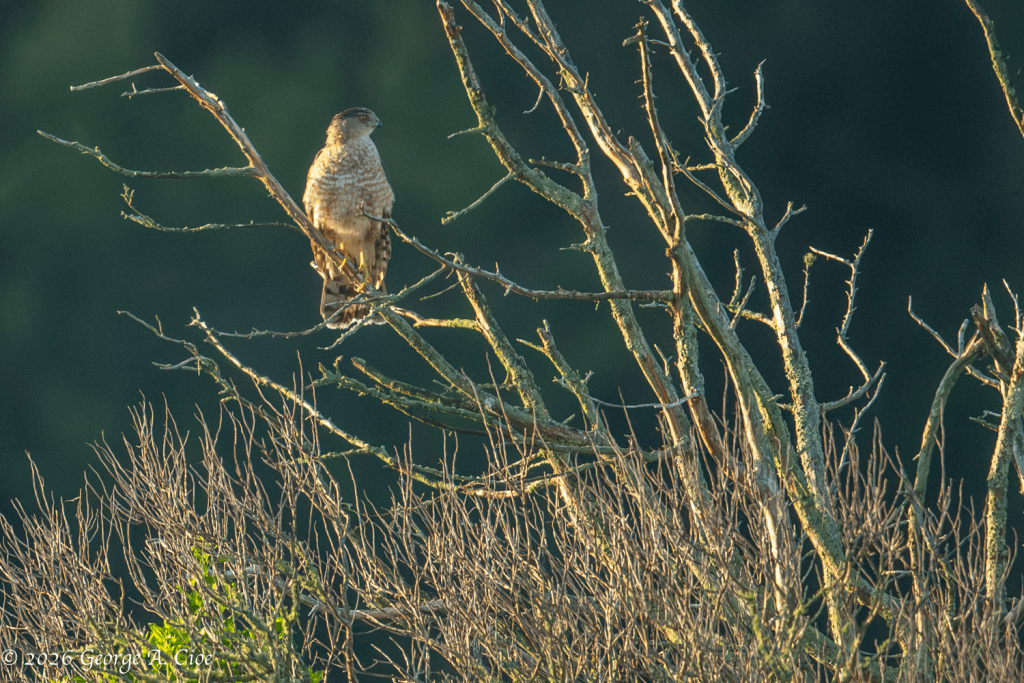
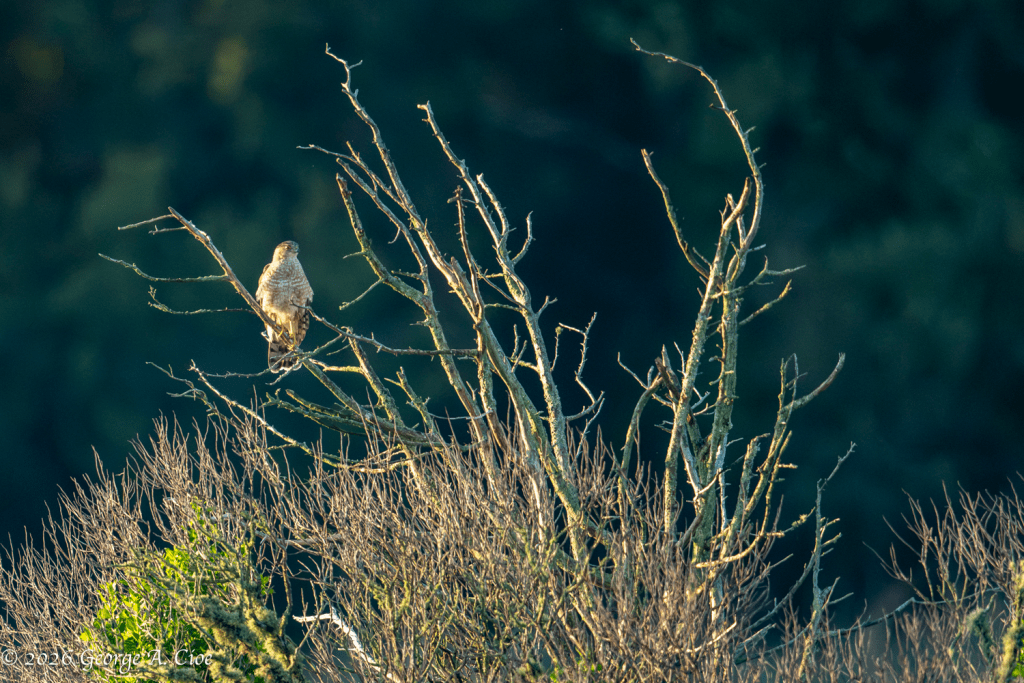
This Cooper’s Hawk understood that better than any real estate developer ever could.
The dead shrub looked like weathered fingers reaching into the morning sky. I’ve watched Mourning Doves, Barn Swallows, Northern Rough-winged Swallows, Red-winged Blackbirds and even ravens use this very perch.
This morning…
Its newest tenant arrived.
The golden sunrise wrapped around the hawk like a spotlight.
He didn’t fidget.
He didn’t pace.
He simply watched.
Only his head moved.
Left.
Right.
Down.
Then back again.
People often say hawks have incredible eyesight.
That’s true.
But eyesight alone doesn’t make a predator successful.
Patience does.
Timing does.
Experience does.
A Cooper’s Hawk is built differently than many other raptors.
Broad, rounded wings.
A remarkably long tail.
Not because it spends its life soaring over open country.
Quite the opposite.
It is a woodland fighter pilot.
Its world is measured in split seconds and inches.
When it launches, it doesn’t merely chase birds.
It threads itself through a maze of branches at astonishing speed, banking, twisting and accelerating between limbs that look impossible to navigate.
And that lifestyle comes at a price.
Scientists who examined more than 300 Cooper’s Hawk skeletons discovered something astonishing.
Nearly one out of every four showed old, healed fractures—most often in the wishbone.
Think about that.
Almost twenty-five percent had survived what amounted to high-speed aerial crashes.
The scars remained.
The hawks simply healed…
…and went right back to work.
That may be the most remarkable thing about them.
They are predators.
But they’re also survivors.
When they finally catch another bird, the story isn’t over.
Unlike falcons, which typically dispatch prey with a bite, Cooper’s Hawks rely on the incredible strength of their feet. They grip their prey and repeatedly squeeze until it dies. Occasionally, if the struggle continues near water, they’ve even been observed holding prey underwater until it stops moving.
Nature can be beautiful.
Nature can also be brutally efficient.
For years, Cooper’s Hawks were considered birds of deep forests.
Not anymore.
They’ve quietly adapted to our neighborhoods, parks and cities, where bird feeders attract exactly what Cooper’s Hawks are looking for.
Rock Pigeons.
Mourning Doves.
Starlings.
A suburban buffet.
I watched one take a Northern Flicker from my backyard feeder.
In some places, their populations are actually higher in towns than in the forests they once called home.
Even family life comes with extraordinary challenges.
The female is considerably larger than the male.
Large enough, in fact, that an unwary male could easily become mistaken for lunch if he approached at the wrong moment.
So the smaller male announces himself with reassuring calls before approaching the nest.
He builds it.
Then, for nearly three months, he becomes the provider.
While the female guards their young, he does almost all of the hunting, delivering meal after meal until the fledglings are ready to leave home.
Standing there in the marsh this morning, none of that was obvious.
I simply saw a hawk on a dead bush.
Quiet.
Motionless.
Patient.
But that’s one of the great joys of nature.
The more you learn…
…the more extraordinary ordinary becomes.
What looked like an old shrub was actually an observation tower.
What looked like a beautiful bird was one of nature’s most accomplished aerial hunters.
And what appeared to be a peaceful sunrise…
…was simply another workday for a master of the marsh.
I’d love to share my posts with you. If you subscribe, they’ll come straight to your inbox—most days, like a little note from me to you. It means a lot to know you’re reading along.
Browse my complete art portfolio and shop for prints at imagesbygacioe.shop



Leave a Reply