





I’m not an entomologist.
And I don’t play one on TV.
In fact, what I know about butterflies could easily fit on that little strip of paper inside a fortune cookie.
With room left over for the lucky numbers.
But fortunately for you, I planted a butterfly bush.
Actually, two butterfly bushes.
And as luck would have it, I now have butterflies.
Which means I feel compelled to photograph them.
I think it’s because they fly.
And if something flies anywhere near me, sooner or later I’m going to point a camera at it.
Birds, however, have the decency to fly in a reasonably predictable manner.
An Osprey says, “I’m going over there.”
And generally speaking, it goes over there.
A butterfly says, “I’m going over there.”
Then goes left.
Right.
Up.
Down.
Backwards.
Sideways.
Possibly through another dimension.
And then lands six inches from where it started.
Try following one through an 200mm lens.
You can get whiplash.
Butterflies appear to be the early prototypes from Nature’s aviation department—the models produced before the engineers completely understood lift, drag, navigation, or the importance of proceeding in a straight line.
For a while I suspected butterflies and bats shared some genetic material.
They don’t.
Not even close.
That was Research Finding Number One.
Good start, George.
But their seemingly erratic flight does have a purpose. A butterfly’s light body, broad wings, and rapid changes in direction can make its path difficult for a predator to anticipate.
It turns out the little lunatic knows exactly what it’s doing.
I’m the one who doesn’t.
And that made me curious.
So I did some research.
Which is generally dangerous because once I start researching something I’ve photographed, I inevitably discover that the creature in question is considerably more interesting than I ever imagined.
And that is exactly what happened.
Meet the Monarch
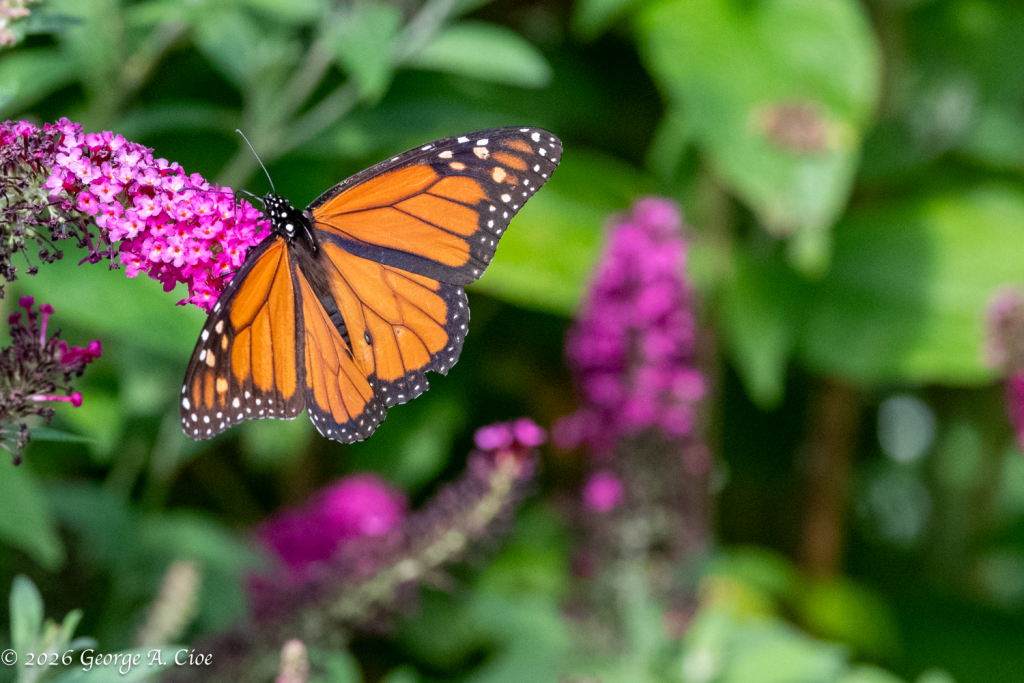
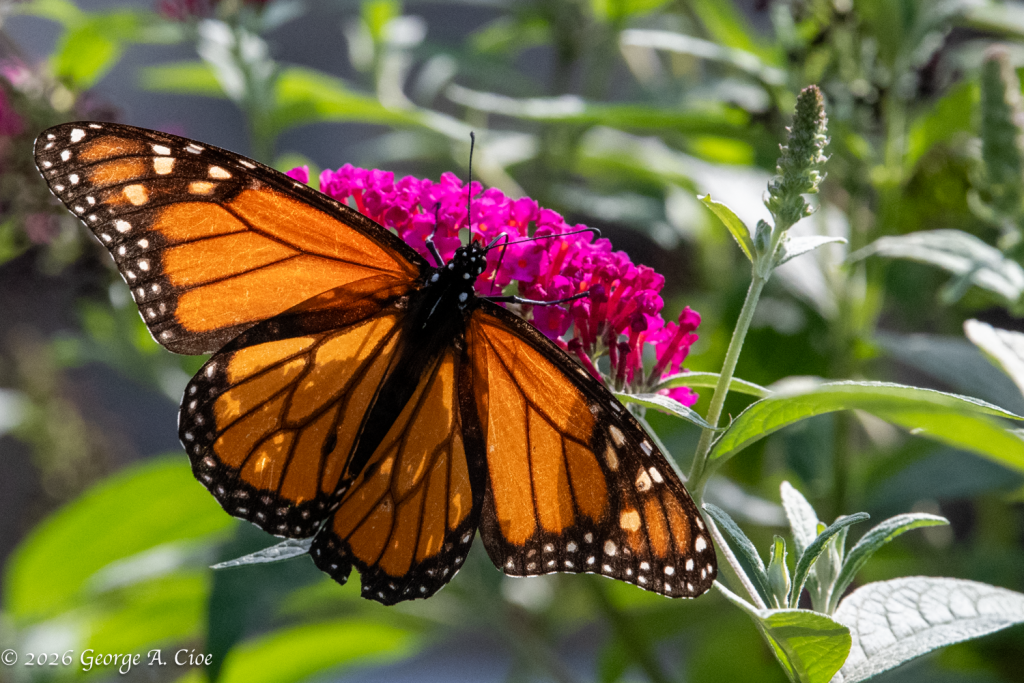
The first four photographs are Monarch butterflies — Danaus plexippus.
You know the uniform.
Orange wings.
Heavy black veins.
White spots along the black borders.
The unmistakable look of a butterfly that knows it has achieved celebrity status.
And I learned something wonderful: adult Monarchs weigh, on average, only about half a gram.
Half a gram!
I have probably eaten crumbs heavier than that.
Yet some Monarchs from eastern North America migrate all the way to the mountain forests of central Mexico. Even more remarkable, the individuals making that southbound trip have never made the journey before. The migration unfolds across generations, with later generations continuing the northward journey the following year.
Think about that.
No GPS.
No Google Maps.
No interstate signs.
No guy in the passenger seat saying,
“You missed the exit.”
Just a half-gram butterfly heading toward Mexico.
Meanwhile, I occasionally have difficulty finding my car in a parking lot.
There was another discovery.
Monarch caterpillars eat milkweed, which supplies chemical defenses that help make Monarchs distasteful to many predators. But once they’re adults, Monarchs switch to nectar from many kinds of flowers.
Which explains my butterfly bushes.
Apparently I have opened a restaurant.
And judging from the traffic, reservations are strongly recommended.
The butterfly lands, unrolls its proboscis—essentially a flexible drinking tube normally carried coiled beneath its head—and starts probing the tiny flowers for nectar.
In other words, the Monarch arrives at my backyard bar carrying its own straw.
Now THAT is evolutionary preparedness.
And take a close look at the first photograph.
You’re seeing something we often miss when butterflies are fluttering around: the underside of a Monarch’s wings is considerably more muted than the brilliant orange upper surface.
Same butterfly.
Completely different presentation.
Business casual underneath.
Las Vegas on top.
Then I discovered something else while studying my photographs.
You can tell male and female Monarchs apart. Males have a small black scent patch on a vein of each hindwing; females lack those spots and generally have somewhat thicker black wing veins. Do you see them? (Take a closer look near the bottom of the wings. They are bilateral and symmetric.)
Which means entomologists can apparently determine the sex of a Monarch from across the garden. (And now you can!)
I can’t tell whether the person waving at me across Stop & Shop is someone I know.
Science is humbling.
And Then the Swallowtail Arrived
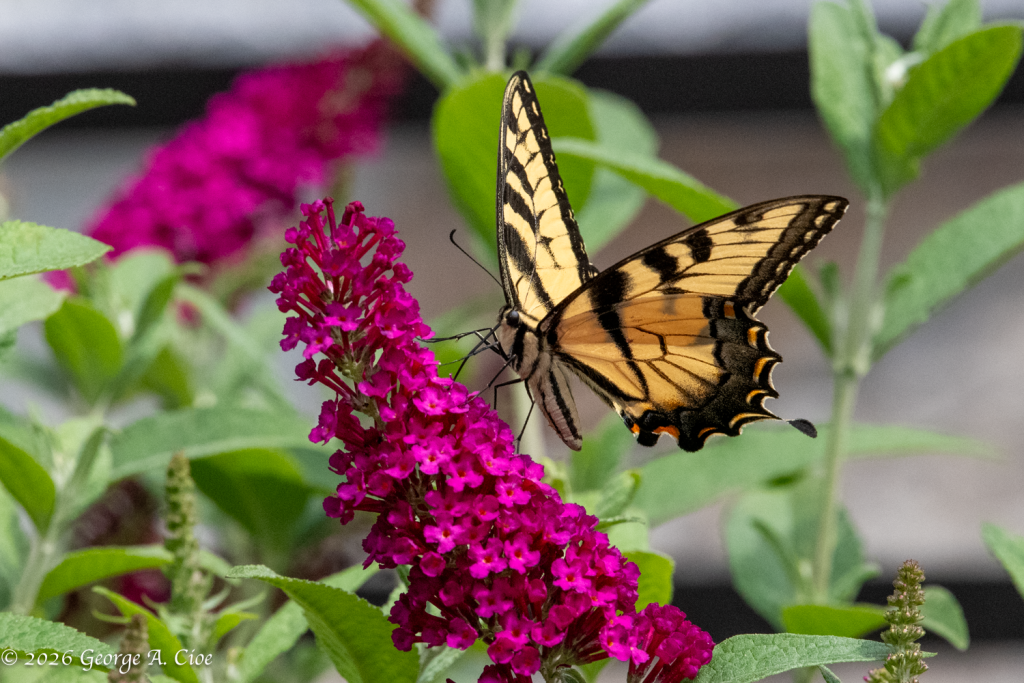
Photographs five, six, and seven feature a completely different visitor:
The Eastern Tiger Swallowtail — Papilio glaucus.
And this butterfly does not enter a garden.
It makes an entrance.
Large.
Yellow.
Black tiger stripes.
Those magnificent tails extending from the hindwings.
If the Monarch is wearing an elegant orange tuxedo, the Tiger Swallowtail has arrived wearing formal attire with tails.
Literally.
Look closely at those last three photographs and you can see how dramatically different its architecture is from the Monarch’s.
This thing looks engineered.
And yet it is doing exactly what the Monarch was doing.
Eating.
Which brings me to perhaps the most important thing I learned from this entire investigation:
My butterfly bushes are basically an insect buffet.
Pink flowers.
All-you-can-drink nectar.
Plenty of landing space.
No cover charge.
And a photographer lurking nearby with a Nikon.
There is always a catch.
The Part I Didn’t Expect
But here’s what really got me.
I planted those bushes because I liked the flowers.
Then the butterflies came.
So I photographed them because I liked the butterflies.
Then I researched the butterflies because I had photographed them.
And because I researched them, tomorrow when I see one, I won’t see quite the same thing I saw yesterday.
I’ll know a little more.
I’ll notice a little more.
I’ll wonder a little more.
That’s one of the great gifts of photography.
The camera makes you look.
Curiosity makes you see.
A butterfly isn’t merely something pretty fluttering among the flowers anymore.
It’s an exquisitely engineered pollinator.
A nectar-drinking flying machine.
A creature that undergoes one of nature’s most extraordinary transformations.
And in the case of the Monarch, something weighing roughly half a gram can participate in a migration spanning a continent.
All while flying as though someone just released a helium balloon inside a ceiling-fan showroom.
Which brings me back to where this investigation began.
I am still not an entomologist.
I still don’t play one on TV.
And what I know about butterflies would now require considerably more than a fortune-cookie slip.
Maybe a cocktail napkin.
Possibly two.
But I know this:
Tomorrow, when I walk past those butterfly bushes, I’ll stop.
I’ll look.
And when one of these magnificent little creatures arrives, I’ll raise the camera.
It will go left.
I’ll go left.
It will go right.
I’ll go right.
It will go up.
I’ll go up.
Then it will inexplicably disappear while I stand there staring through a 200mm lens at an empty flower.
And somewhere nearby, I am absolutely certain, a butterfly will be watching me.
Thinking:
“Look at this idiot.”
And frankly?
It will have a point.
Naturally.
I’d love to share my posts with you. If you subscribe, they’ll come straight to your inbox—most days, like a little note from me to you. It means a lot to know you’re reading along.
Browse my complete art portfolio and shop for prints at imagesbygacioe.shop




Leave a Reply