



I really didn’t want to write this story.
I’d much rather tell you about an Osprey.
Or a Great Blue Heron.
A fisherman quietly working the edge of the marsh.
A kayaker slipping through the morning mist.
A paddleboarder enjoying water so calm that the clouds seem to have fallen into it.
That’s the Narrow River I love.
But lately, there is another side of the river that has me concerned.
And this one isn’t about getting the photograph.
It’s about somebody getting hurt.
I spend a lot of mornings standing in the Narrow River with my camera mounted on a tripod.
Sometimes I’m there for hours.
I’m hardly alone.
There are fishermen standing waist-deep in the water.
Kayakers.
Paddleboarders.
Birders.
Photographers.
Families.
People in small boats.
All of us sharing a remarkably beautiful—and remarkably narrow—piece of Rhode Island.
And then comes the sound.
WHOOOOOOOSH.
A powerboat comes roaring through.
The bow is up.
Water is flying.
And behind it comes a wall of water.
I’ve had wakes so large that I’ve had to grab my camera and tripod and move quickly to avoid being swamped.
Think about that for a moment.
I’m standing in moving water, trying to protect thousands of dollars of photographic equipment while simultaneously trying to keep my footing as a large wake rolls toward me.
The camera can be replaced.
I can’t.
And neither can the fisherman standing in the water.
Or the person balancing on a paddleboard.
Or the kayaker who suddenly finds himself broadside to a large wake.
This isn’t an argument against powerboats.
I’m a boater.
I understand boats.
I understand wakes.
And I understand that anybody can make a mistake.
Miss a sign.
Lose track of speed.
Get distracted.
I’ve made plenty of mistakes in my life.
That’s not what bothers me.
What bothers me is when it happens again and again, particularly around Sprague Bridge, where slowing down isn’t merely courteous.
It’s the rule.
Narragansett’s Harbor Management Plan says that in the Narrow River, from 100 feet east of Sprague Bridge to 300 feet west of it, a vessel may not operate faster than the posted five miles per hour or create a wake. The same town rules require vessel operation that protects people and property from damage caused by waves and wakes and prohibit reckless or careless operation, including creating wake or wash potentially dangerous to people or property.
That distinction matters.
It doesn’t say:
“Five miles per hour unless you’re in a hurry.”
It doesn’t say:
“No wake unless the fishing is really good on the other side of the bridge.”
And it certainly doesn’t say:
“Everybody else, hang on.”
No wake means no wake.
The rules go further. Narragansett restricts vessels engaged in activities involving speeds above five miles per hour from coming within 200 feet of areas and craft particularly vulnerable to wake, specifically including canoes, kayaks and rowing shells. The ordinance also prohibits operating a vessel recklessly or negligently so as to endanger another person’s life, safety or property.
Rhode Island law reinforces that responsibility.
R.I. General Laws §46-22-9 prohibits operating a vessel recklessly so as to endanger the life, limb or property of another person. It also prohibits operating a vessel in a manner that unreasonably or unnecessarily interferes with other vessels or the free and proper navigation of Rhode Island’s waterways. The statute expressly recognizes legally established 5-mph/no-wake restrictions.
Rhode Island’s general boating-speed statute, §46-22-9.5, also expressly allows state and local authorities to establish lower speed limits where necessary. And §46-22-14 provides the statutory mechanism for special local boating regulations.
The state’s boating regulations also incorporate the federal Inland Navigation Rules governing vessel operation on Rhode Island’s inland waters. Those are part of the larger principle every responsible boater learns:
Operate safely. Keep a proper lookout. Understand the water you’re navigating. And share it responsibly.
There’s even an environmental reason to slow down.
The Rhode Island Coastal Resources Management Council’s Narrow River Special Area Management Plan specifically recognizes riverbank and salt-marsh erosion from boat wakes, along with the conflicts created by multiple recreational uses of this unusually narrow waterway.
So this isn’t just about me.
And it isn’t about my camera.
It’s about our river.
Look at these photographs.
Look at the water being displaced.
Look at the proximity to Sprague Bridge.
Look at the fisherman standing in the water as a boat passes.
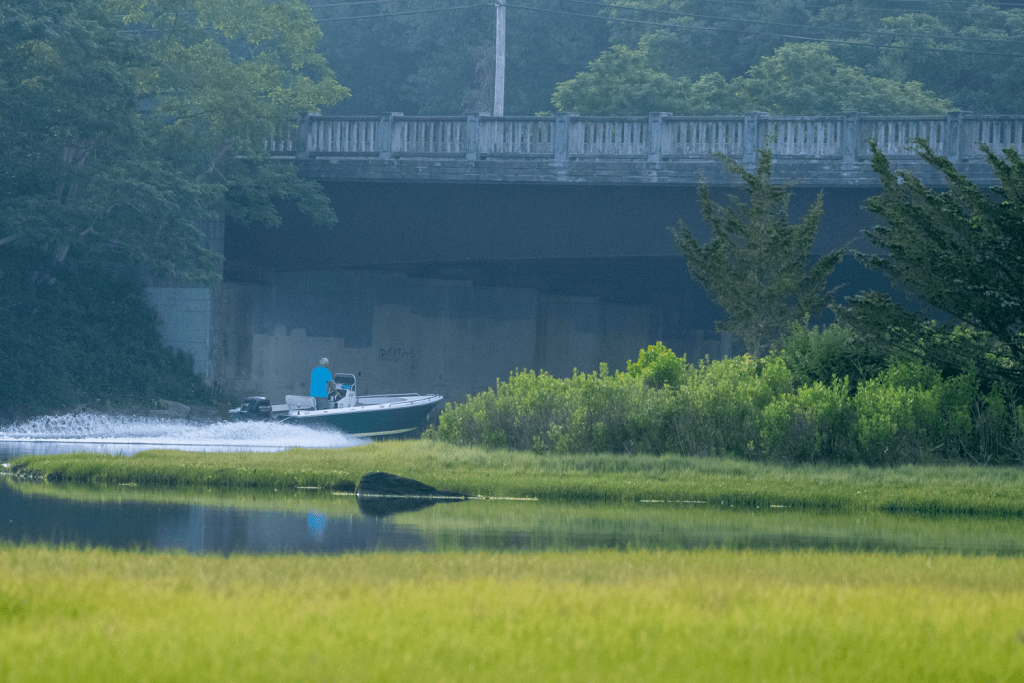
One photograph shows a boat moving toward and beneath Sprague Bridge with a substantial trail of disturbed water behind it.
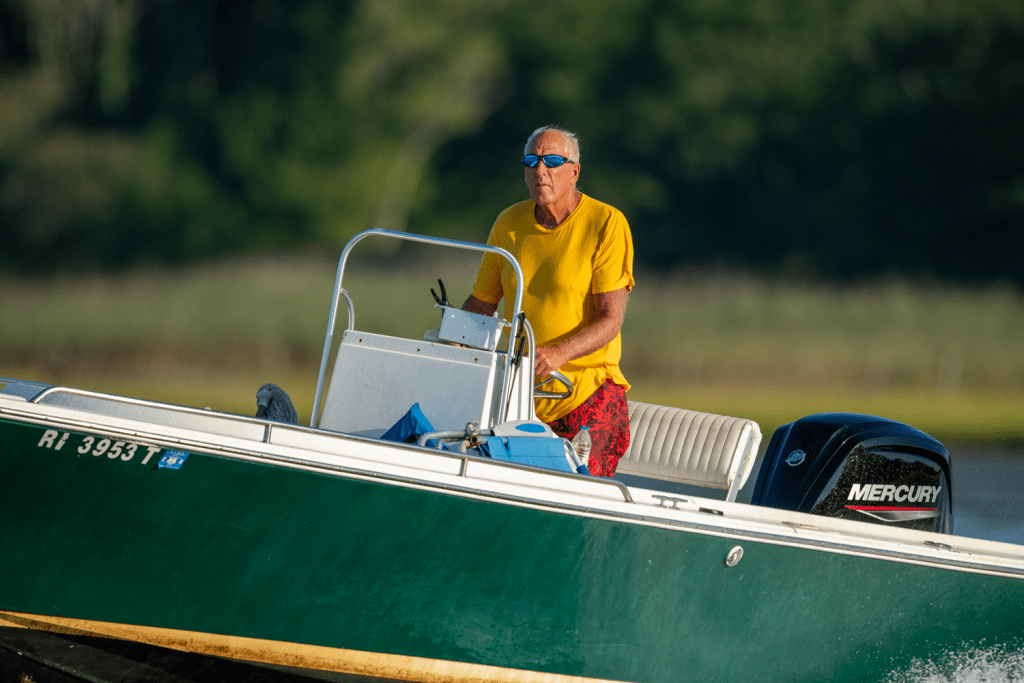
Another captures spray exploding alongside the hull.
And several photographs clearly record the registration numbers.
I have also photographed the same green-hulled boat on more than one occasion. I’m deliberately not going to speculate about the operator’s intentions or declare anyone guilty of an offense. That’s a determination for the appropriate authorities.
I’m showing what my camera recorded.
The photographs can speak for themselves.
Because this isn’t about embarrassing somebody.
It’s about preventing an accident.
A fisherman shouldn’t have to scramble toward shore.
A kayaker shouldn’t have to brace for somebody else’s wake.
A paddleboarder shouldn’t suddenly find the water disappearing beneath his feet.
And a photographer shouldn’t have to choose between saving his camera and maintaining his balance.
We can all use this river.
Powerboats.
Fishing boats.
Kayaks.
Paddleboards.
Canoes.
Birders.
Fishermen.
Photographers.
Wildlife.
That’s precisely what makes the Narrow River so extraordinary.
But sharing something requires consideration for the people with whom you’re sharing it.
Slow down.
Look around.
Respect the no-wake zones.
And when you see someone standing in the water, fishing from a kayak, paddling with a child, photographing a bird, or simply enjoying a quiet morning…
Give them room.
Give them calm water.
Give them the same consideration you’d hope they would give you.
Because nobody owns the Narrow River.
We share it.
And I’d much rather my next story from Sprague Bridge be about an Osprey catching breakfast than about somebody getting hurt.
I’d love to share my posts with you. If you subscribe, they’ll come straight to your inbox—most days, like a little note from me to you. It means a lot to know you’re reading along.
Browse my complete art portfolio and shop for prints at imagesbygacioe.shop




Leave a Reply