

Some images just surprise me.
Not because something dramatic happened.
No dive.
No chase.
No fish dangling from a beak.
Sometimes it is the most basic ingredient in photography that makes an image special.
Light.
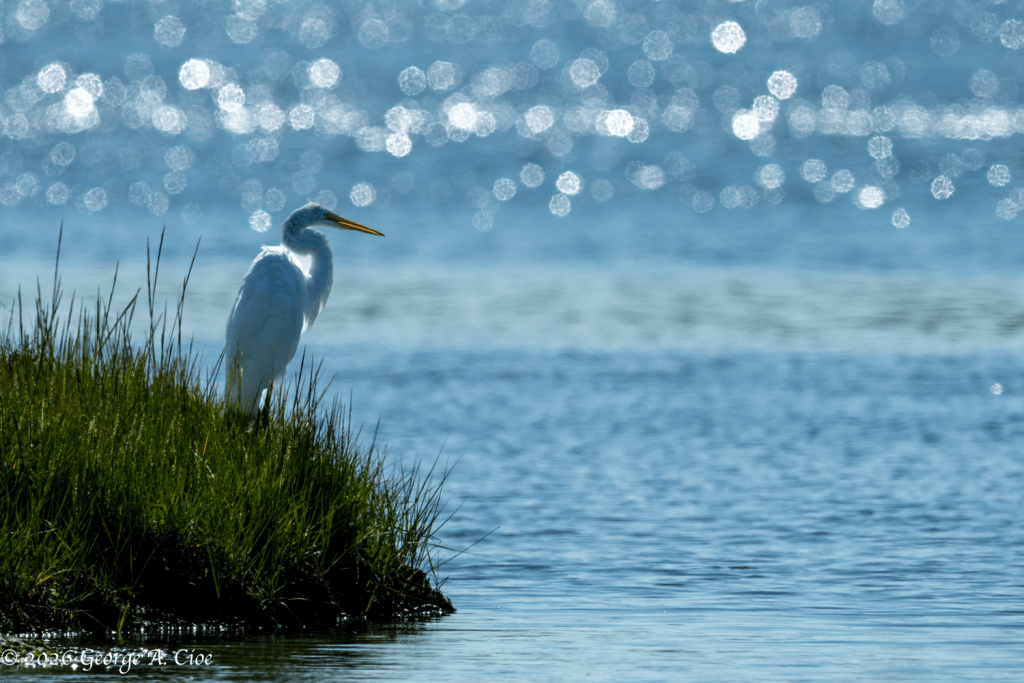
This photograph is one of those images.
And I have to admit something.
I have no idea.
Not a clue.
Why the bokeh is so spectacular.
I know the photographic reasons it can happen. But exactly how all the ingredients came together this perfectly?
That belongs to the morning.
A Great Egret stood quietly at the edge of the marsh, partially tucked into the grasses.
And behind it, the river had apparently decided to throw a party.
Hundreds of circles of light danced across the background.
Some bright.
Some faint.
Some overlapping.
Some almost perfectly round.
They look less like ordinary highlights and more like tiny living organisms suspended in another world.
The geometry blew me away.
Circles within circles.
Patterns without any apparent pattern.
Order emerging from randomness.
And in the middle of all that visual commotion stood the Egret.
Perfectly still.
That contrast may be what I love most about this photograph.
The background dances.
The Egret doesn’t.
There is a natural explanation for those wonderful circles.
They are most likely specular highlights—tiny, intensely bright reflections of sunlight bouncing from ripples and irregularities on the surface of the water. Because those points of reflected light were far outside the plane of focus, the lens rendered them not as sharp points, but as large circles of confusion.
Bokeh.
But several things had to cooperate.
The long focal length compressed the scene and magnified those distant highlights. The shallow depth of field dissolved the water behind the Egret. The angle of the sun created countless little mirrors on the river’s surface. And the aperture of the lens helped determine the wonderfully rounded shape of those highlights.
Even the changing surface of the river contributed.
Every tiny ripple tilted a little differently toward the sun.
For a fraction of a second, one caught the light.
Then another.
And another.
Nature was essentially switching on hundreds of microscopic spotlights.
I just happened to be standing in the right place when the performance began.
And then there is the Egret itself.
Photographing a Great Egret in strong light can be surprisingly difficult. Those magnificent white feathers reflect so much light that preserving their detail while also exposing the darker surroundings can push a camera’s dynamic range. Get it wrong and that beautiful plumage becomes a featureless patch of white.
But get it right…
And the bird seems to glow.
Here, the light catches the edges of the feathers along the neck, shoulder and back, creating a delicate rim of illumination. One side of the bird disappears gently into shadow while the other seems outlined by the morning itself.
The grasses anchor everything.
Dark.
Earthy.
Textured.
Then comes the white Egret.
Then blue water.
And finally that extraordinary field of floating light.
Layer upon layer.
Texture upon texture.
Stillness against movement.
Shadow against brilliance.
Reality against something that almost doesn’t look real.
That’s one of the things I continue to love about photography.
I can understand aperture.
Focal length.
Depth of field.
Reflection.
Refraction.
Exposure.
I can explain why a lens produces bokeh.
But understanding the mechanics doesn’t completely explain the wonder.
Nature supplied the water.
The sun supplied the light.
The Egret supplied the patience.
My lens turned hundreds of tiny reflections into floating circles.
And for one brief moment, all of those ordinary ingredients arranged themselves into something extraordinary.
I pressed the shutter.
And the light did the rest.
Naturally.
I’d love to share my posts with you. If you subscribe, they’ll come straight to your inbox—most days, like a little note from me to you. It means a lot to know you’re reading along.
Browse my complete art portfolio and shop for prints at imagesbygacioe.shop




Leave a Reply