


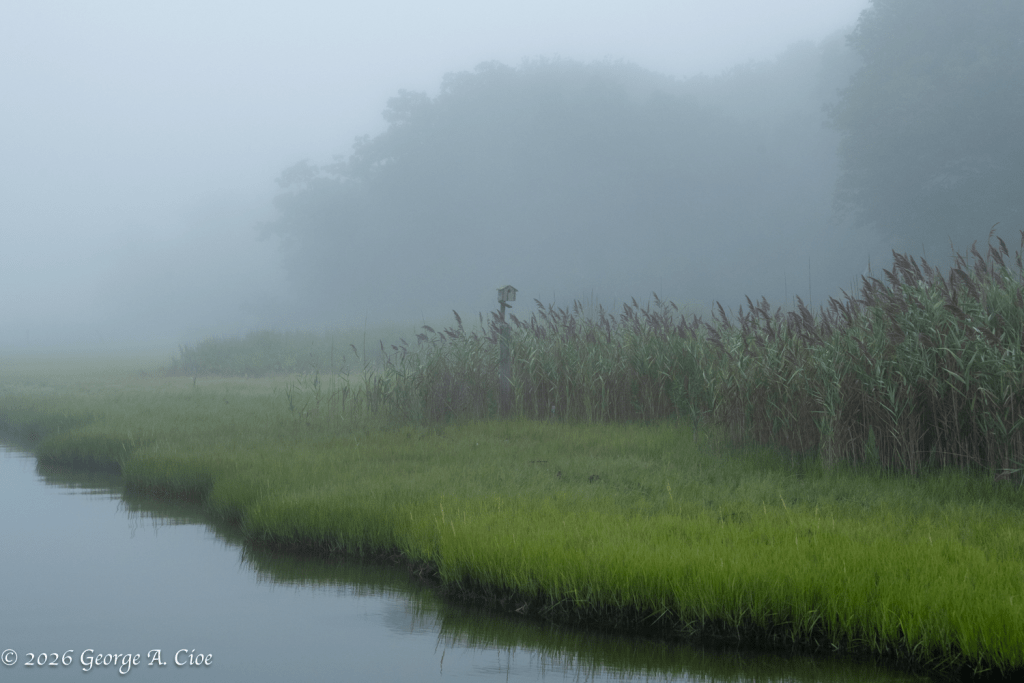
I have passed this birdhouse many times.
It has probably been standing there for years.
Quietly.
Weathering.
Slowly surrendering itself to the marsh.
On most mornings, it is simply one small object in a very busy landscape. Trees, grasses, reeds, water, shadows, and countless other details compete for attention.
But this morning, the fog changed everything.
It did not add anything to the scene.
It took things away.
The distant trees disappeared first. Then the far edge of the marsh softened into suggestion. Lines became less certain. Colors surrendered their brightness.
And suddenly, there it was.
The birdhouse.
Alone.
The fog had removed every competing voice from the composition and given this small, ruined structure the entire morning to itself.
That is one of the strange gifts of fog.
It simplifies.
It turns a landscape into a watercolor, washing away the unnecessary until only the essential remains. Greens became quieter greens. The reddish-purple plumes of the reeds rose gently above them. The sky and distant trees dissolved into layers of blue-gray.
Nothing shouted.
Everything whispered.
And the birdhouse, worn by years of sun, rain, salt air, wind, and winter cold, seemed to belong perfectly within those muted tones.
Then I looked more closely.
Its floor was dangling beneath it.
Nearly gone.
Whatever security this little house once offered had been lost long ago. It was well beyond repair and certainly beyond habitation. No bird could safely build a nest there now. What had once been a refuge had become a remnant.
The fog did not conceal that damage.
The soft, diffused light dramatized it.
There were no harsh highlights or deep shadows—only an even, silvery illumination that revealed the weathered boards, the moss-covered roof, the rough post, and that final piece of the floor hanging precariously below.
It was not beautiful because it had escaped time.
It was beautiful because it had not.
From a naturalist’s point of view, the scene carried a quiet lesson. A birdhouse is useful only while it remains dry, enclosed, secure, and structurally sound. This one could no longer protect eggs or nestlings from weather or predators. Its life as a nesting place was over.
But nature had not finished with it.
Lichen and moss had begun claiming the roof. Moisture had softened its wood. Wind had opened its seams. The marsh was slowly taking back what had once been placed there by human hands.
Around it, the reeds leaned together in the damp air. Their seed heads carried subdued shades of burgundy and brown. Below them, the marsh grass held the saturated green of late summer.
The wetland was not mourning the birdhouse.
Nature rarely mourns in the way we do.
It transforms.
What can no longer serve one purpose begins serving another. Wood softens. Fungi arrive. Insects find crevices. Fibers loosen and eventually return to the earth. Loss becomes material for new life.
That may be what interested me most.
In bright sunlight, I might have seen only a broken birdhouse.
Something neglected.
Something needing to be removed.
But in the fog, I saw the dignity of an ending.
It stood above the reeds without usefulness, without perfection, and without apology. Its floor hung by a final attachment, yet the little house remained upright—still occupying its place in the marsh, even as the marsh reclaimed it.
For a few minutes, the fog gave it a presence I had never noticed before.
Or perhaps that presence had always been there.
Perhaps what changed was me.
The background disappeared.
The distractions fell away.
And in that softened, silvery morning, I finally became quiet enough to see not what the birdhouse had lost—
but what time had written upon it.
Naturally.
I’d love to share my posts with you. If you subscribe, they’ll come straight to your inbox—most days, like a little note from me to you. It means a lot to know you’re reading along.
Browse my complete art portfolio and shop for prints at imagesbygacioe.shop



Leave a Reply