



I once knew a woman whose answer to “How are you?” was always the same.
Always.
“Just ducky.”
I assumed that meant she was doing well.
But after spending time photographing Mallards, I realized it may have meant:
“I appear calm, but beneath the surface I am paddling furiously, monitoring everything around me, searching for food, maintaining several thousand feathers, and trying not to become lunch.”
That is, indeed, very ducky.
Ducks are constants in the watery world.
Ocean.
Bay.
Sound.
River.
Lake.
Pond.
Seasonal wetland.
Puddle with delusions of grandeur.
If water remains in one place long enough, a duck will eventually arrive to inspect it.
There is a low hollow just off Boston Neck Road, in a field within the John H. Chafee National Wildlife Refuge, that seasonally fills with surface water. It isn’t exactly waterfront property. It’s more like temporary accommodations with no guarantee of late checkout.
But the ducks use it until the water disappears.
Mallards are practical that way.
Sometimes they arrive with a magnificent sweep of wings, extended feet, and complete aerodynamic authority.
Other times, the landing looks suspiciously like an aquatic crash followed by an immediate attempt to appear as though everything went precisely according to plan.
“I meant to do that.”
My favorite entrance, however, is much quieter.
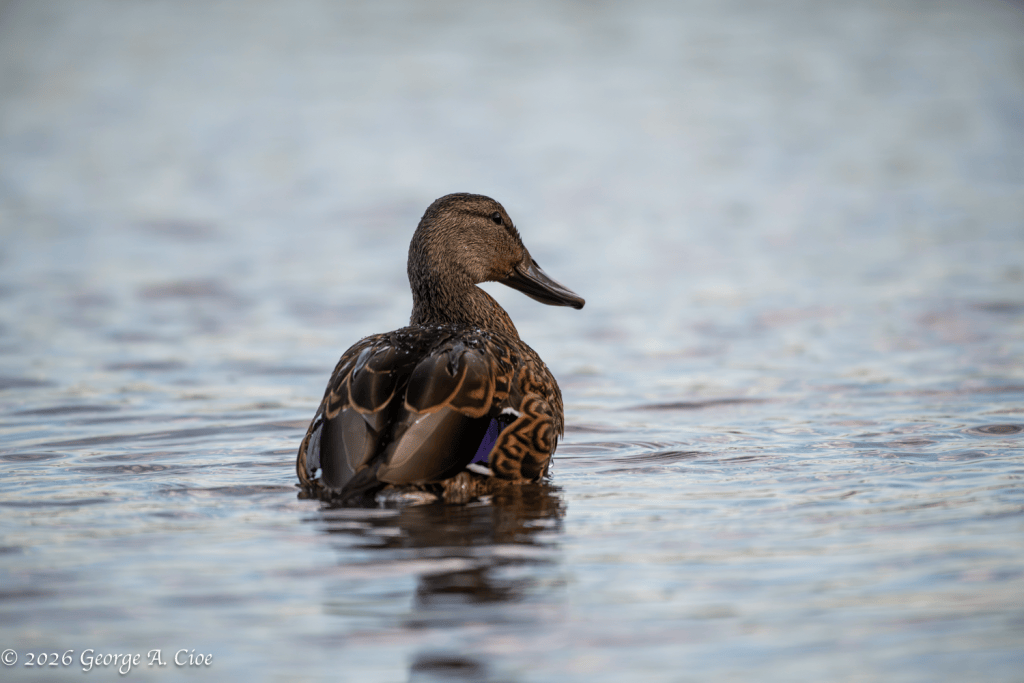
A Mallard simply glides into view like a piece of driftwood carried by the current.
Above the waterline, she is tranquility itself.
Below it, those webbed feet may be paddling, steering, braking, and making countless tiny corrections.
That’s not a bad model for life.
Remain calm on the surface.
Keep working underneath.
Move toward a destination.
Increase awareness.
Take up a cause.
Change a mind.
Protect something precious and irreplaceable.
And never let anyone see how hard you are paddling.
The older I get, the less I take these ordinary appearances for granted.
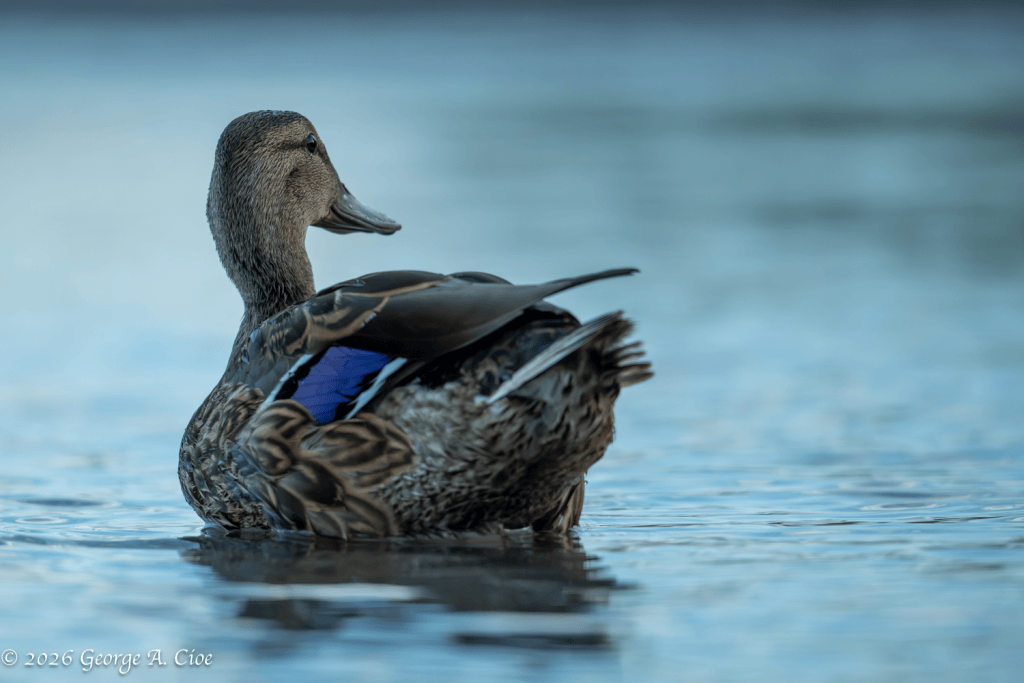
So, on a beautiful August morning, when a female Mallard glided past me and entered a small cove, I watched.
She turned.
She gave me the once-over.
Mallards possess an expression that suggests they have already reviewed your résumé, checked your references, and found several areas of concern.
Eventually, she decided I was harmless.
Or slow.
Either conclusion worked in my favor.
Then she announced—without actually announcing anything—that it was bath time.
Naturally, I stayed for the show.
A bathing Mallard does not politely sprinkle a little water beneath each wing.
No.
She plunges, rolls, shakes, dips, splashes, twists, and churns the surface as if she is simultaneously bathing, fighting an invisible alligator, and testing an experimental washing machine.
Her head went down.
Her neck followed.
Her body rolled forward as water moved across her back and between her feathers.
Then her bill emerged.
Head.
Neck.
Back.
Wings.
Repeat.
It reminded me of “the wave” traveling around a crowded stadium—except every spectator was a feather, the stadium was a cove, and the only person cheering was a seventy-year-old photographer standing nearby with an enormous lens.
By George, I had found the Mallard Wave.
She repeated the movement again and again—about twenty times—pausing periodically to work her bill through her plumage.
That preening is far more important than it appears.
A Mallard’s feathers are an exquisitely engineered system. The bird uses its bill to clean them, realign their microscopic barbs and barbules, and distribute oil from the uropygial—or preen—gland near the base of its tail. The oil helps condition the feathers, but waterproofing also depends upon their tightly interlocking structure and the insulating layer of air trapped within the plumage.
In other words, this wasn’t vanity.
It was scheduled maintenance.
She was cleaning, repairing, realigning, lubricating, and inspecting her most important equipment.
Mallard service department.
One owner.
Low mileage.
Some birds stand on an elevated perch with their wings spread, allowing the sun and wind to help dry them. Mallards usually finish the job right on the water—or in water shallow enough for their feet to touch bottom.
Then came the grand finale.
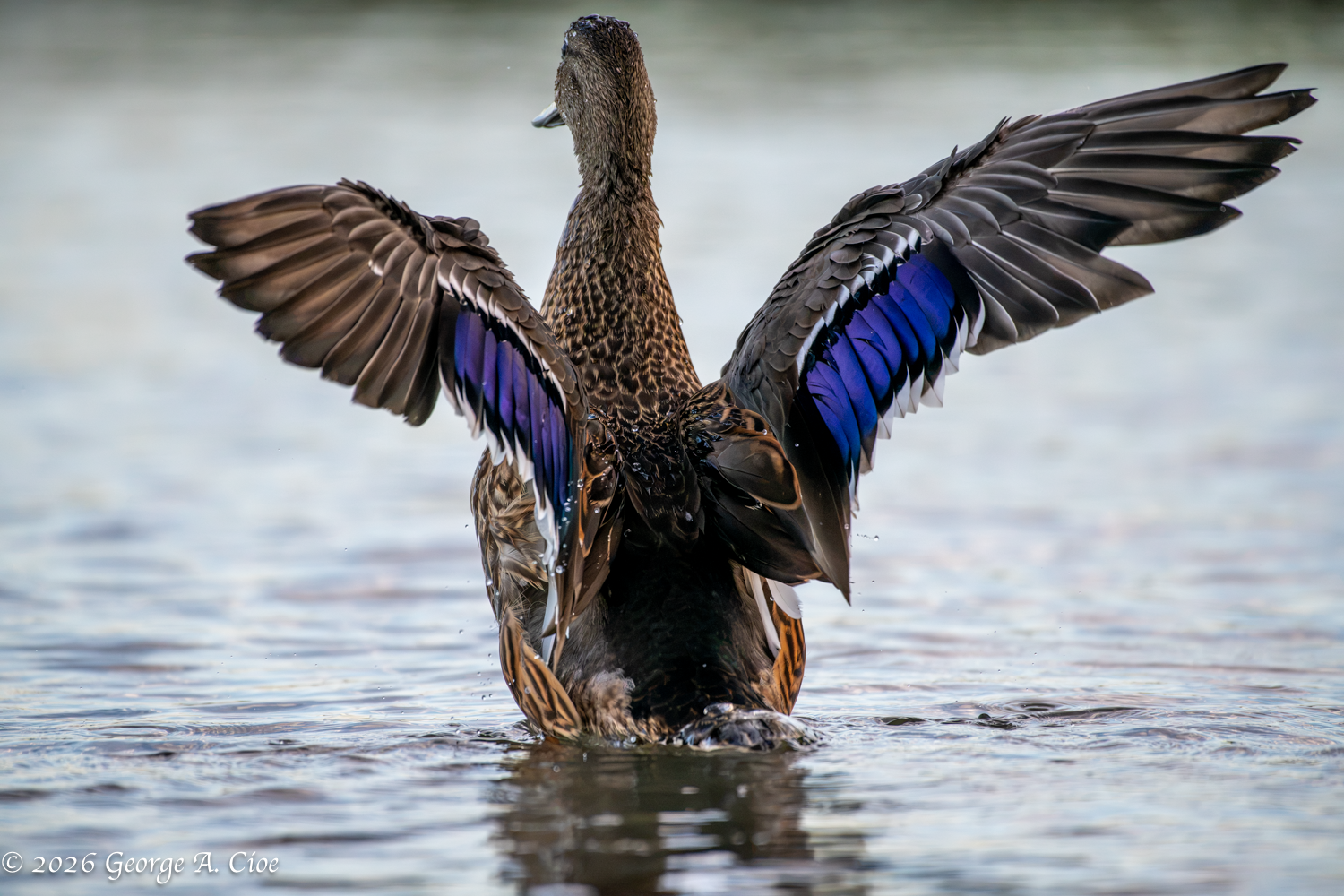
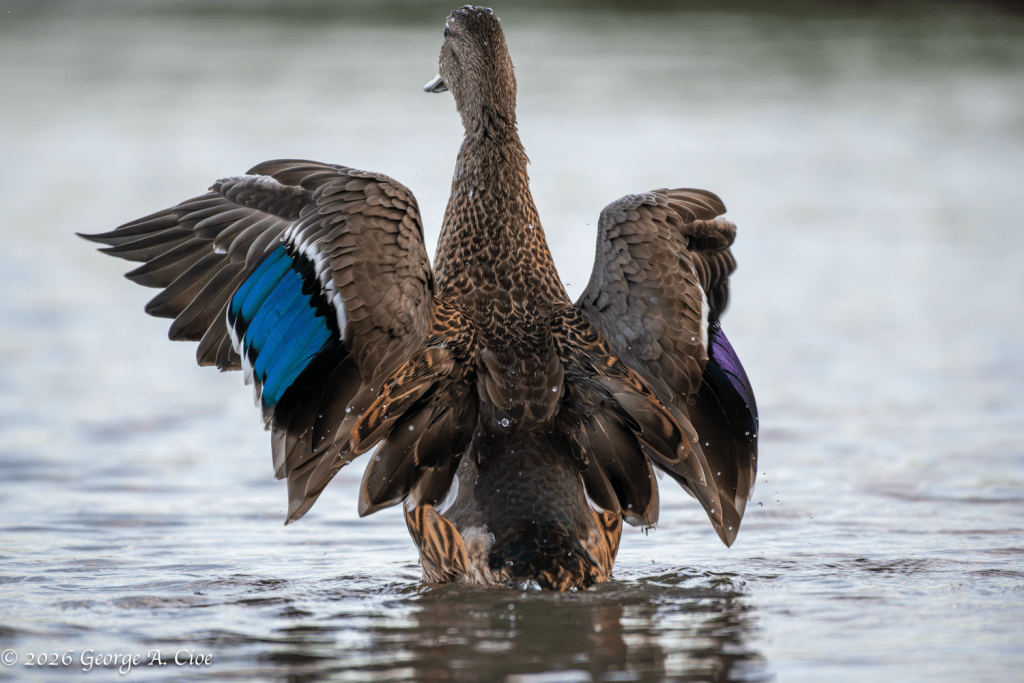
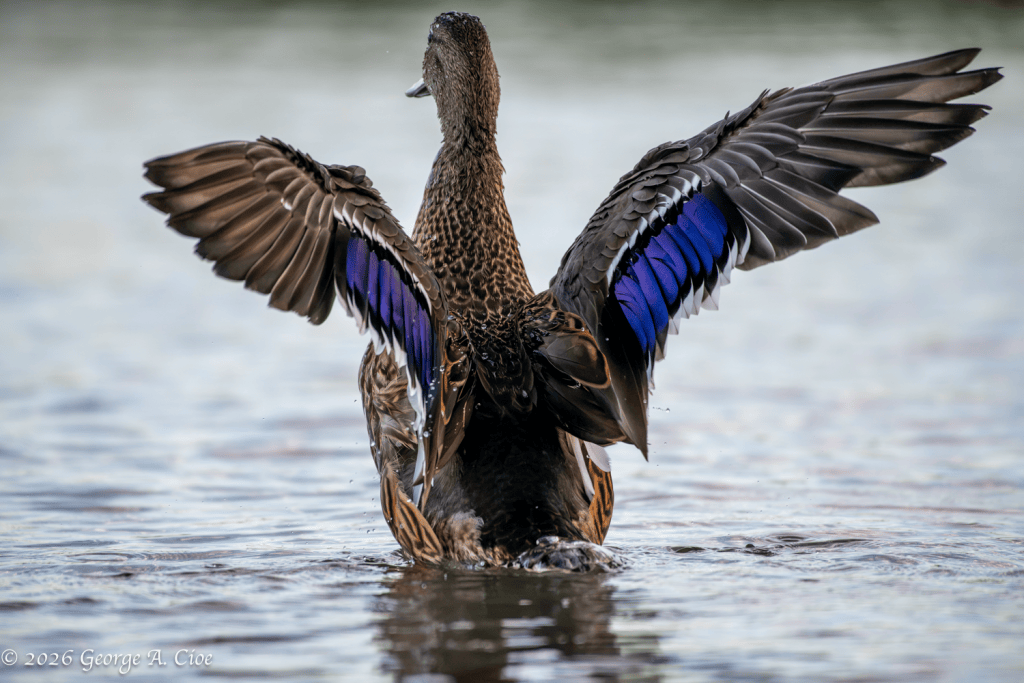
She rose upright, exposed the brilliant blue-violet speculum feathers on her wings, and flapped with tremendous force. Water flew in every direction as her wings opened, folded, opened again, and rearranged themselves.
It was part drying cycle.
Part feather reset.
Part preflight inspection.
And part Broadway finale.
Then she settled back onto the water, performed a few last-minute adjustments with her bill, and returned to looking perfectly composed.
Two seconds later, she was gone.
Pit stop complete.
Feathers serviced.
Flight systems checked.
Mission accomplished.
See you later.
Some other time.
Naturally.
Just ducky.
I’d love to share my posts with you. If you subscribe, they’ll come straight to your inbox—most days, like a little note from me to you. It means a lot to know you’re reading along.
Browse my complete art portfolio and shop for prints at imagesbygacioe.shop



Leave a Reply