
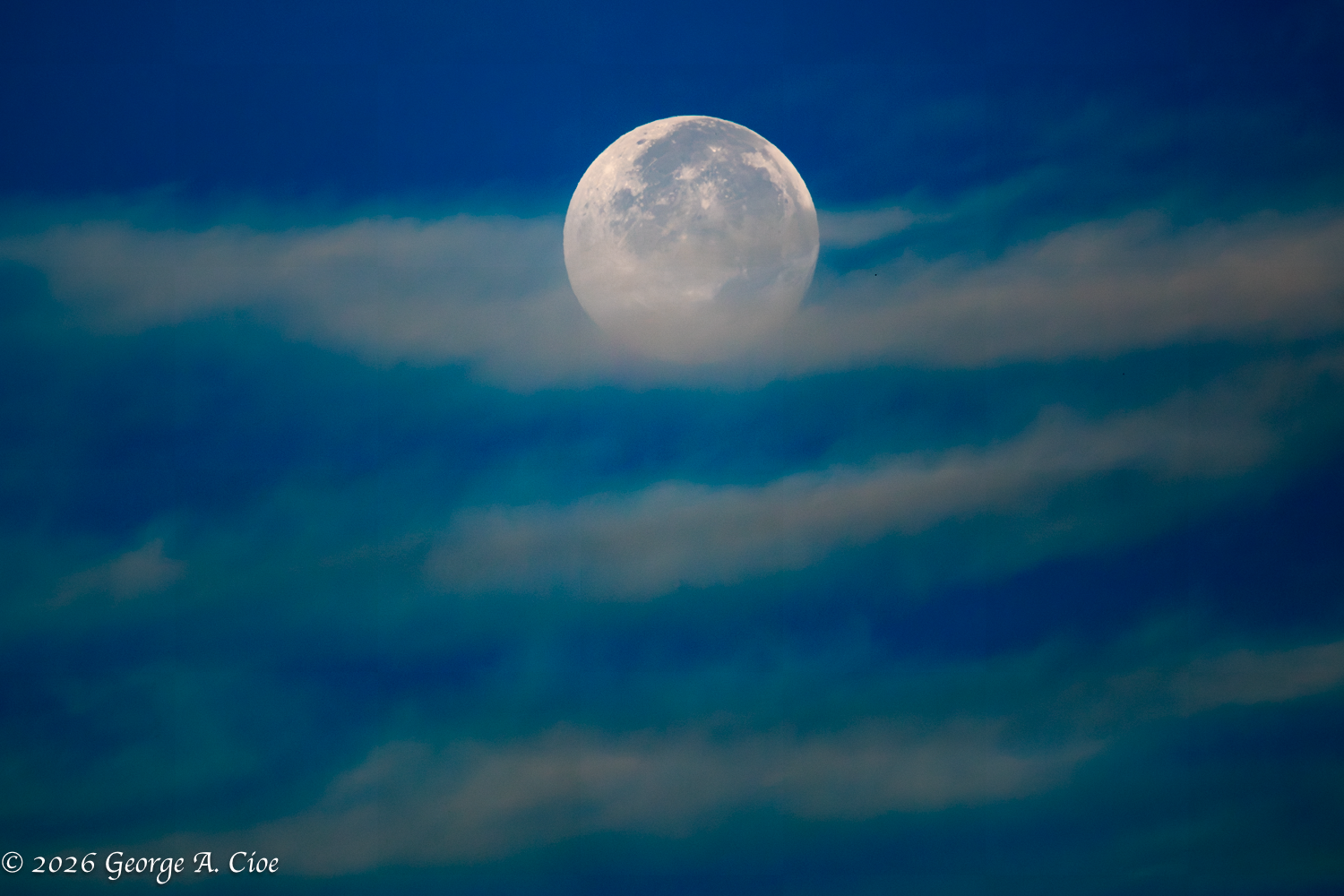
Standing there, I felt wonderfully small.
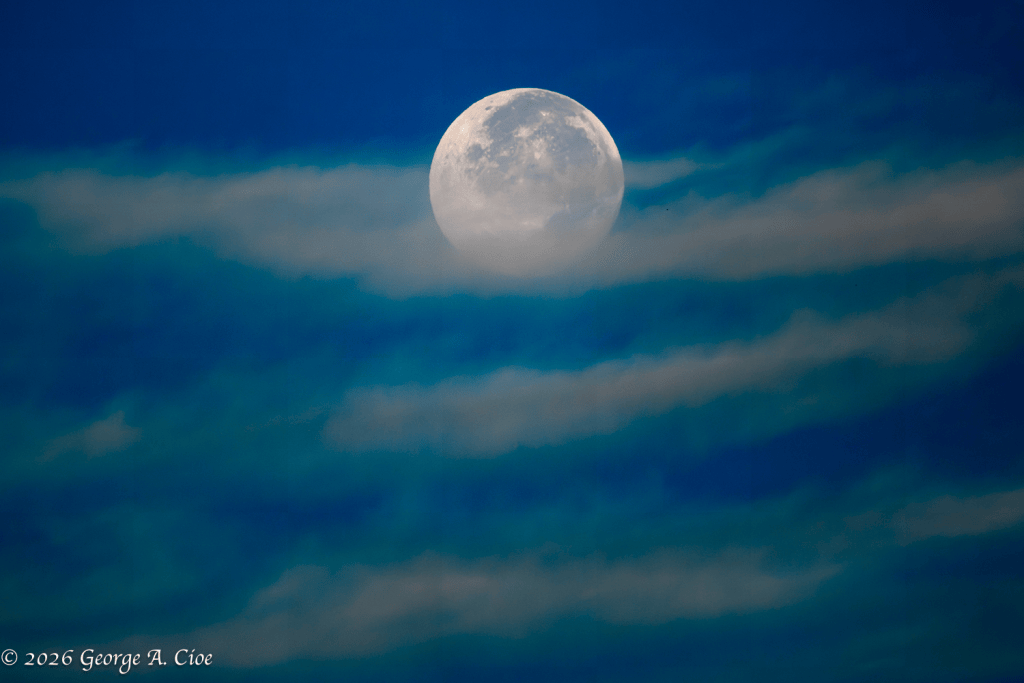
Above me, the last darkness of night was surrendering to morning. Clouds whispered their way across the emerging blue, and there—seemingly suspended between night and day—hung the moon.
Familiar.
Ancient.
And absolutely extraordinary.
I raised my camera, but for a moment I forgot about photography.
I simply stared.
Human beings have stared at that same moon for as long as there have been human beings capable of looking up.
Once, it was unreachable.
Then mysterious.
Then measurable.
And eventually, astonishingly, walkable.
We went from looking at the moon and wondering what it was to leaving footprints upon it.
Think about that.
Not because we stopped believing.
Because we started questioning.
Because somebody measured.
Somebody experimented.
Somebody looked at the evidence and was willing to say:
Maybe what we have always believed isn’t true.
That willingness may be one of humanity’s greatest gifts.
For much of history, people believed Earth occupied the center of the universe and the heavens revolved around us. Careful observation eventually revealed something far more humbling—and far more magnificent.
We discovered that Earth circles the Sun.
And then discovered that our Sun is merely one star among hundreds of billions in our galaxy.
And our galaxy?
One among an almost incomprehensible number of galaxies.
We didn’t become less important by discovering that.
We became more aware of just how extraordinary our existence really is.
People once believed illness could be caused by “bad air” or mysterious imbalances in the body. Then microscopes, experiments, and painstaking scientific work revealed bacteria, viruses, cells and the mechanisms of disease. Germ theory transformed medicine, sanitation and public health.
People once believed the continents had always occupied their present positions. When Alfred Wegener proposed that they moved, his idea was widely rejected. Decades of additional evidence eventually gave us plate tectonics—a framework that helps explain earthquakes, volcanoes, mountains and the very architecture of our planet.
We once thought species were permanently fixed and unrelated.
Then fossils, anatomy, genetics and generations of observation revealed something breathtaking:
Life has a history.
We are part of it.
Evolution isn’t an insult to human existence.
I think it makes existence even more miraculous.
And that brings me back to the moon.
Because standing beneath it this morning, I couldn’t help thinking about our own time.
We have more information available to us than any civilization in human history.
And somehow, finding the truth can still be difficult.
Maybe even more difficult.
Opinion can masquerade as fact.
Repetition can masquerade as evidence.
Popularity can masquerade as expertise.
And something appearing on a screen a thousand times doesn’t make it true.
That is why curiosity alone isn’t enough anymore.
We need disciplined curiosity.
Ask questions.
Challenge assumptions.
Look for evidence.
Consider the source.
Seek independent confirmation.
Be willing to discover that the thing you desperately wanted to be true simply isn’t.
And perhaps hardest of all, be willing to change your mind when the evidence changes.
There is no shame in that.
Quite the opposite.
Changing a belief because better evidence has emerged isn’t weakness.
It is intellectual courage.
Science itself isn’t a collection of commandments carved into stone. It is a method for getting closer to reality—observation, measurement, experimentation, replication, criticism and correction.
Sometimes painfully.
Sometimes slowly.
But forward.
That is how we went from fearing eclipses to predicting them.
From blaming mysterious forces for disease to developing vaccines and antibiotics.
From imagining the moon as an unreachable light in the heavens to placing human beings upon its surface.
Every one of those advances required somebody, somewhere, to question what everybody “knew.”
And that’s what this photograph became for me.
Not simply a photograph of the moon.
A reminder.
Look up.
Ask why.
Demand evidence.
Remain curious.
And never become so attached to a belief that you become afraid of discovering the truth.
Because the truth doesn’t need us to believe in it.
It waits.
Patiently.
Like that moon.
And every once in a while, when the clouds move aside and we are willing to really look, we see a little more clearly than we did before.
How far we have come.
How much we have learned.
And, wonderfully…
how much there is still left to discover.
I’d love to share my posts with you. If you subscribe, they’ll come straight to your inbox—most days, like a little note from me to you. It means a lot to know you’re reading along.
Browse my complete art portfolio and shop for prints at imagesbygacioe.shop




Leave a Reply