


Sometimes the smallest members of a community tell us the most about the strength of the whole.
From a distance, a salt marsh can look remarkably simple.
Grass.
Acres and acres of it.
A great green expanse bending with the wind, flooding with the tide, drying beneath the sun and seemingly repeating itself from one end of the Narrow River to the other.
But that is what happens when we look at a community from too far away.
We see what is most abundant.
And we miss almost everything else.
This morning I decided to look closer.
Really closer.
Down between the blades of cordgrass, where the marsh becomes less a landscape and more a neighborhood.
And there it was.
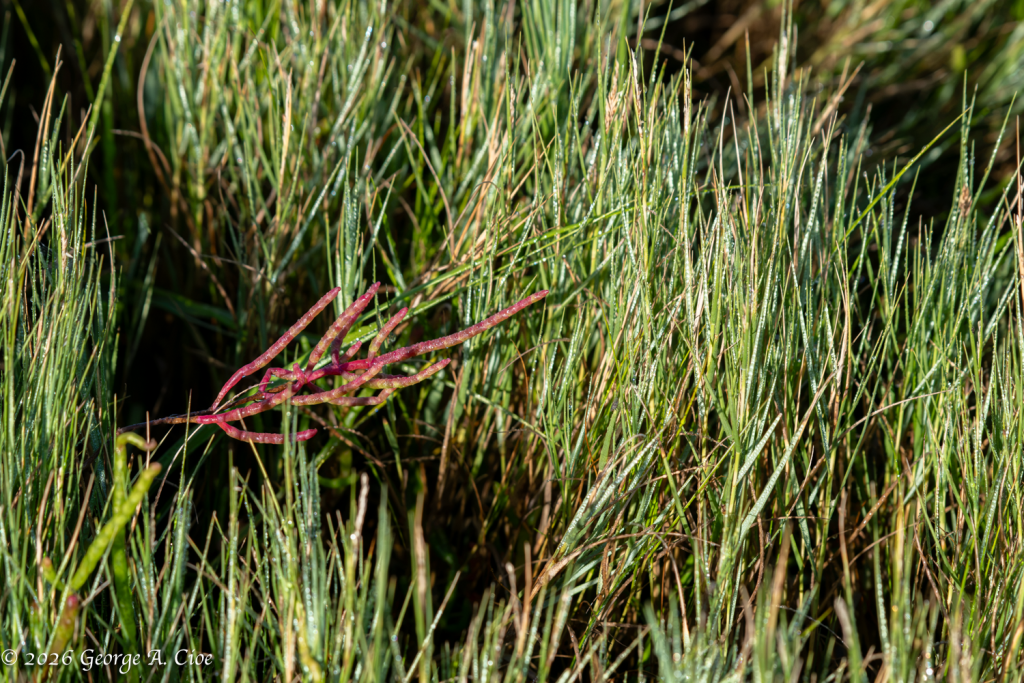
A splash of crimson.
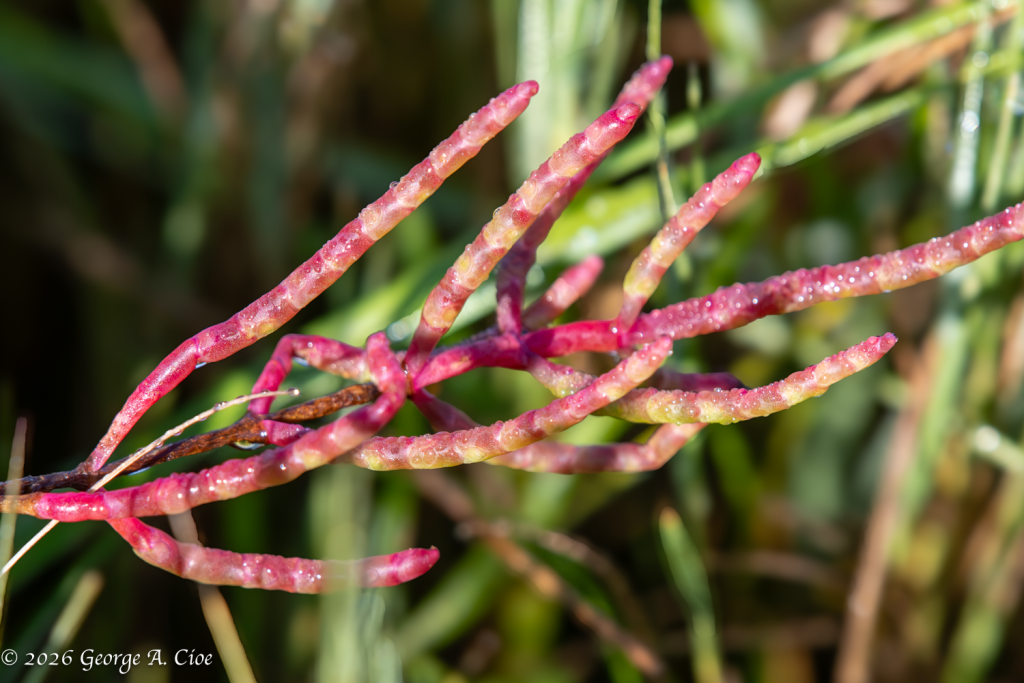
Glasswort.
Its scientific name is Salicornia depressa, although it is also known as pickleweed or saltwort. It is one of the characteristic forbs of southern New England salt marshes, living among a much larger community of cordgrasses, spikegrass, rushes and other salt-tolerant plants.
It looks almost alien.
No broad leaves.
No showy flowers.
Just fleshy, jointed stems that look as though someone assembled the plant from tiny pieces of coral.
Yet that strange architecture has a purpose.
Glasswort is a halophyte—a plant adapted to living where salt would make survival difficult for most vegetation. Its succulent tissues help it cope with the physiological stresses of a saline environment.
And now, as summer begins surrendering to autumn, some of those green stems are becoming extraordinary shades of pink, red and burgundy.
Against all that green, they are impossible to ignore.
At least once you know to look for them.
Then, only a few feet away, I found something completely different.
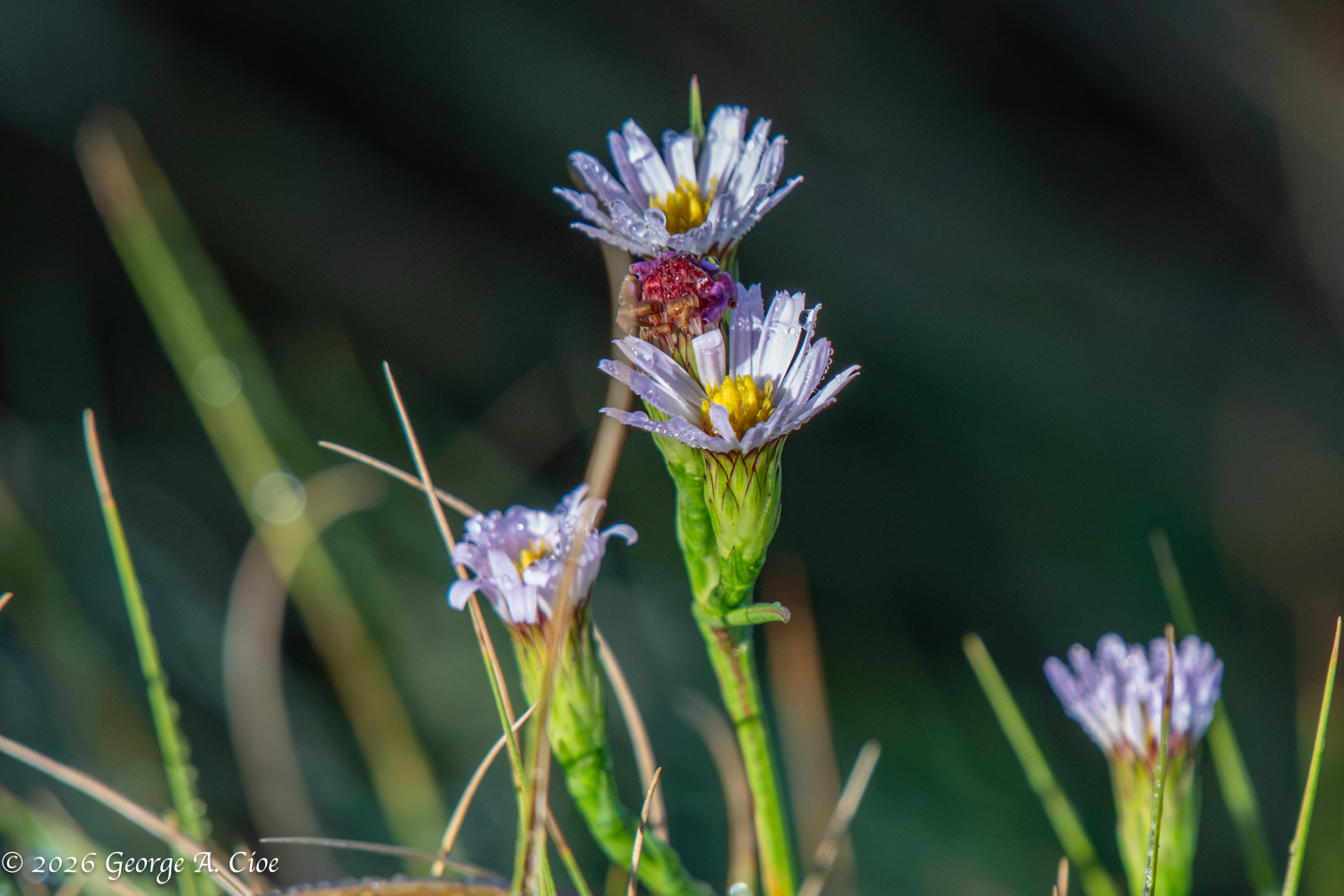
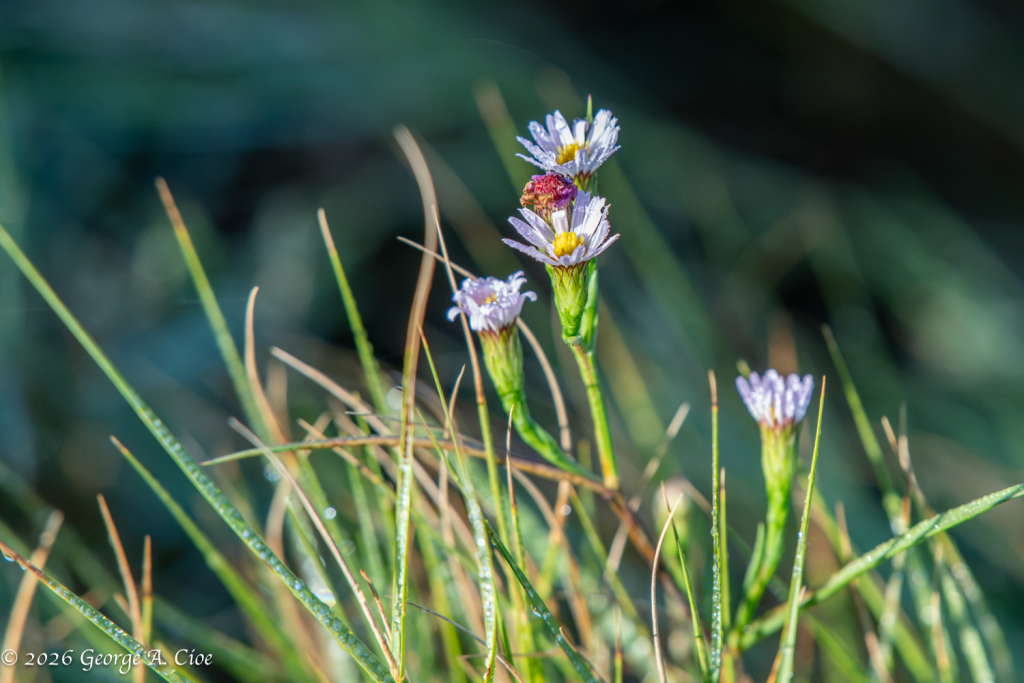
Tiny lavender flowers rising above the grass.
Annual saltmarsh aster, Symphyotrichum subulatum.
Where glasswort appears rugged and almost prehistoric, the aster seems impossibly delicate. Pale lavender rays surround little yellow centers, flowers scarcely large enough to attract our attention.
But they attract someone else’s.
Asters are visited by bees, flies, wasps, butterflies, moths and beetles, and annual saltmarsh aster has been identified as an important nectar plant for native bees.
Think about that.
In this immense sea of grass, a few little flowers may become feeding stations.
A place for an insect to land.
A source of nectar.
A place where pollen is transferred and another generation begins.
The glasswort plays its own part. Salicornia produces seeds that enter the marsh food web; studies of salt marshes have documented dabbling ducks exploiting Salicornia seeds, particularly as flooding releases them from the plants.
And surrounding all of them is the great green architecture of the marsh itself.
Smooth cordgrass, Spartina alterniflora, is one of the foundation plants of the North Atlantic salt marsh. Its stems slow water and trap sediment. Below ground, its dense network of roots and rhizomes helps bind marsh soils together. Salt marshes provide nursery and refuge habitat for fish and crabs, buffer shorelines, trap sediments and nutrients, and store carbon. Rhode Island monitoring programs specifically identify marsh habitat as important to fish including striped bass.
Suddenly that “field of grass” isn’t a field of grass at all.
It is an extraordinarily complicated living system.
And perhaps there is something here worth considering about us.
We tend to notice what is most abundant.
The loudest voices.
The largest groups.
The people who occupy the most space.
We divide ourselves into categories because categories make a complicated world easier to understand.
But nature doesn’t seem particularly interested in simplicity.
The marsh isn’t strong because every plant is cordgrass.
It is strong because it is a community.
Some members hold the soil.
Some trap sediment.
Some tolerate conditions others cannot.
Some provide nectar.
Some produce seeds that become food.
Some occupy tiny openings where the dominant plants cannot.
And some may contribute things we haven’t even discovered yet.
Remove enough of those seemingly insignificant pieces and eventually the community is no longer the community it once was.
There is another lesson here, too.
Difference isn’t disorder.
Difference can be resilience.
Ecologists worry about declining biological and genetic diversity precisely because diversity gives living systems more ways to respond to change. Even within smooth cordgrass itself, researchers have warned that reduced genetic diversity may diminish the marsh’s ability to adapt to stresses such as rising seas.
Maybe societies aren’t so different.
Our strength doesn’t come from everyone looking alike, thinking alike, contributing alike or occupying the same place.
A healthy community needs its cordgrass.
But it needs its glasswort, too.
It needs the little aster almost hidden among the blades.
It needs builders and protectors, teachers and artists, scientists and fishermen, young people and old people, newcomers and people whose roots reach back generations.
Some stand prominently above the landscape.
Others quietly fill spaces most of us never notice.
But each can contribute something.
And perhaps our greatest mistake—whether we’re looking at a salt marsh or at one another—is assuming that less abundant means less important.
I went to the Narrow River looking for wildlife.
As usual, the river changed the assignment.
It asked me to look down.
To get closer.
To notice what I had walked past before.
There, beneath a canopy of cordgrass wet with morning dew, I discovered an entire little world.
Crimson glasswort.
Lavender asters.
Tiny flowers waiting for pollinators.
Plants engineered by evolution to endure salt, tides, flooding, heat and storms.
All occupying the same few feet of earth.
All different.
All belonging.
And together, creating something none could create alone.
A marsh.
Perhaps that is one of nature’s quieter definitions of community:
Not sameness.
Belonging.
I’d love to share my posts with you. If you subscribe, they’ll come straight to your inbox—most days, like a little note from me to you. It means a lot to know you’re reading along.
Browse my complete art portfolio and shop for prints at imagesbygacioe.shop



Leave a Reply