

I don’t know.
Call me old-fashioned.
Call me a traditionalist.
Call me someone who believes an artist should possess at least one skill beyond access to a hardware store and a working knowledge of adhesive.
But I have always believed art should reflect talent, imagination, dedication and the ability to express something that stirs an emotional response.
Maybe it fills us with wonder.
Maybe amazement.
Maybe joy.
Maybe tears.
Maybe it simply makes us stop, stare and whisper:
“How on earth did they do that?”
At the very least, it should make us pause.
That’s art.
At least in my book.
A few years ago, Trish and I visited the Guggenheim Museum in New York to see a renowned exhibition of what was described as “Conceptual and Minimalist Art.”
Not my cup of tea.
Actually, there were things in the restroom that I found more compelling.
And at least those had an identifiable purpose.
As we walked through the exhibition, I became increasingly convinced that the entire thing was an elaborate psychological experiment.
“This can’t be real,” I whispered to Trish.
“I bet there are hidden cameras recording our expressions, and the videos are being displayed in the next room.”
I paused, delighted by my own brilliance.
“Maybe we’re the real exhibit!”
That’s when I got the look.
You know the look.
Everyone who has been married longer than fifteen minutes knows the look.
It is the look that says:
Be quiet.
Stop talking.
And, for the love of God, do not touch the art.
Among the masterpieces I remember was a miniature Roman column with an egg balanced on top.
Presumably hard-boiled.
Otherwise, the exhibit would eventually have become performance art.
Then there was a four-by-eight sheet of plywood with a section of chain-link fence nailed to it.
I believe the piece was intended to explore the barriers human beings construct between themselves and society.
I interpreted it as something left over after somebody repaired a dog kennel.
But the pièce de résistance was an otherwise empty display area featuring a freshly painted white wall with a banana stuck to it.
That was it.
A banana.
On a wall.
I stared at it for several minutes, waiting for something profound to happen.
Nothing did.
Although I developed a craving for a fruit salad.
To this day, I regret not bringing a granola bar and taping it beside the banana.
I could have called it:
Continental Breakfast.
It might be worth six million dollars by now.
After two hours of columns, eggs, plywood, fencing and produce, I left thinking:
“Well, there are two hours I’ll never get back.”
Fast-forward several years to the Narrow River.
There was plenty happening that morning. Birds were calling. The outgoing tide was quietly carrying bits and pieces of the marsh toward the sea. The river’s surface reflected the cool blue-gray light of dawn.
Then I noticed it.
A single white gull feather drifting with the current.
It was delicate.
Graceful.
Almost weightless.
And suddenly, I was feeling…
Minimalist.
I raised my camera.
No Osprey diving.
No Great Blue Heron swallowing something sideways.
No gull stealing breakfast from another gull and then flying away while screaming legal objections.
Just one feather.
Floating.
Existing.
Being feathery.
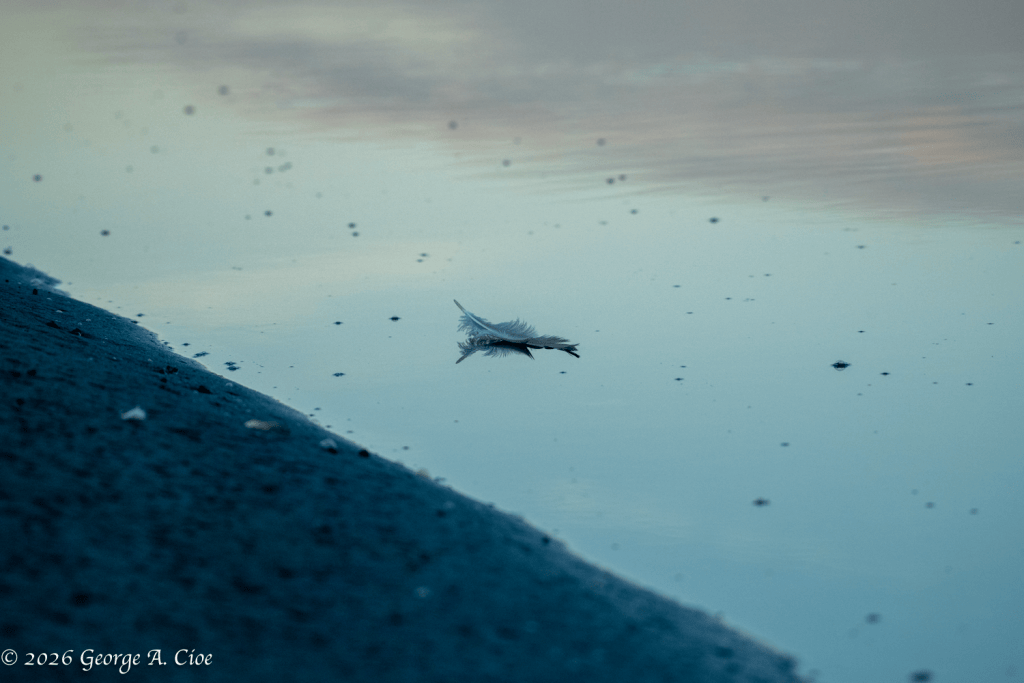
I took the first photograph with the dark riverbank cutting diagonally through the frame. The tiny feather drifted between shadow and open water, surrounded by enough empty space to make a Guggenheim curator hyperventilate.
Then I moved closer.
Much closer.
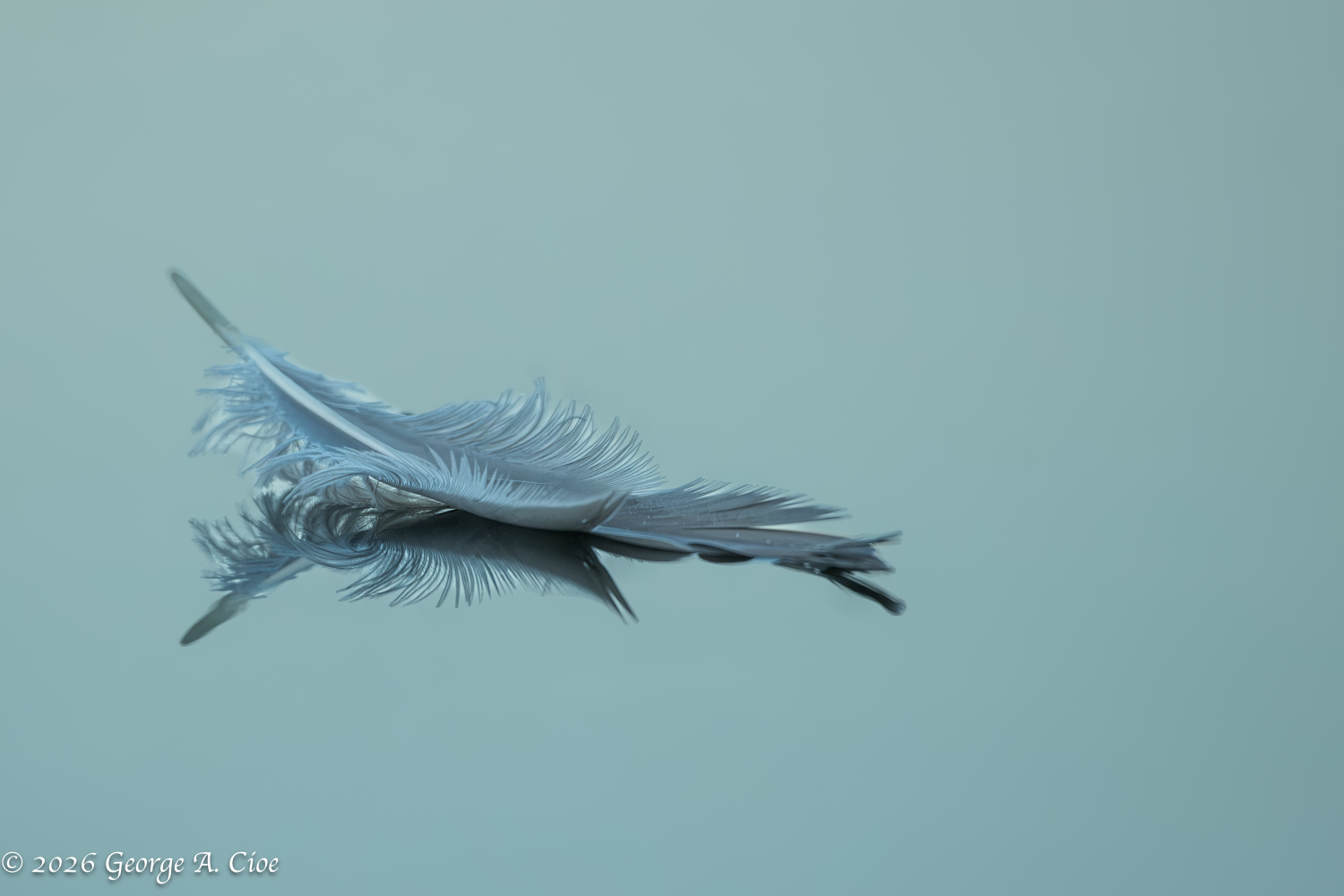
There it was in all its glorious detail—barbs curling, edges fraying and droplets clinging to its surface. Its reflection turned one feather into something resembling a tiny bird, a delicate sculpture or perhaps a ballerina who had fallen asleep on a mirror.
It was beautiful.
And unlike the banana, it had not required duct tape.
Later, in Lightroom®, I removed a few distracting elements and simplified the scene, preserving all the essential qualities of minimalist art:
One subject.
Plenty of empty space.
A mysterious title.
And absolutely no practical explanation.
Some people might say I used Photoshop®.
I didn’t.
I use Lightroom®, which is essentially Photoshop’s well-behaved younger cousin—the one who comes to Thanksgiving, helps clear the table and doesn’t replace Uncle Charlie’s head with a watermelon.
When I finished, I sat back and admired my creation.
Perhaps I had finally come to understand conceptual art.
Perhaps the feather symbolized freedom.
Impermanence.
The fragile passage of life.
The weightlessness of existence.
Or perhaps a gull had simply molted.
Either way, I now have two photographs and the beginnings of an exhibition.
All I need is a large white room, a security guard and a small plaque warning visitors not to touch anything.
So, tell me:
Which would you prefer hanging on your wall?
A banana?
Or a gull’s feather?
Choose carefully.
The feather won’t attract fruit flies.
I’d love to share my posts with you. If you subscribe, they’ll come straight to your inbox—most days, like a little note from me to you. It means a lot to know you’re reading along.
Browse my complete art portfolio and shop for prints at imagesbygacioe.shop


Leave a Reply