
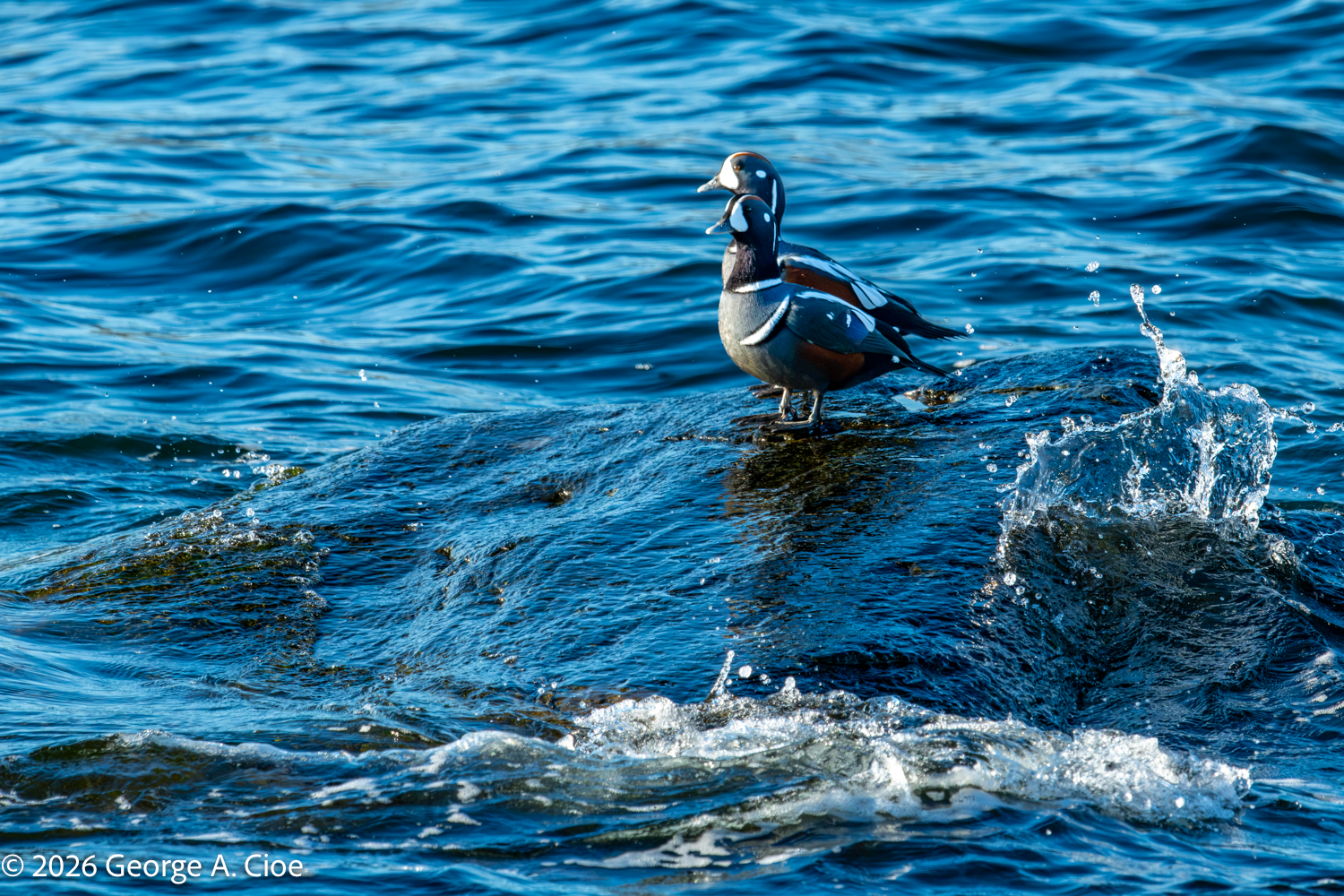
Two handsome bachelors. One very rocky coastline. And a winter vacation destination that would send most sensible birds straight to a travel agent.
There they were.
Two of the most extravagantly dressed gentlemen in the entire avian kingdom.
Standing on a wave-washed rock at Sakonnet Point, Rhode Island.
Looking absolutely magnificent.
And completely overdressed for the occasion.
Meet the Harlequin Duck.
A bird so beautifully adorned that it looks as though Mother Nature handed a paintbrush to Picasso and said, “Have at it!”
Deep slate blue.
Rich chestnut.
Brilliant white markings arranged with such extraordinary precision that they resemble the decorative flourishes on an expensive Italian sports car.
And the remarkable thing?
These are their everyday clothes.
No special occasion required.
But before we discuss their fashion sense, there’s a question worth asking.
What on earth are these two doing here in November?
And perhaps more importantly, where are their girlfriends?
Welcome to Rhode Island. Leave Your Luggage on the Rocks.
Every autumn, something wonderful happens along the rocky coastline of southeastern New England.
Harlequin Ducks begin arriving.
Not because they’ve heard about our spectacular seafood restaurants.
Although, come to think of it, seafood is precisely why they’re here.
These extraordinary birds spend their breeding season primarily along cold, fast-flowing rivers and streams in northern regions, including eastern Canada.
Imagine a duck that looks at a roaring mountain stream, complete with slippery boulders, dangerous currents, and whitewater rapids, and thinks:
Perfect place to raise a family!
Most ducks prefer a quiet pond.
Harlequins apparently prefer something with a difficulty rating.
Their scientific name, Histrionicus histrionicus, refers to theatrical performance, a fitting description for a bird whose plumage looks like an elaborate stage costume.
And the show doesn’t end when summer does.
As northern rivers cool and winter approaches, many eastern Harlequins move south to traditional coastal wintering areas.
Including Sakonnet Point.
Why here?
Because the rocky shoreline, turbulent surf, and underwater abundance of small marine creatures provide exactly the conditions these birds love.
While other ducks might seek the protection of a quiet harbor, Harlequins gravitate toward pounding waves and exposed rocks.
They’re not looking for a peaceful winter retreat.
They’re looking for an all-inclusive adventure resort.
With complimentary seafood.
Dinner Is Served. Hold the Silverware.
Harlequin Ducks are accomplished divers.
And when I say accomplished, I mean extraordinarily capable.
They plunge beneath the surface into cold, turbulent water, searching for small crustaceans, mollusks, and other marine invertebrates.
They can maneuver around submerged rocks in conditions that would send a human swimmer scrambling for shore.
Their compact bodies, powerful feet, and remarkable underwater agility make them perfectly suited to this challenging environment.
And here’s something fascinating.
Unlike many ducks that spend much of their time feeding on aquatic vegetation, wintering Harlequins rely heavily on animal prey.
They probe and search around rocks for creatures such as amphipods, small crabs, and other invertebrates.
Essentially, they’re dining at a seafood buffet.
Except the buffet is underwater.
The tables are moving.
And every few seconds, someone dumps another wave over your head.
I suspect the restaurant would receive mixed reviews on Yelp.
So, How Long Are They Staying?
Harlequins generally begin appearing along Rhode Island’s rocky coastline during autumn, often in October and November.
They can remain throughout the winter, with many departing during March and April as they return toward their northern breeding grounds.
In other words, these two gentlemen may be spending approximately five or six months with us.
And unlike many tourists, they have absolutely no interest in our beaches during July.
Their idea of paradise is a bitterly cold January morning with waves crashing against the rocks.
Mine?
Well, I’m willing to stand there with forty pounds of camera equipment to photograph them.
But I draw the line at jumping in.
Two Gentlemen. No Ladies. What’s Going On?
Now we arrive at the question that first occurred to me when I photographed this handsome pair.
Why two males?
Where are the females?
Have these gentlemen been abandoned?
Are they enjoying a little time away from domestic responsibilities?
Or is this the duck equivalent of a boys’ weekend?
The answer is considerably more interesting.
Harlequin Ducks form seasonal pair bonds, and their winter social lives are an important part of their breeding strategy.
Unlike many birds that wait until spring to begin courting, Harlequins can establish or renew pair bonds during the autumn and winter months.
Males and females may gather in small groups, and males frequently associate with other males.
Seeing two males together doesn’t necessarily mean they’re a bonded pair, nor does it mean they are unsuccessful bachelors.
They may simply be traveling, resting, or feeding together.
And females?
They’re around, too, although their appearance is considerably more understated.
Female Harlequins wear beautifully camouflaged brown plumage with distinctive white facial markings.
Their coloring serves an important purpose during the breeding season, when females nest near rushing northern streams and must remain inconspicuous while incubating their eggs.
The males, meanwhile, look like they’ve dressed for opening night at the Metropolitan Opera.
Which raises an interesting question.
If the females are trying not to attract attention, why are the males dressed like they’re desperate for it?
Nature, apparently, has a sense of humor.
And one more fascinating detail: Harlequins can show considerable fidelity to familiar wintering areas, and established pairs may reunite in subsequent seasons.
So it’s entirely possible that some of the ducks we see at Sakonnet Point this winter have visited these very rocks before.
Perhaps even for years.
I wonder if they recognize the scenery.
Or the photographer.
The Art of Living Dangerously
There’s something especially captivating about Harlequin Ducks.
They are relatively small sea ducks, yet they thrive in an environment of tremendous physical energy.
Their world is one of crashing surf, swirling currents, submerged rocks, and relentless motion.
And they navigate it with astonishing confidence.
Look closely at my photograph.
Two magnificent males stand together on a dark, slippery rock.
The brilliant blue Atlantic surrounds them.
Water surges over the stone.
A wave erupts beside them, sending droplets into the air like shattered crystal.
And the ducks?
Completely unfazed.
They look as though they’re waiting for someone to bring them cocktails.
I, on the other hand, am standing some distance away, trying to keep my camera steady, track the action, anticipate the waves, and capture a fraction of a second that tells the story.
Wildlife photography is often like that.
Hours of preparation.
Years of experience.
Thousands of dollars in equipment.
And two ducks that couldn’t care less.
But every so often, nature arranges something extraordinary.
The light.
The colors.
The motion of the sea.
And two little birds whose beauty seems almost impossible.
All coming together in one fleeting moment.
That’s why I keep returning.
Because Sakonnet Point isn’t simply a place where Harlequin Ducks spend the winter.
It’s a place where the remarkable becomes visible to anyone willing to stop, watch, and appreciate it.
And if you happen to visit this winter, look carefully at the rocks along the shoreline.
You may see these splendid little travelers.
Two gentlemen enjoying their seasonal escape.
No reservations.
No luggage.
No worries about the weather.
And apparently, no need for a date.
Although I suspect that, come spring, the boys will have considerably more on their minds than seafood.
And so will the ladies.
Nature, after all, has a way of making sure the show goes on.
Naturally.
I’d love to share my posts with you. If you subscribe, they’ll come straight to your inbox—most days, like a little note from me to you. It means a lot to know you’re reading along.
Browse my complete art portfolio and shop for prints at imagesbygacioe.shop


Leave a Reply