
“Curiosity keeps our minds engaged. Wonder keeps our hearts young. And humility reminds us that no matter how much we know, there’s always something extraordinary waiting just beyond our understanding.”
There are two kinds of birdwatchers.
Those who know what they’re looking at.
And those who are about to learn something.
I belong to both groups.
Although, admittedly, I spend a considerable amount of time in the second.
Sometimes identifying a bird is easy.
Cardinal.
Blue Jay.
Robin.
House Sparrow.
Piece of cake.
And sometimes?
Not a clue.
Absolutely, positively, unequivocally clueless.
Which brings me to my latest adventure at Sachuest Point National Wildlife Refuge.
I was walking along one of the trails, enjoying the morning, when a small flock of birds suddenly took flight.
Four or five of them.
Maybe more.
And something caught my attention.
WHITE!
Not just a little white.
Great big, bold, unmistakable flashes of white across their wings.
Now, I’ve photographed a fair number of birds over the years.
And I’ve learned quite a bit.
Enough, apparently, to recognize when I have absolutely no idea what I’m looking at.
I know what you’re thinking.
Mockingbird!
Nope.
These white patches were considerably broader than anything I’d expect to see on a Northern Mockingbird.
And the birds were smaller.
So I watched.
And waited.
And wondered.
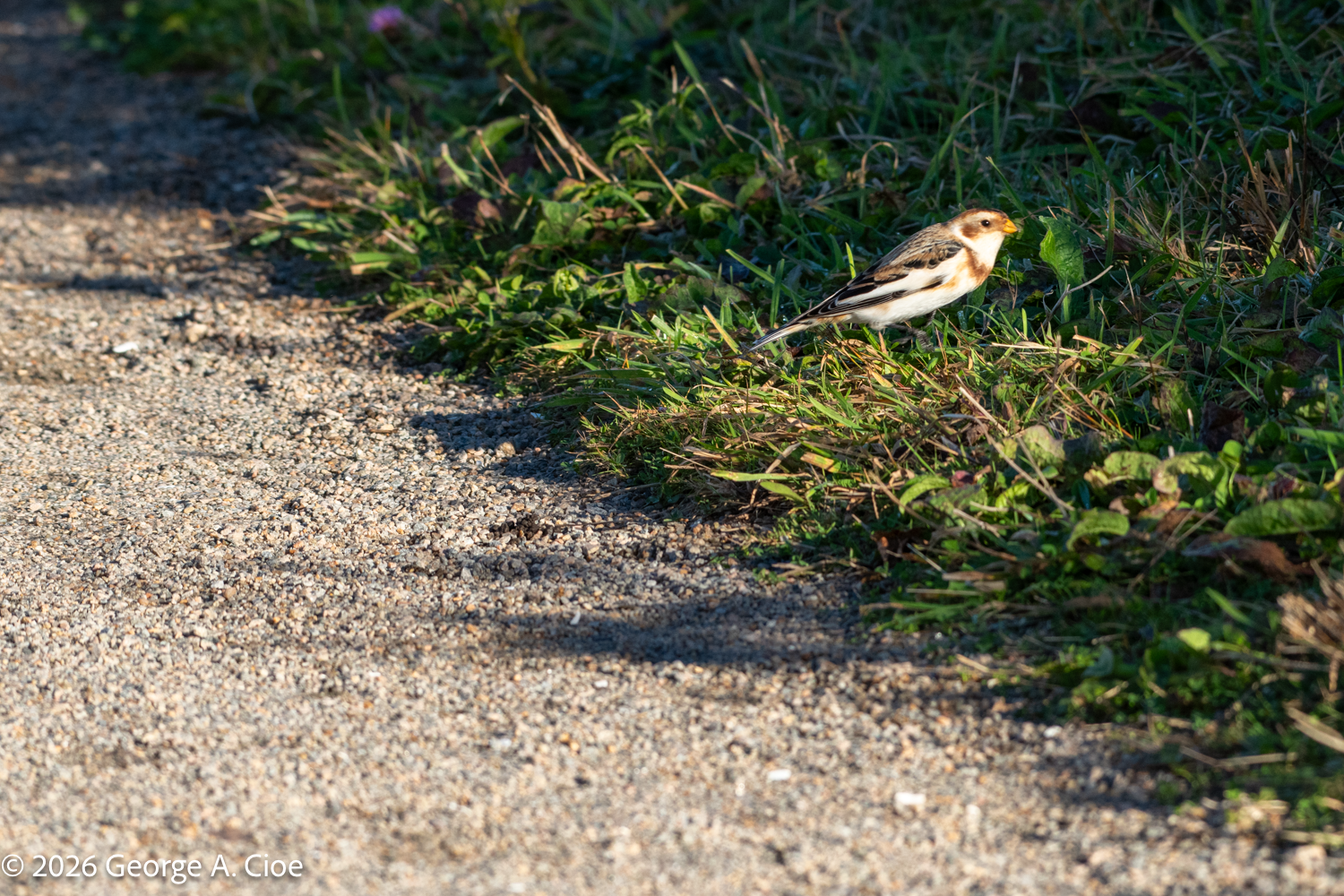
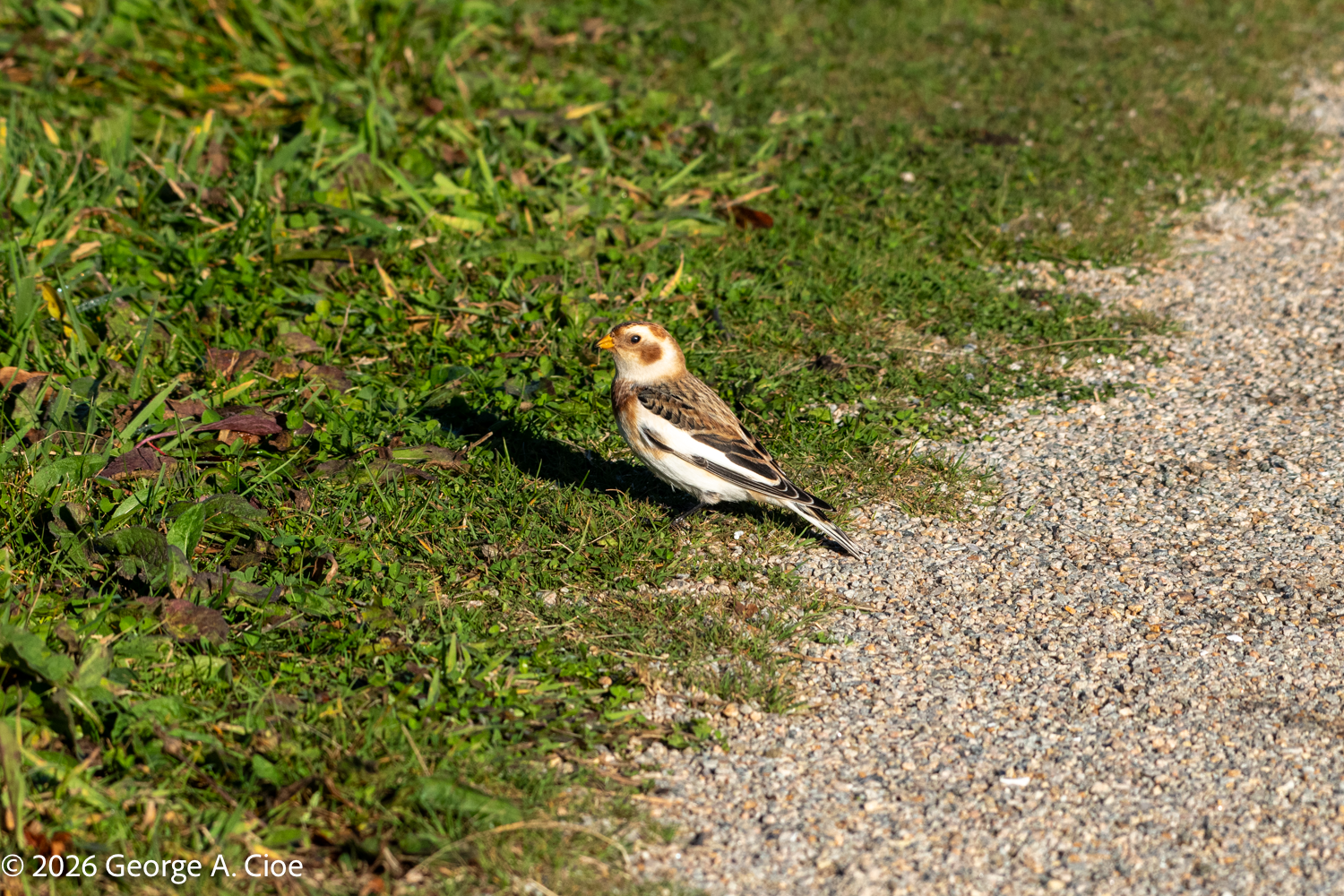
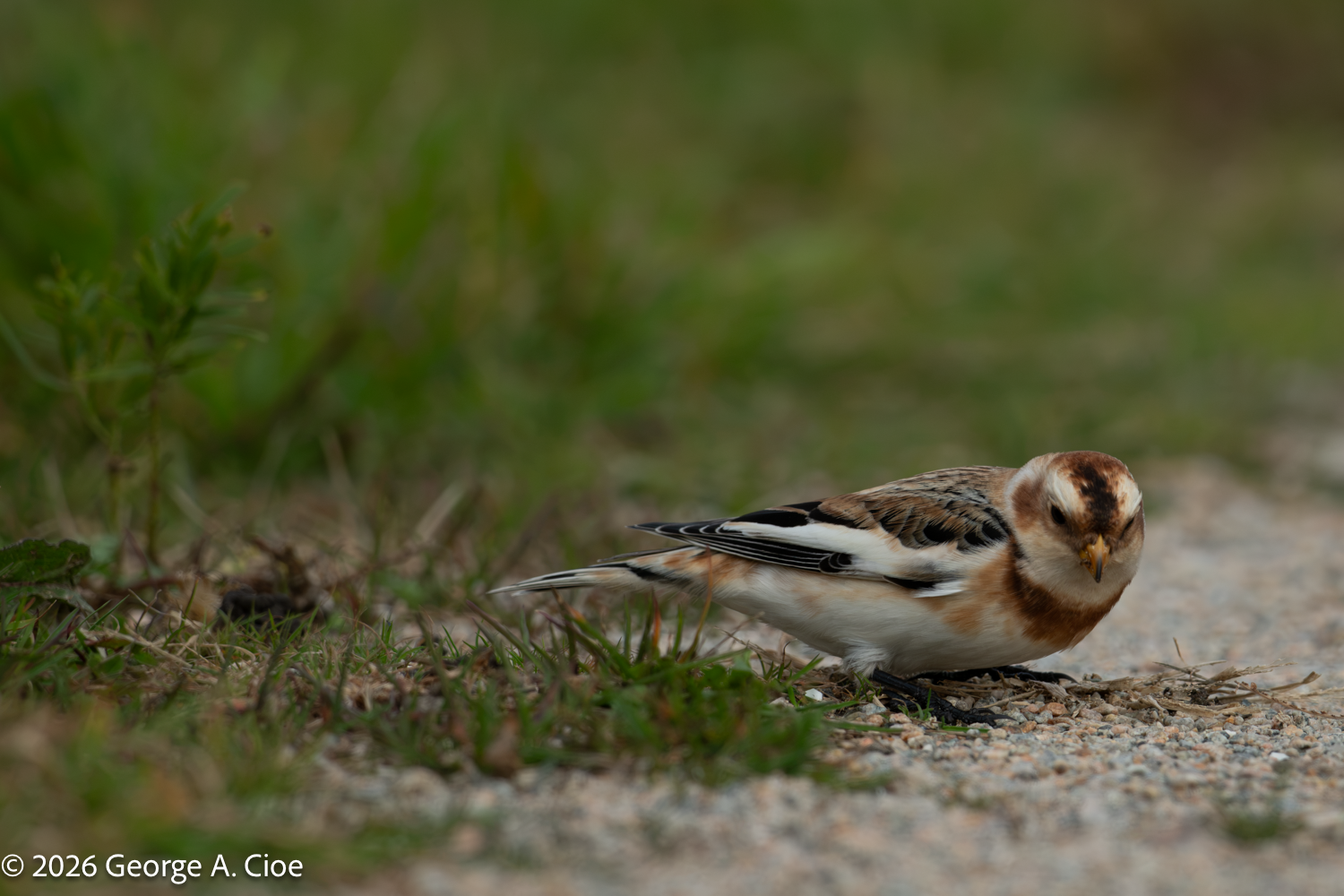
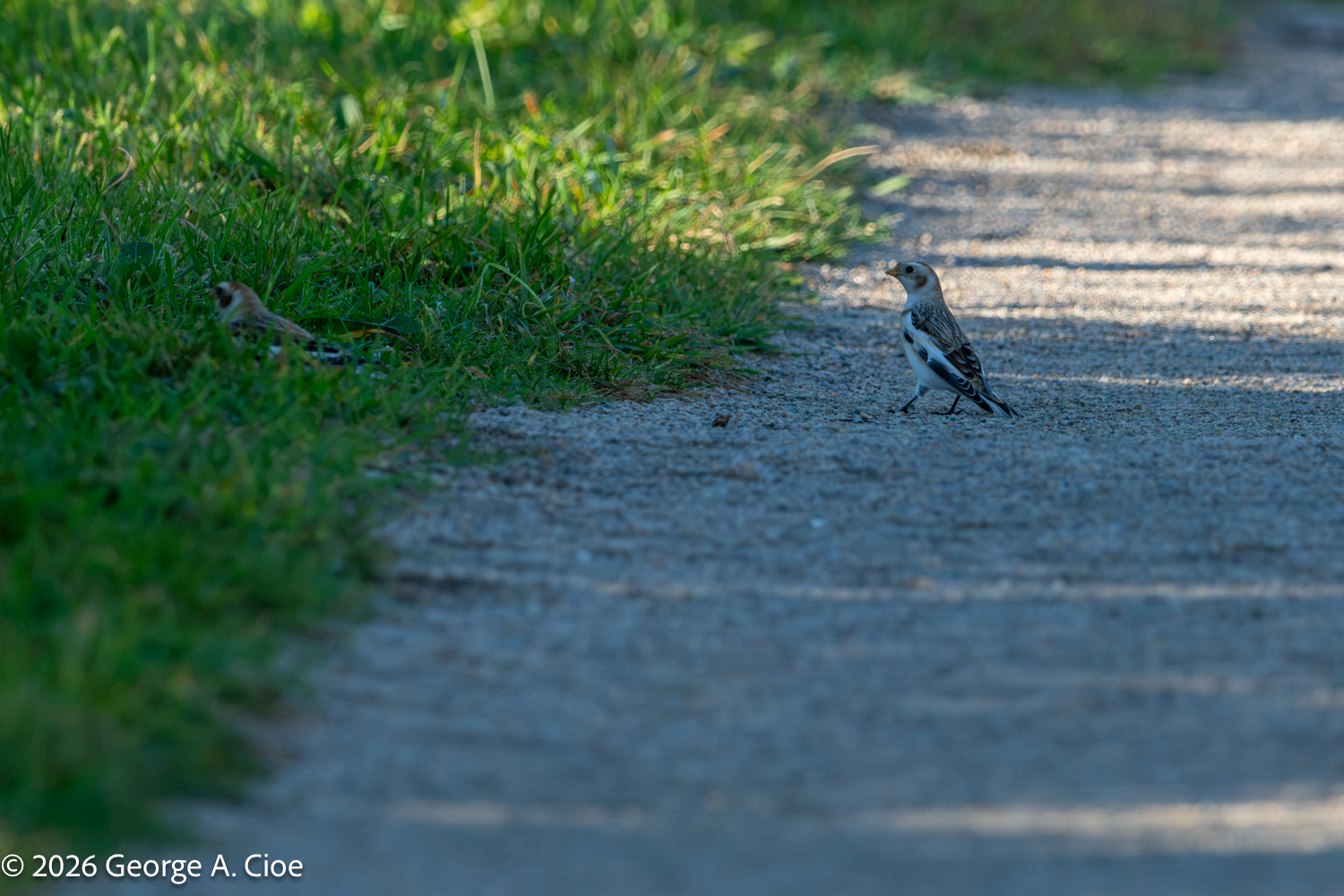
Then one of these mysterious little creatures landed right in the middle of the gravel path ahead of me.
BINGO!
Click.
Click.
Click.
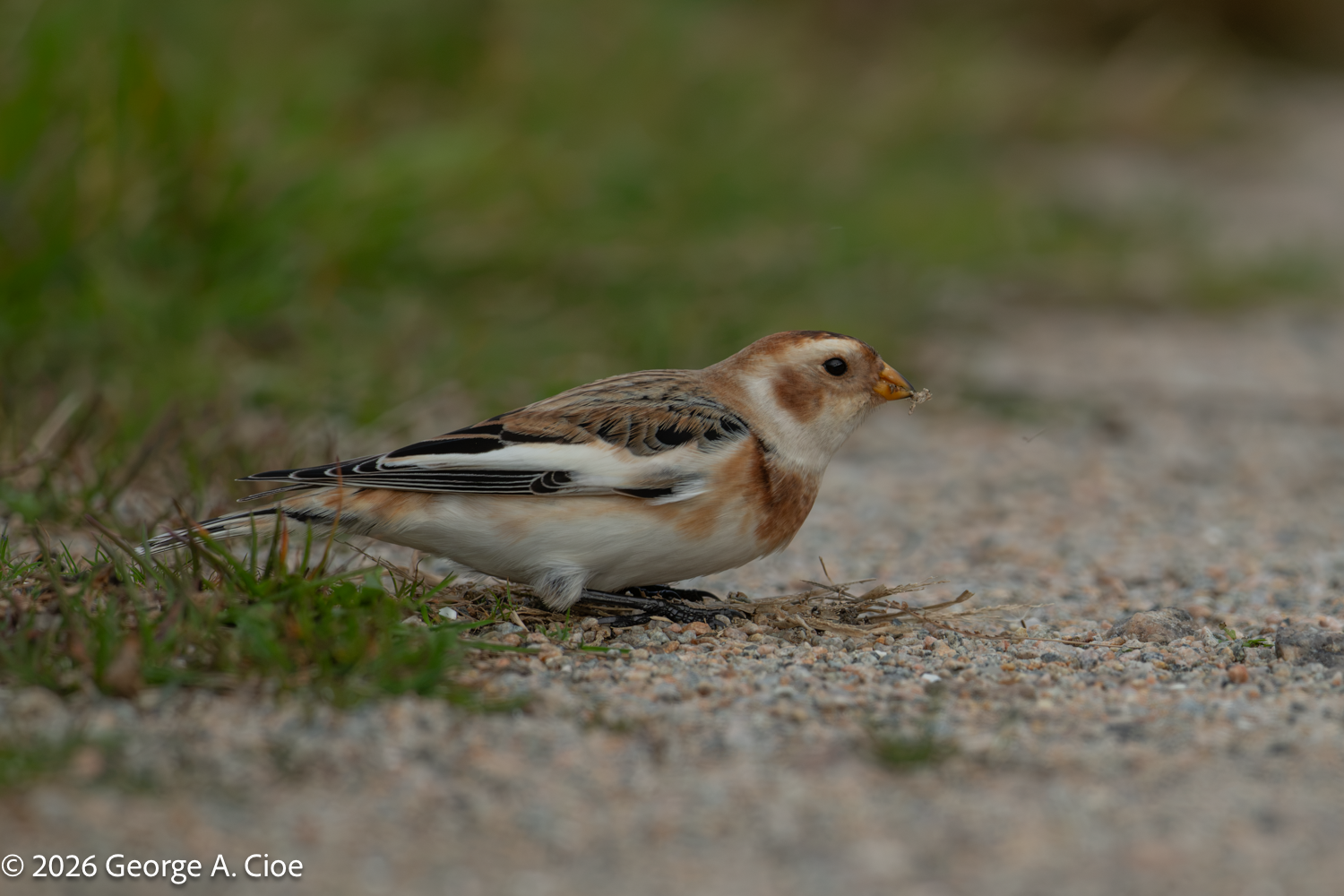
It scurried into the grass, where it appeared to be searching for seeds.
Then another appeared.
And another.
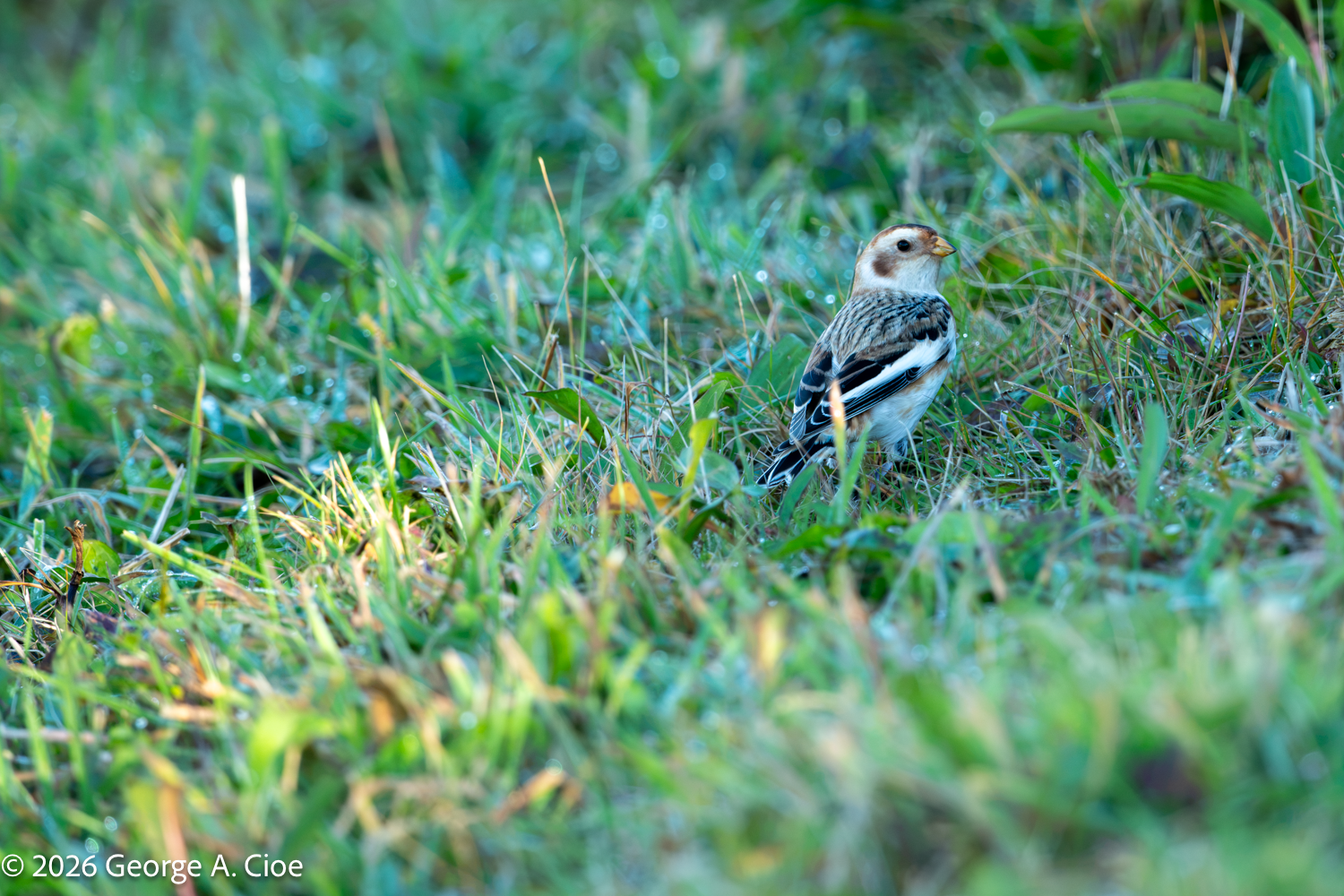
They were remarkably well camouflaged against the gravel and vegetation.
Until they flew.
Then those brilliant white wings practically announced their departure.
It was like watching someone turn on the Christmas lights.
And turn them off again.
I was fascinated.
And completely stumped.
A combination that, I’ve discovered, makes for a pretty wonderful morning.
Eventually, I learned what I’d been photographing.
Snow Buntings!
My first!
And what an extraordinary little bird to discover.
For starters, these aren’t ordinary neighborhood songbirds.
They’re visitors from the Arctic.
The REAL Arctic.
The kind of place where winter isn’t a season.
It’s practically a permanent resident.
Snow Buntings breed on the barren tundra of the far north, including Greenland and the northernmost islands of Canada.
And here’s something that made me smile.
Male Snow Buntings sometimes arrive at their Arctic breeding grounds when temperatures can plunge to minus 22 degrees Fahrenheit.
MINUS 22!
Most of us wouldn’t go outside to retrieve the newspaper.
These little fellows are shopping for real estate.
And they’re in a hurry.
You see, suitable nesting crevices among the rocks are limited, so the males arrive early to stake their claims.
The females generally follow three or four weeks later.
Which strikes me as an eminently sensible arrangement.
“Darling, you go ahead and find us a nice place. I’ll be along when the weather improves.”
Sounds like a pretty good marriage to me.
And once the family gets started, the male has another important responsibility.
Room service.
Because the female spends much of her time incubating eggs in a well-insulated nest tucked deep inside a rocky crevice, her mate delivers food frequently, sometimes about every fifteen minutes.
Every fifteen minutes!
Breakfast.
Second breakfast.
Elevenses.
Lunch.
Afternoon snack.
Dinner.
And probably something before bedtime.
Suddenly, being a Snow Bunting husband doesn’t sound quite so relaxing.
But there’s more.
These birds are beautifully adapted to life in some of the harshest environments on Earth.
During the breeding season, adult males develop striking black-and-white plumage.
But here’s the fascinating part.
They don’t necessarily need to grow an entirely new set of feathers to achieve that appearance.
The brownish tips of their winter feathers gradually wear away, revealing the brilliant white beneath.
Nature’s version of removing a winter coat.
Except they’re actually wearing it out.
And when autumn arrives, Snow Buntings travel south to spend the winter in places like Rhode Island.
They frequent open fields, beaches, dunes, lakeshores, and other places where they can search for seeds.
Their winter plumage includes warm, rusty-brown tones that help them disappear into the landscape.
Which explains why I had so much trouble spotting them once they landed.
On the ground?
Masters of disguise.
In flight?
A miniature airborne blizzard.
In fact, Snow Buntings have sometimes been called “Snowflakes” because large flocks can resemble swirling snow as they rise and settle over winter fields.
Imagine hundreds of these little birds lifting into the air together, their black-and-white wings flashing against a cold November sky.
Now THAT is something I’d love to photograph.
And there’s another reason I find them remarkable.
They’re survivors.
These little creatures endure Arctic cold, fierce winds, long migrations, and the constant challenge of finding enough food to sustain themselves.
And they do it without a down jacket.
Or heated seats.
Or a Starbucks.
I have difficulty getting motivated to leave the house when the temperature drops below freezing.
Clearly, they are made of sterner stuff.
But perhaps the most wonderful part of this encounter wasn’t the bird itself.
It was the discovery.
Because after all these years of wandering through fields, forests, marshes, and shorelines with a camera around my neck, I’m still learning.
A lot.
And I love that.
There’s something wonderfully humbling about realizing how much you don’t know.
Every time I think I’ve become reasonably knowledgeable about the natural world, something comes along to remind me that I’ve barely scratched the surface.
Sometimes it’s an unfamiliar bird.
Sometimes it’s a flower.
Sometimes it’s an animal behavior I’ve never witnessed.
And sometimes it’s a perfectly ordinary-looking patch of grass that suddenly erupts into a flock of extraordinary Arctic travelers.
I suppose I could be embarrassed that I didn’t recognize a Snow Bunting.
But why?
The excitement of discovering something new is one of life’s great pleasures.
And I hope I never lose it.
Because learning isn’t something we finish when we leave school.
Or earn a degree.
Or reach a certain age.
It’s something we can choose to do every single day.
Curiosity keeps our minds engaged.
Wonder keeps our hearts young.
And humility reminds us that no matter how much we know, there’s always something extraordinary waiting just beyond our understanding.
That’s one of the reasons I love wildlife photography.
It gets me outdoors.
It makes me pay attention.
It challenges what I think I know.
And occasionally, it rewards me with a little bird that has traveled thousands of miles from the Arctic just to remind me how much I still have to learn.
Well, perhaps it didn’t come all that way specifically for my benefit.
But I certainly benefited from its visit.
And isn’t that what life is all about?
Discovering.
Learning.
Growing.
Finding joy in something you didn’t know existed yesterday.
I began that morning knowing absolutely nothing about Snow Buntings.
I ended it knowing considerably more.
And feeling considerably richer for the experience.
Not a bad return on a morning walk.
So here’s to never knowing it all.
To keeping our eyes open.
To asking questions.
To being surprised.
And to the wonderful realization that, regardless of our age, the world still has an extraordinary amount to teach us.
All we have to do is remain curious.
And occasionally remember to press the shutter.
Because sometimes the greatest discoveries come with wings.
And sometimes?
They come disguised as little snowflakes.
I’d love to share my posts with you. If you subscribe, they’ll come straight to your inbox—most days, like a little note from me to you. It means a lot to know you’re reading along.
Browse my complete art portfolio and shop for prints at imagesbygacioe.shop


Leave a Reply