

I’ve driven by this spot more times than I can count.
Walked in nearby fields. Chased light through these woods. Watched seasons turn like clockwork.
And all that time…
I didn’t know.
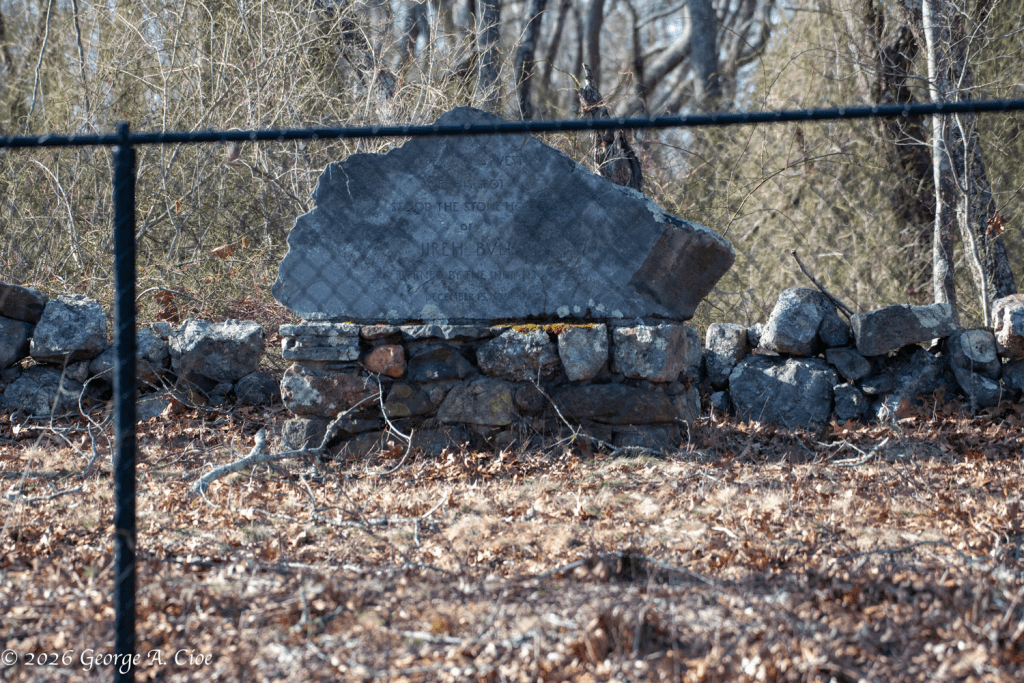
It took a stone behind a black fence to slow me down long enough to ask a better question.
Not just “What is this?”
But “What happened here… and why?”
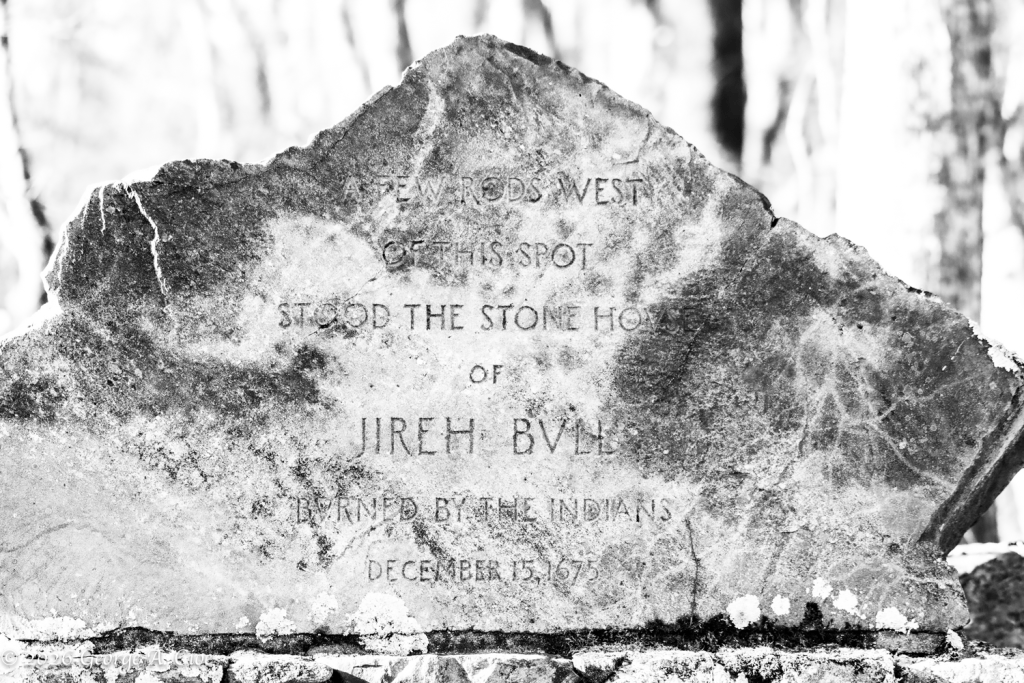
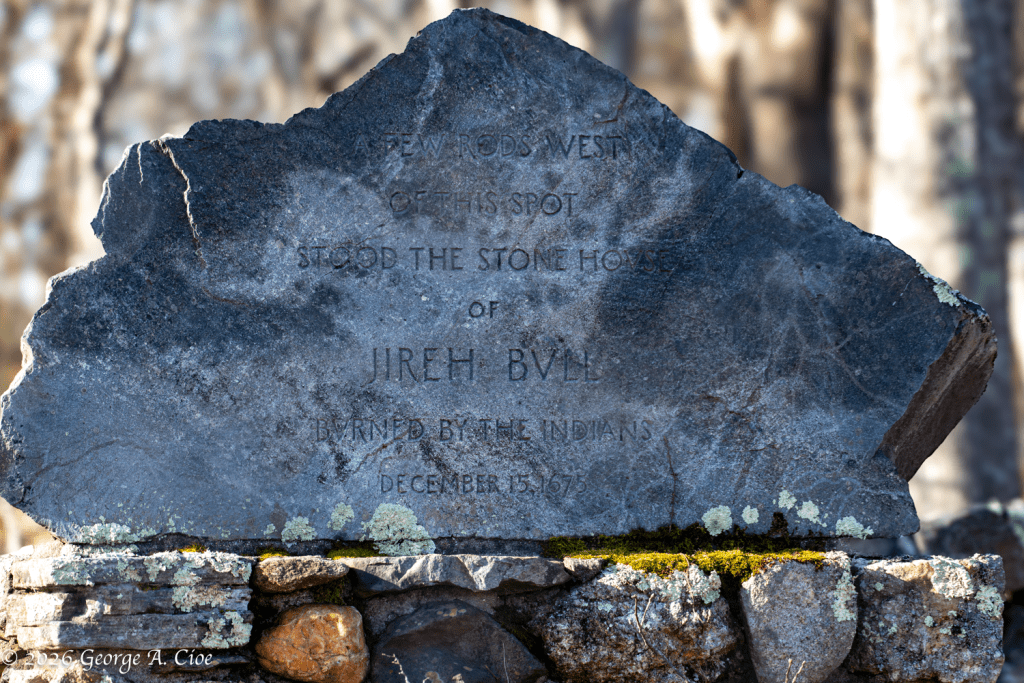
The inscription itself is easy to miss—weathered, softened by time, and not exactly shouting for attention. So it feels only right to share it here, as it appears on the rock:
A Few Rods West
of this spot
Stood the Stone House
of
Jireh Bull
Burned By The Indians
December 15, 1675
A single sentence.
Simple.
Direct.
And carrying more weight than its size suggests.
What I learned surprised me—not because the history is hidden, but because it’s been there all along, waiting for someone willing to look a little deeper.
This site marks the location of the Jireh Bull House, burned on December 15, 1675, during King Philip’s War.
King Philip’s War was a 1675–1676 conflict born from deepening tensions over land, control, and survival between New England colonists and Native American tribes. It became one of the deadliest wars per capita in American history, leaving destruction on both sides and reshaping the region forever.
But that sentence on the stone is only the beginning.
I learned that this wasn’t just an isolated event.
Word had spread that this fortified house would become a gathering point for colonial troops from Connecticut, Plymouth, and Massachusetts Bay.
They never made it.
The house was attacked before those forces could arrive.
I learned that this land—quiet now, almost indifferent—was once part of a much larger and more complex landscape of tension, survival, and shifting alliances in the Narragansett homeland.
That matters.
Because this story was never one-sided.
I learned that people have spent years—decades—trying to understand this place.
In 1917, Norman Isham excavated the site near the Pettaquamscutt River, uncovering remnants of the house beneath earthen mounds.
Artifacts were recovered—pieces of everyday life.
Not relics of battle.
Relics of living.
And I learned something else that stayed with me.
We don’t have all the answers.
Isham wasn’t able to oversee the final collection of artifacts. Their exact locations were lost.
We don’t know which items came from which phase of the house—before, during, or after the war.
History, even when carefully studied, still carries uncertainty.
And maybe that’s part of respecting it.
More recently, I learned about ongoing research—like the work of Colin Porter at Brown—looking not just at the structure itself, but at the broader relationships between Native Americans and colonists, and how places like this fit into that story.
Not just a site.
A context.
A connection.
Standing there, looking through that fence, I realized this wasn’t just a moment of discovery.
It was a moment of responsibility.
Because once you learn something like this…
You don’t just keep driving.
So I’m sharing it.
Not as a historian.
Not as an expert.
Just as someone who finally stopped long enough to see what had been there all along.
If this strikes you the way it struck me, and you want to learn more, here are a few places worth your time:
- The Rhode Island Historical Society and its library collections
- Eleanor Monahon’s “A New Look at the Jireh Bull Excavation” (1961)
- Nina Zannieri’s Jireh Bull Site (1982)
- Brown University research connected to the Pettaquamscutt area
- Background on King Philip’s War
Some of these take a little effort to find.
That feels appropriate.
Because maybe that’s the point.
History isn’t always put right in front of us.
Sometimes…
It’s behind a fence.
Waiting for us to care enough to stop, ask, and learn.
I know I will never drive by this spot the same way again.
And maybe that’s how we grow.
Not by going somewhere new…
But by finally understanding where we already are.
Click here for a map view of the location of the Jireh Bull memorial.
I’d love to share my posts with you. If you subscribe, they’ll come straight to your inbox—most days, like a little note from me to you. It means a lot to know you’re reading along.
Browse my complete art portfolio and shop for prints at this link: imagesbygacioe.shop
Leave a Reply