


It started, as these things often do, with a simple decision.
“Want to go for a walk?”
And just like that, Trish and I found ourselves back at Sachuest National Wildlife Refuge—Spring finally making a guest appearance in Rhode Island, like it had been stuck in traffic somewhere around Connecticut.
The sky was putting on a show.
Big, dramatic whites. Deep, confident blues. And out near the water, that soft haze that makes everything feel like it’s being revealed… slowly… on purpose.
You get the sense that something is about to happen.
And it does.
The refuge was alive.
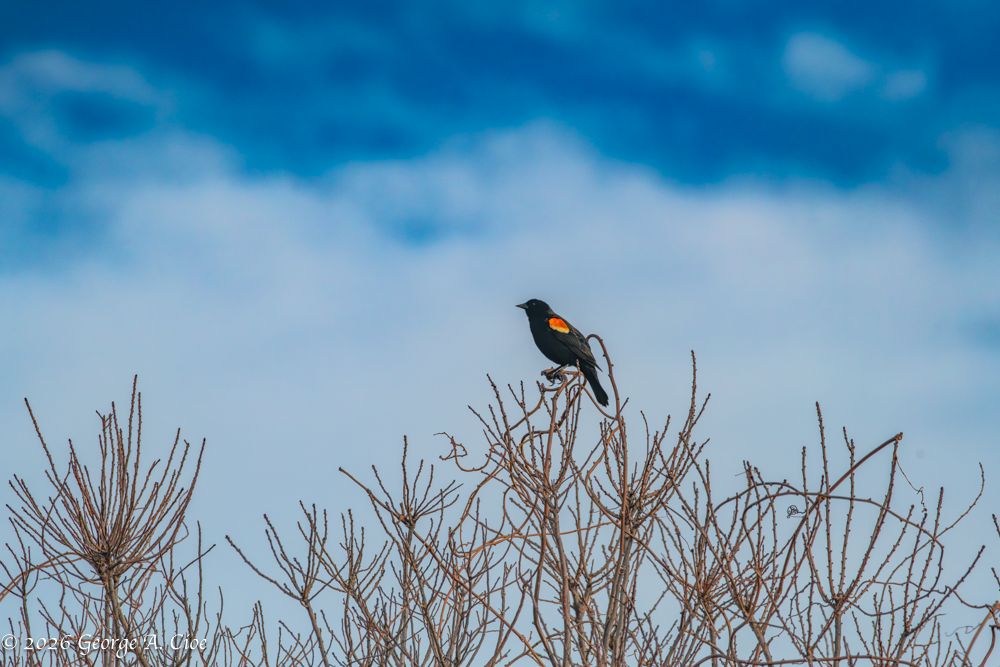
Red-winged blackbirds were in full theatrical mode—flashing epaulets like over-caffeinated traffic cops. And the chorus of territorial proclamations was non-stop. The choreography was predictable. One bird perched on watch while the other dropped to the ground to build the nest.
Harlequin Ducks bobbed offshore like nature’s abstract art. There were four this time scurrying to climb over the breakers to avoid catching a wave into the rocky shoreline.
Brant moved low and steady in the distance. Gracefully moving along a seascape that included St. George’s.
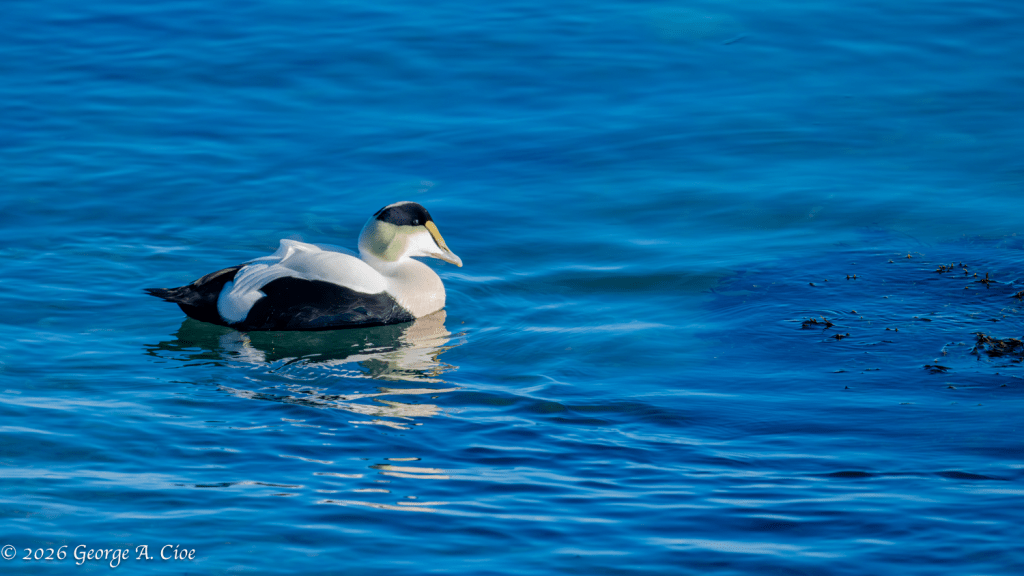
Common Eiders looked like they owned the place.
It was already a great morning.
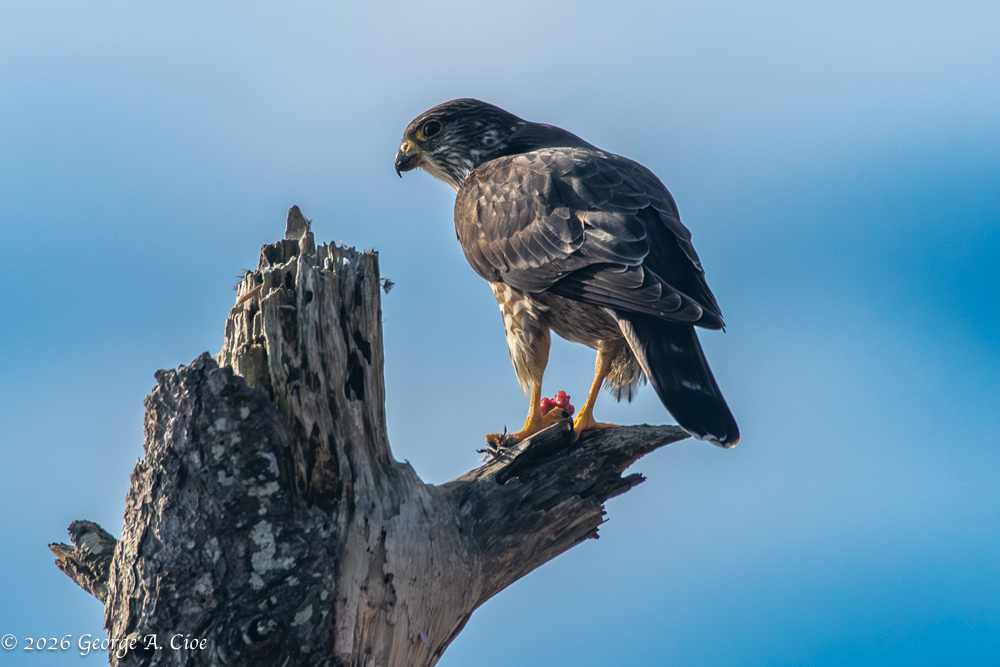
Then we saw it.
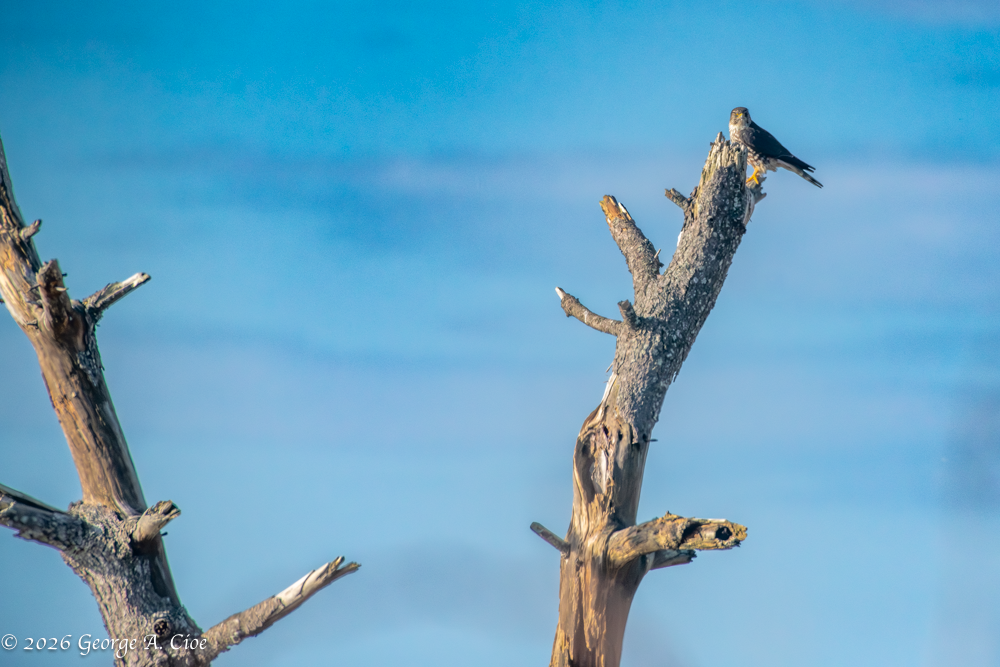
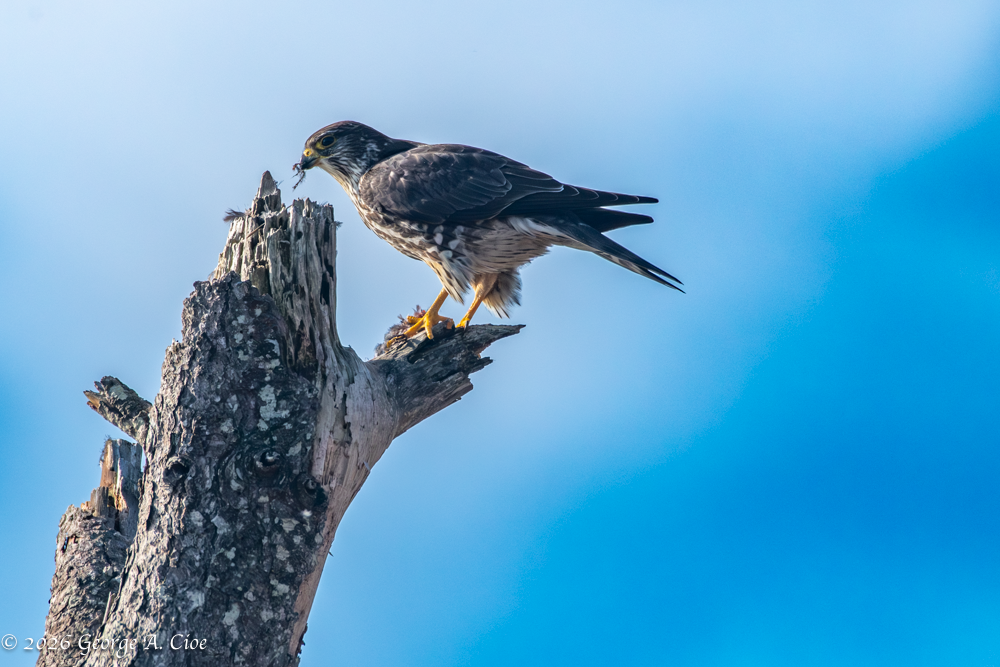
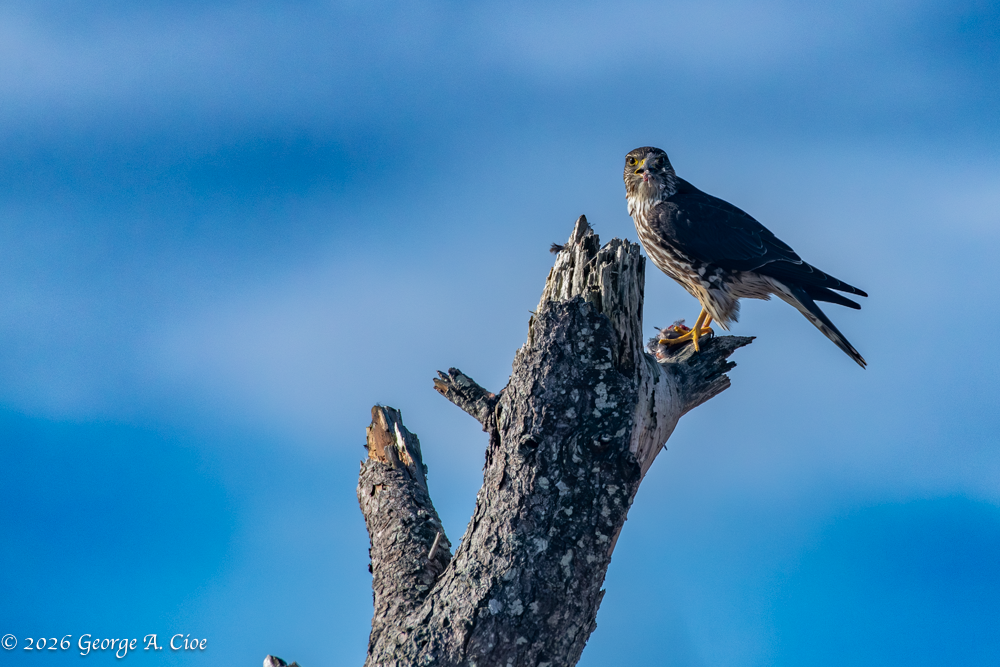
Perched high—very high—on the jagged crown of a dead tree.
Still.
Focused.
Working on something.
At first, from a distance, you go through the usual mental checklist.
“Cooper’s Hawk?”
“Sharp-shinned?”
“Northern Harrier?”
Camera up. Zoom in.
Pause.
Tilt head.
Nope.
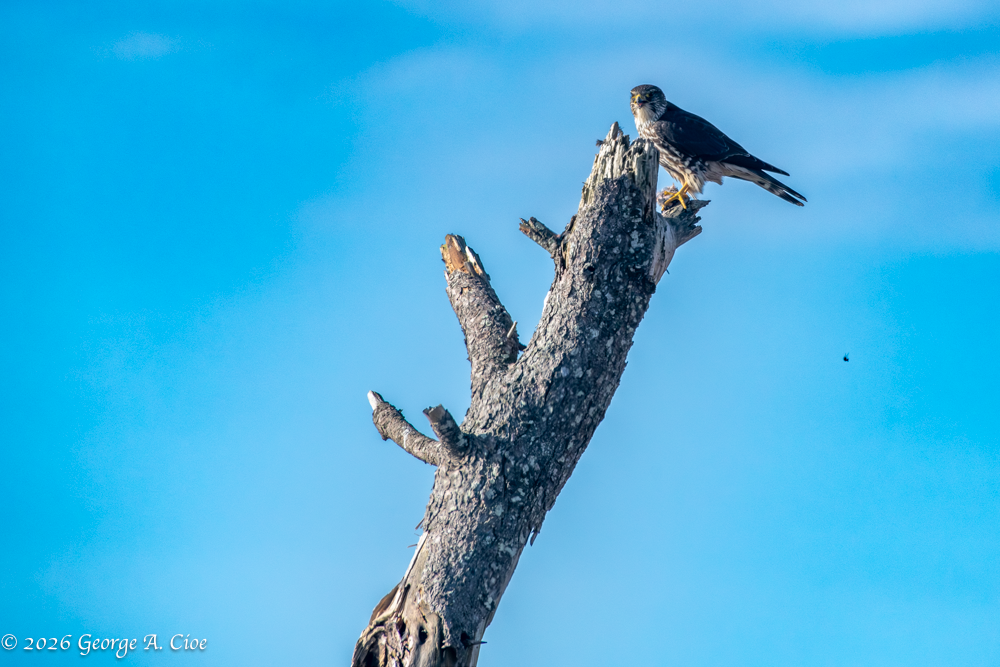
Merlin.
Our first Merlin!
And not just perched.
Dining.
This wasn’t a polite little lunch.
No menu. No reservations.
Just nature—honest, efficient, and a little hard to watch.
Feathers drifting.
Beak working.
A mourning dove, by all appearances.
And then—because nature occasionally leans into dark humor—we see it.
Further down the path.
A single mourning dove.
Just standing there.
Facing… directly… toward the Merlin.
Now I don’t know what was going through that dove’s mind.
But I’m fairly certain the answer wasn’t,
“Run.”
And there, above it all, on the top of that dead tree—
The answer.
Here’s what struck me.
We almost missed it.
Because Merlins are like that.
They’re widespread—especially during migration and winter—but seeing one isn’t something you plan.
It’s something that happens fast.
They live in two gears:
Stillness…
and absolute chaos.
One moment, they’re perched like this—scanning open ground from a treetop or a low edge along a marsh or field.
Patient.
Deliberate.
Almost invisible.
And the next?
Gone.
A blur.
A missile.
If you’ve ever seen a flock of birds suddenly explode into the air for no apparent reason…
There’s a good chance a Merlin was the reason.
They cover ground so quickly that if you hesitate—even for a second—they’re already out of range.
Which makes what we were watching…
…a gift.
Because today, this one had already done the hard part.
Now here’s something that makes this even more impressive.
A Merlin isn’t a big bird.
Not much larger than an American Kestrel.
But heavier.
Denser.
Built like a fighter jet instead of a glider.
And like most raptors, the female is larger than the male—something worth remembering the next time you think size determines who’s in charge.
And that meal?
That’s no small feat.
Merlins routinely take birds their own size.
Sometimes bigger.
They’ve even been observed hunting in pairs—one flushing a flock into chaos while the other comes in at just the right moment to capitalize.
Which, when you think about it…
…is less “bird behavior” and more “coordinated aerial strategy.”
They don’t even build their own nests.
Why bother?
They take over abandoned ones—crow nests, old raptor nests, even magpie constructions.
Real estate by acquisition.
Historically, they’ve had quite the reputation.
They were once called “pigeon hawks”—not because they ate pigeons exclusively, but because in flight they look like one.
Their name—columbarius—even nods to that connection.
And the name “Merlin” itself?
Comes from old French—esmerillon.
Which sounds exactly like something medieval nobility would say while pointing dramatically at the sky.
Which makes sense.
Because they did.
Merlins were the falcon of choice for noblewomen—
including Mary, Queen of Scots.
Used to hunt skylarks.
Imagine that.
Centuries ago, someone standing in a field, watching this same kind of bird do exactly what we were witnessing.
And now here we were.
Two people on a trail in Rhode Island.
Watching the same story unfold.
We stayed for a while.
Long enough to take it in.
Long enough to understand that what we were seeing wasn’t rare because Merlins are rare…
…it was rare because timing is everything.
Eventually, we moved on.
The dove down the path remained.
The Merlin… did not.
And that dead tree?
That wasn’t just a perch.
It was a moment.
One of those moments that reminds you:
Nature doesn’t soften the edges.
It doesn’t explain itself.
It simply continues.
And if you’re paying attention—
Really paying attention—
Every once in a while…
…it lets you watch.
Naturally.
I’d love to share my posts with you. If you subscribe, they’ll come straight to your inbox—most days, like a little note from me to you. It means a lot to know you’re reading along.
Browse my complete art portfolio and shop for prints at this link: imagesbygacioe.shop


Leave a Reply