

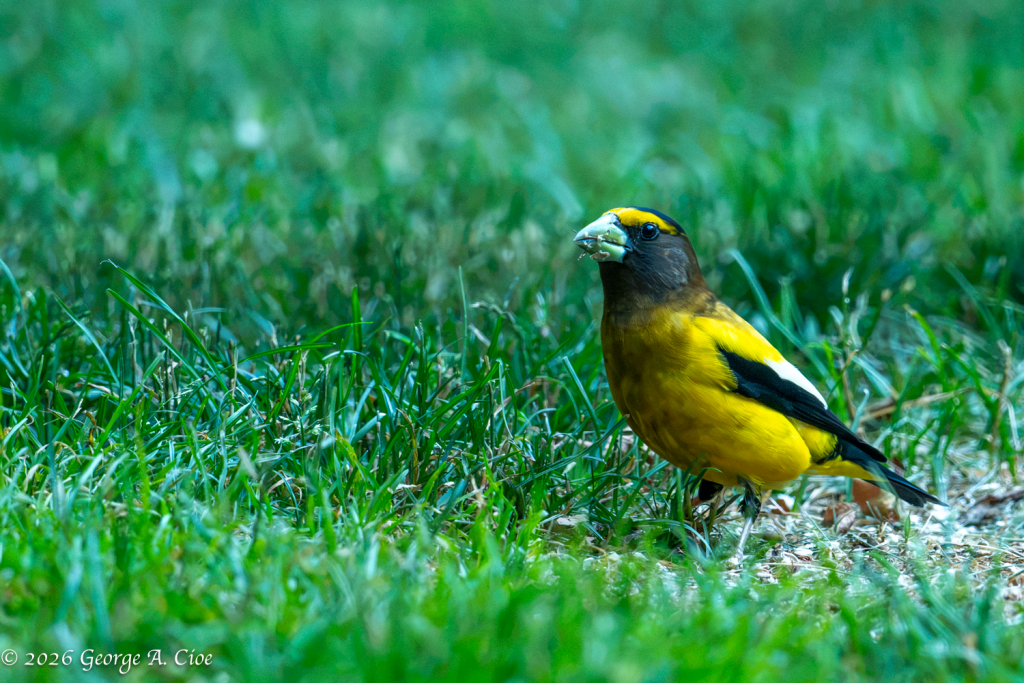
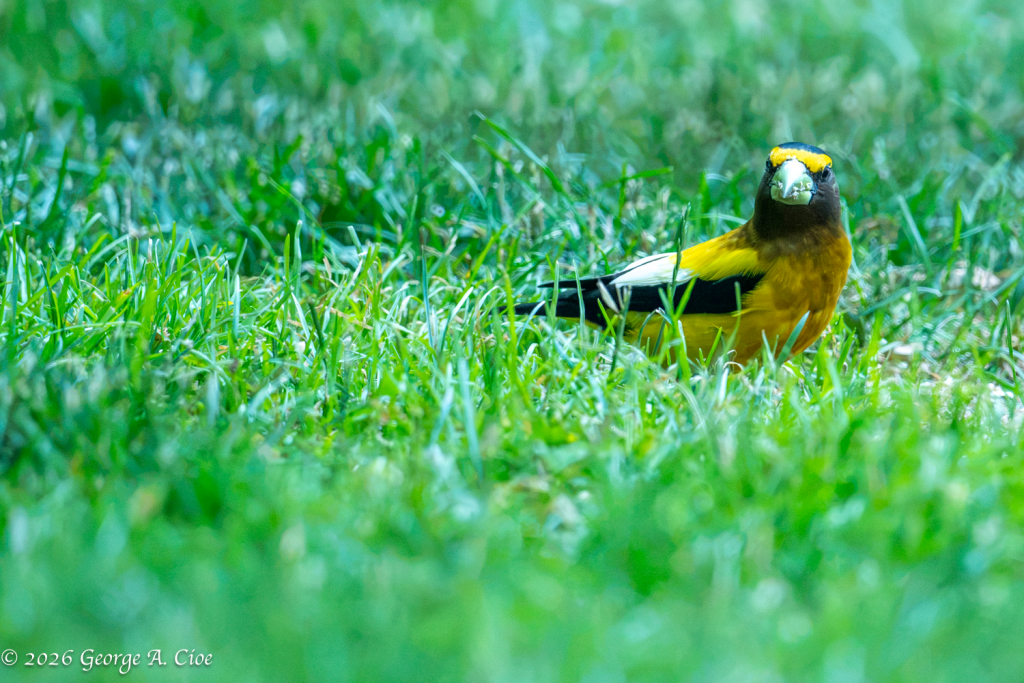


The Rare Evening Grosbeak Appearance on July 4, 2026
I made a point of refreshing the bird fountain and birdbath in my yard early this morning.
5:30 AM.
There I am, standing in the backyard with a hose in my hand, delivering fresh water to the neighborhood birds, hoping it might help them survive the 100-degree heat.
I was feeling downright heroic.
Not Superman heroic.
More like… Saint Francis of Assisi with a garden hose.
Then I noticed movement on the lawn.
Yellow movement.
A lot of yellow movement.
I squinted.
Am I looking at two American Goldfinches standing shoulder to shoulder?
There was simply too much yellow to belong to one bird.
Then it flew.
One bird.
One very large bird.
It landed in a nearby tree, and I immediately abandoned my humanitarian mission. The birds were officially on their own.
I sprinted inside, grabbed my camera, and raced back out.
At first I wondered if I’d stumbled upon one of those incredibly rare yellow cardinals.
Nope.
Wrong beak.
No crest.
Definitely not a cardinal.
I fired off a handful of identification shots.
Then I zoomed in on the LCD.
“It’s a finch.”
A finch?
No…
Finchenstein.
Good grief.
This thing looked like somebody had put a Goldfinch in the gym, fed it nothing but protein shakes, and introduced it to anabolic sunflower seeds.
If a Goldfinch is a compact sedan…
This was a pickup truck.
The bill alone looked capable of opening walnuts… pecans… and probably the occasional bank vault.
Turns out it was an Evening Grosbeak.
A first for me.
And not just any first.
An Evening Grosbeak is one of those birds that makes experienced birders spill their coffee. They were once much more common throughout the Northeast, but today they’ve declined dramatically. Here in Rhode Island, they’re considered uncommon, irregular winter visitors. Some years none are reported. Other years, when food becomes scarce farther north, they invade New England in what birders call an “irruption.”
Seeing one in Narragansett?
That’s a pretty special day.
Of course, the bird didn’t know any of that.
He acted like he owned the place.
He marched around my lawn with all the confidence of a bouncer outside an exclusive nightclub.
The Mourning Doves moved.
The House Finches kept their distance.
Even the squirrels seemed to glance over and silently agree,
“Let’s not mess with that guy.”
He’d crack a sunflower seed with that oversized ivory bill like a man snapping a toothpick.
Crunch.
Gone.
Another.
Crunch.
Gone.
No pecking.
No nibbling.
No delicacy whatsoever.
This bird didn’t eat.
He demolished.
After a few minutes, he flew into one of our fruit trees, turned around, and gave me a look that could only be interpreted one way.
“Nice fountain.”
“Could use better landscaping.”
“And while we’re at it… what’s with that ridiculous camera?”
Touché, Finchenstein.
Touché.
He stayed just long enough for me to capture a few portraits before disappearing over the treetops as suddenly as he’d arrived.
That’s one of the things I love most about wildlife photography.
You can spend weeks chasing a bird you’ve planned for…
…or have an unforgettable visitor literally land in your back yard while you’re watering the birdbath.
Nature doesn’t make appointments.
She makes surprises.
And every once in a while…
She sends Finchenstein.
Naturally.
I’d love to share my posts with you. If you subscribe, they’ll come straight to your inbox—most days, like a little note from me to you. It means a lot to know you’re reading along.
Browse my complete art portfolio and shop for prints at imagesbygacioe.shop



Leave a Reply