
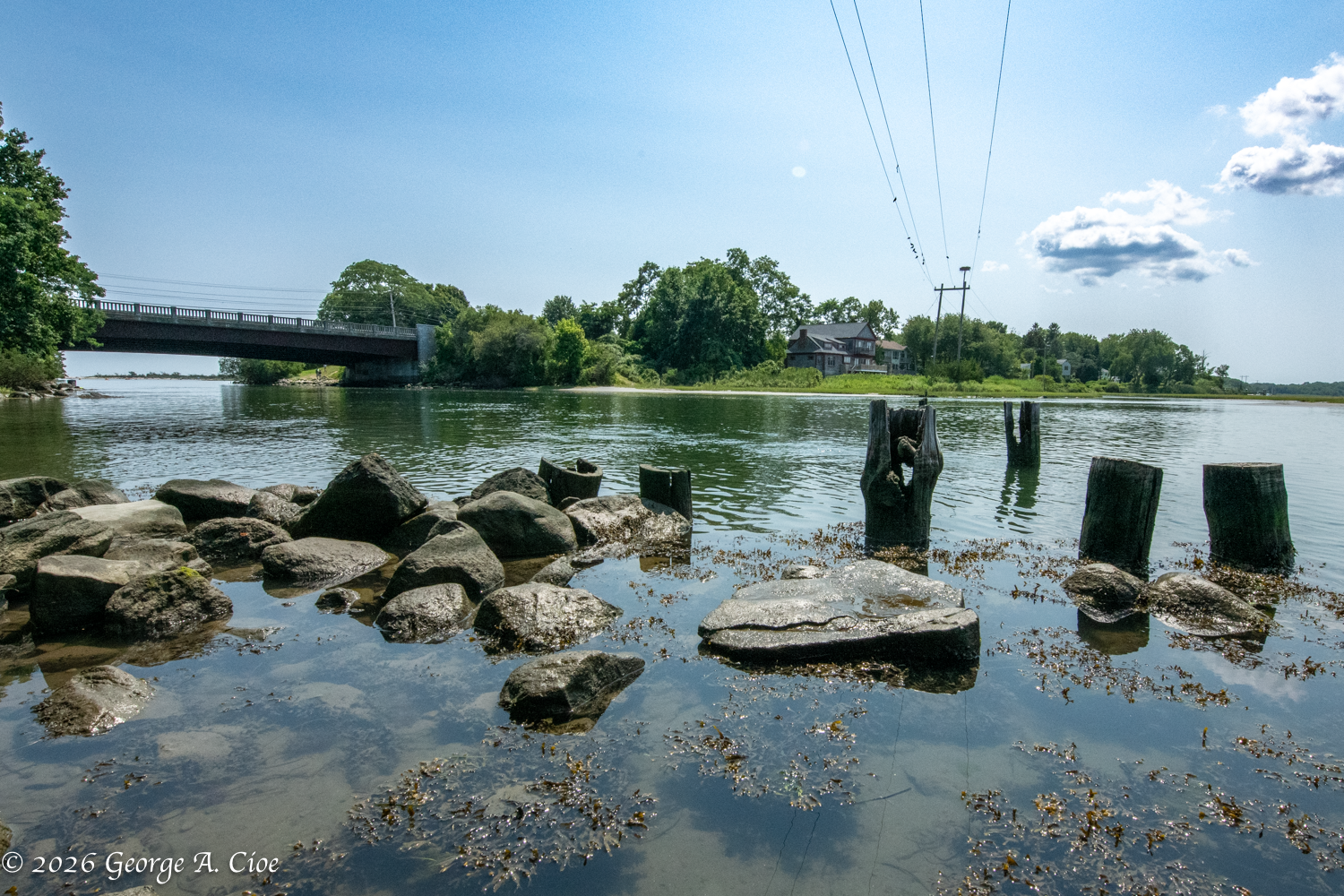


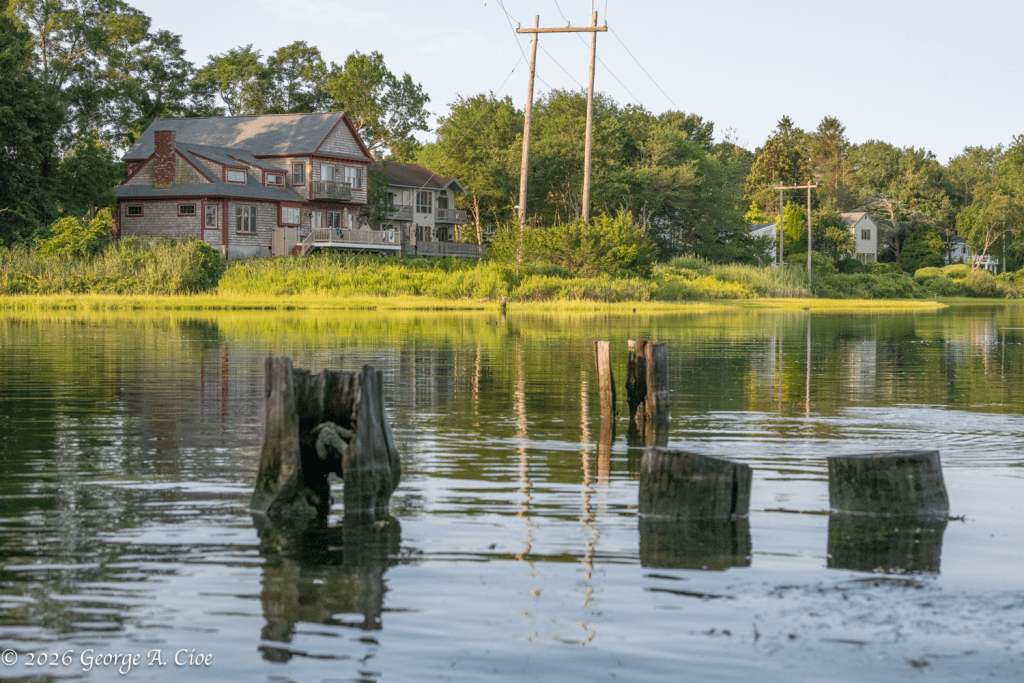

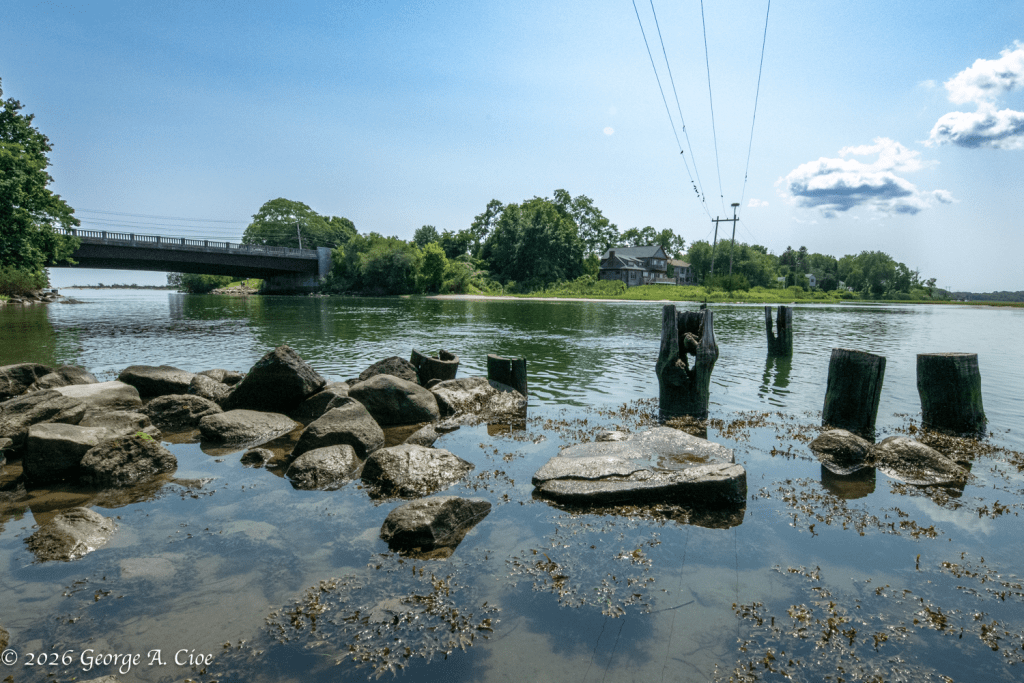
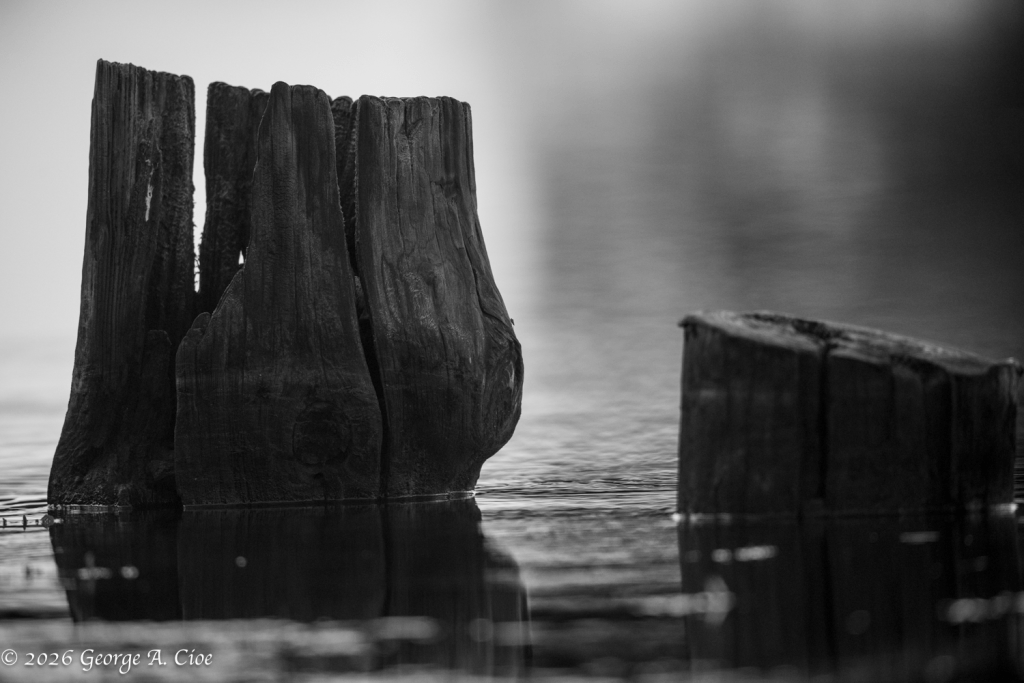
I’ve photographed these old wooden pilings in the Narrow River many times.
They’re just north of the Sprague Bridge.
I’ve photographed birds sitting on them.
Water flowing around them.
Morning light illuminating them.
I’ve probably passed them hundreds of times.
And for all those years, I knew exactly what they were.
Old pieces of wood.
There you have it.
Another exhaustive historical investigation by G. A. Cioe.
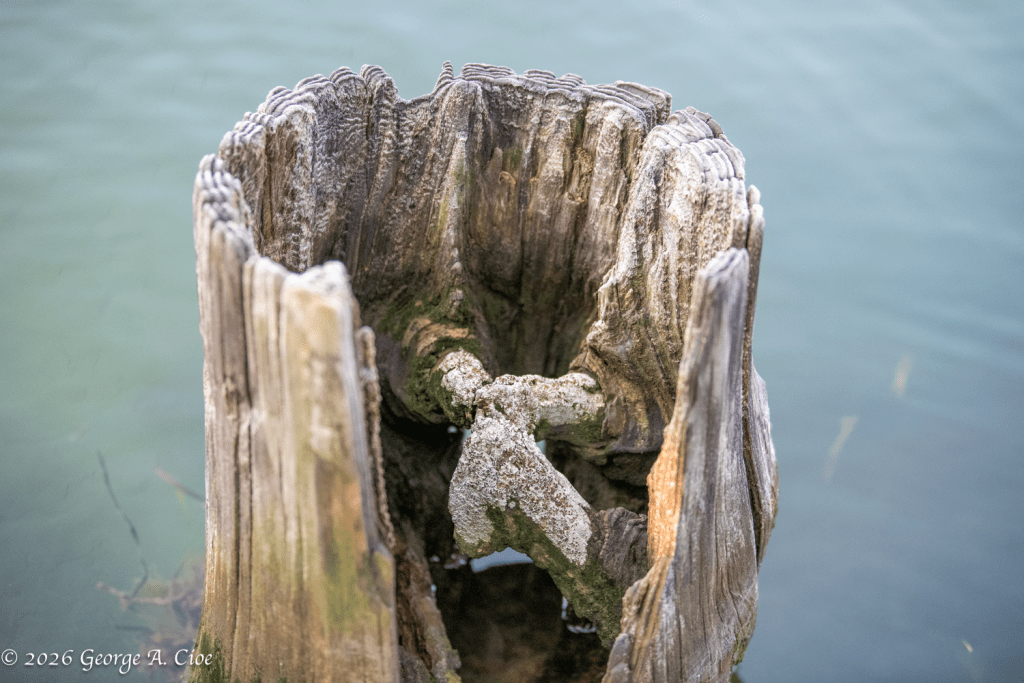
Then one morning, I photographed one from above.
And something caught my attention.
What I had always thought of as one old piling wasn’t one piling at all.
It was a cluster of substantial timbers grouped tightly together.
And one of them had decayed so dramatically that I could look down inside it.
It was hollow.
But not empty.
Several strange wooden projections reached toward the center.
They looked remarkably like the arms of a starfish.
Now I was curious.
Why were these massive timbers here?
Why were there others nearby?
And why did they seem to form a line across the Narrow River?
Suddenly these weren’t old pieces of wood anymore.
They were evidence.
Evidence of something.
So I started digging.
And that’s when a few rotten timbers sticking out of our river became something I never expected.
A railroad.
A Trolley Ran Across Our River
At the turn of the twentieth century, Narragansett was already a celebrated seaside destination.
People came for the ocean.
The beaches.
The hotels.
The social scene.
Narragansett Pier had become one of New England’s great summer resorts.
And around 1900, another way of getting here arrived.
The Sea View Railroad.
Despite the rather grand name, the Sea View was an electric interurban railway—part railroad, part trolley system—connecting communities along the western shore of Narragansett Bay and bringing passengers south toward Narragansett Pier.
This was real transportation infrastructure.
Passengers.
Freight.
Workers.
Vacationers.
Families heading for the shore.
And it crossed the Narrow River.
Right here.
That was the moment I went back and looked at my photographs differently.
The pilings.
The heavy timber construction.
The line across the river.
They weren’t random remnants anymore.
They were pieces of another Narragansett.
A Narragansett where, more than a century before I stood in the river with my Nikon, electric railcars crossed this same stretch of water.
Two Bridges, Side by Side
Then I found the photograph.
October 13, 1916.
A Rhode Island State Board of Public Roads photograph shows the old covered Boston Neck Road bridge crossing the Narrows at essentially the location of today’s Sprague Bridge.
And behind it is another bridge.
Long.
Low.
Wooden.
The caption identifies it:
The Sea View Railroad bridge.
There they were.
Two bridges crossing this little section of Narrow River at the same time.
One carried Boston Neck Road.
The other carried the Sea View.
Imagine standing here around 1910.
No modern Sprague Bridge overhead.
No SUVs.
No kayaks equipped with enough electronics to locate a submarine.
Instead, an electric railcar approaches the river.
It rolls onto the wooden trestle.
Steel wheels click across rails supported by timbers driven into the same river bottom I’m standing in today.
Inside are people headed toward Narragansett.
Ladies in long dresses.
Gentlemen wearing hats despite apparently possessing perfectly adequate hair.
Children looking out the windows.
Workers.
Vacationers.
People going somewhere.
People coming home.
All crossing the same Narrow River we know today.
That changed these timbers for me completely.
They weren’t debris.
They were witnesses.
Then the Automobile Arrived
Unfortunately for the Sea View, Americans were falling hopelessly in love with something else.
The automobile.
And automobiles had one enormous advantage over trolleys.
They went wherever you pointed them.
No tracks.
No timetable.
No conductor.
And if you suddenly decided you’d rather go somewhere other than Narragansett—which I personally find difficult to understand—you could.
The automobile changed transportation.
The Sea View struggled.
By 1920, the railroad was finished.
The electric cars stopped crossing Narrow River.
Rails could be removed.
Wire could be salvaged.
Equipment could be reused or sold.
But enormous timbers driven into the river bottom?
Apparently nobody wanted those badly enough.
So they stayed.
Thank goodness.
Because more than a century later, I came along with a Nikon.
The Railroad Disappeared.
Except It Didn’t.
This may be my favorite historical twist in the story.
After the Sea View ceased operating, its right-of-way remained.
In 1921, Nathaniel T. Bacon, who had acquired Sea View property, granted the Narragansett Electric Lighting Company a perpetual easement over portions of the former railroad corridor.
The easement permitted a single or double line of poles along the former railroad route and referred to a 26-sheet survey of the Sea View right-of-way prepared in 1921.
Now look at my photographs.
There they are.
Utility poles marching across the marsh.
And in another photograph, the wires pass directly over the old bridge timbers.
The railroad is gone.
Its path isn’t.
And here’s the part that made me smile.
The Sea View Railroad was electric.
When the electric railroad disappeared, its old corridor became useful for…
electricity.
More than a century later, the wires still help trace a route most of us would never know had been there.
Apparently even history appreciates irony.
The Clue Inside the Timber
And what about that strange hollow timber that started all this?
The closer photograph answered at least part of the mystery.
Those starfish-like shapes inside aren’t old bridge hardware.
They’re wood.
They appear to be the remnants of knots—the bases of branches that once extended into the trunk of the original tree.
We normally see a knot as a circle or oval on a piece of lumber.
But a branch doesn’t begin at the surface of a tree.
Its wood extends into the trunk, its grain intersecting the surrounding grain.
More than a century in the tidal river has allowed different parts of this timber to deteriorate at different rates. Much of the interior is gone, while some of that old branch wood remains.
And that realization gave me one of my favorite moments in this whole investigation.
I wasn’t merely looking inside an old railroad timber.
I was looking inside the tree that became the railroad timber.
Before the railroad.
Before the bridge.
Before Narragansett’s electric trolley carried a single passenger across the river…
there was simply a tree.
It grew branches.
Its trunk thickened around them.
Someone eventually cut it down, shaped it for structural use and put it to work holding up a railroad.
The railroad lasted about two decades.
The timber has been standing here for more than a century afterward.
And all that time, the Narrow River has been slowly taking it apart.
Tides.
Ice.
Storms.
Salt and brackish water.
Marine organisms.
Decay.
Time.
Fiber by fiber, the river has exposed something the bridge builders themselves probably never saw.
The hidden anatomy of the tree they built with.
No archaeological brushes.
No little picks.
Just a century of tides.
Admission free.
Kayak recommended.
And Then the Tracks Came Back
There was one more surprise.
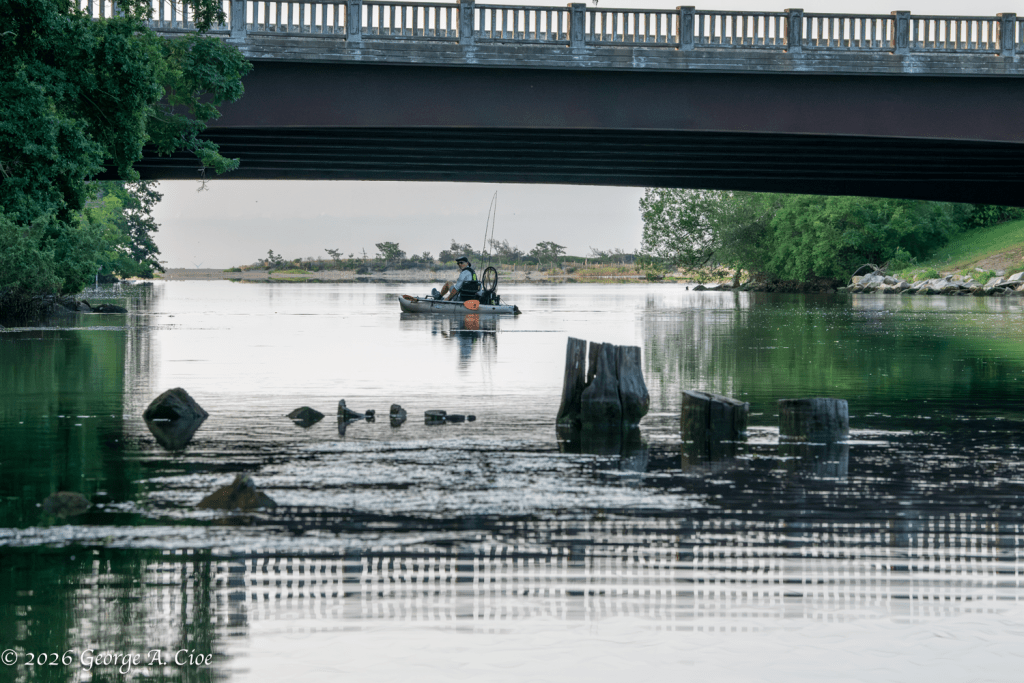
I photographed the pilings beneath today’s Sprague Bridge.
A fisherman happened to be passing through in his kayak.
Above him was the modern bridge.
Below him were the remnants of the old crossing.
And reflected in the water was the railing of the Sprague Bridge.
I didn’t notice anything unusual when I took the photograph.
Then I looked at it later.
The repeating vertical balusters of the bridge railing had been stretched and distorted by the moving water.
I stared at them.
And suddenly I saw it.
Railroad tracks.
Not real ones, of course.
The Sea View’s rails disappeared more than a century ago.
But there they were.
Lines.
Ties.
Tracks seemingly running across the water beside the remains of the old railroad bridge.
I laughed.
Because sometimes photography gives you something you couldn’t possibly arrange.
The old railroad vanished.
The new bridge arrived.
And one quiet morning in 2026, light and water conspired to put the tracks back.
For a fraction of a second.
Click.
I had them.
Three Eras in One Photograph
That photograph has become particularly special to me.
Because without intending to, I photographed three different relationships between people and this river.
At the bottom are the remains of the Sea View Railroad era.
Above them stands the modern Sprague Bridge and the automobile era.
And passing quietly between them is a fisherman in a kayak.
Railroad.
Highway.
Paddle.
Three generations of transportation sharing the same little piece of Narrow River.
And beneath all three…
the river.
Still flowing.
What We Pass Without Seeing
That’s what I love most about this story.
It isn’t really about a railroad.
It’s about looking.
I’ve lived around this river for decades.
I’ve boated on it.
Fished it.
Photographed it.
Watched ospreys dive into it.
Egrets stalk its shallows.
Cormorants fly inches above it.
And those old timbers were sitting there the entire time.
I saw them.
But I hadn’t really seen them.
There’s a difference.
We tend to think history is somewhere else.
Museums.
Mansions.
Battlefields.
Historic buildings with plaques explaining exactly why we’re supposed to care.
But history doesn’t always announce itself.
Sometimes it’s rotting quietly in the water beneath a bridge you’ve driven across a thousand times.
Sometimes barnacles grow on it.
Sometimes a bird uses it as a perch.
Sometimes a fisherman paddles right through the middle of it.
Sometimes electricity still follows its old path across the marsh.
And sometimes history waits until a photographer looks down inside an old timber and thinks:
Wait a minute.
What’s going on here?
That’s all curiosity requires.
One observation.
One question.
And suddenly old pilings become an electric railroad carrying passengers toward Narragansett Pier.
Utility poles become markers of a vanished transportation corridor.
A hollow timber reveals the anatomy of a tree felled more than a century ago.
And the reflection of a modern bridge becomes railroad tracks.
You don’t always have to travel somewhere new to discover something extraordinary.
Sometimes you just have to look more carefully at somewhere you’ve known forever.
The railroad is gone.
The passengers are gone.
The rails are gone.
The bridge is gone.
But a handful of timbers remain.
And more than a century later, the Narrow River still flows around them.
Quietly keeping our history.
The river remembered.
I just finally looked closely enough to ask.
I’d love to share my posts with you. If you subscribe, they’ll come straight to your inbox—most days, like a little note from me to you. It means a lot to know you’re reading along.
Browse my complete art portfolio and shop for prints at imagesbygacioe.shop


Leave a Reply