




Although young and inexperienced, this Osprey still managed to completely fake me out.
And I mean completely.
I had been watching him for about half an hour.
He kept working a stretch of the Narrow River about 800 feet upriver from the Sprague Bridge, where a bend creates something of a choke point for fish.
He’d fly.
Pause.
Hover.
Look down.
Continue.
Then circle around and do it again.
Classic Osprey hunting behavior.
And every single time he hovered, my heart rate went up.
Because hovering can mean one thing every wildlife photographer hopes for:
The dive.
An Osprey hunting fish is one of nature’s great combinations of eyesight, aerodynamics, timing, and sheer commitment.
The bird spots a fish from above, adjusts its approach and, when everything comes together, plunges toward the water.
Feet first.
Talons extended.
Wings swept back.
Sometimes an Osprey merely breaks the surface.
Sometimes it disappears almost completely beneath it.
And then comes the part I find every bit as remarkable as the dive.
It has to get back out.
Wet.
With a very unhappy fish attached.
I wanted that photograph.
Badly.
So every time this youngster approached, I was ready.
Or so I thought.
I kept switching between my tripod-mounted 800mm and my handheld 200–500mm. If he suddenly dove close to me, 800mm could turn a magnificent Osprey into an excellent photograph of half an Osprey.
He made several passes.
Sometimes directly over my head.
Which was apparently his way of reminding me that arthritis had already established permanent residency in my neck.
Then he’d reach the Sprague Bridge, turn around, and start hunting upriver again.
The bridge became his reset button.
Back he’d go.
Another pass.
Another hover.
Another false alarm.
By the fifth or sixth trip, I made the fatal wildlife-photography mistake.
I relaxed.
I lowered the camera.
At my age, periodically restoring blood circulation to your arms isn’t laziness.
It’s preventive maintenance.
And naturally…
that’s when he dove.
No hover.
No warning.
No courteous announcement.
No consultation with the Osprey photography handbook.
One second he was flying.
The next—
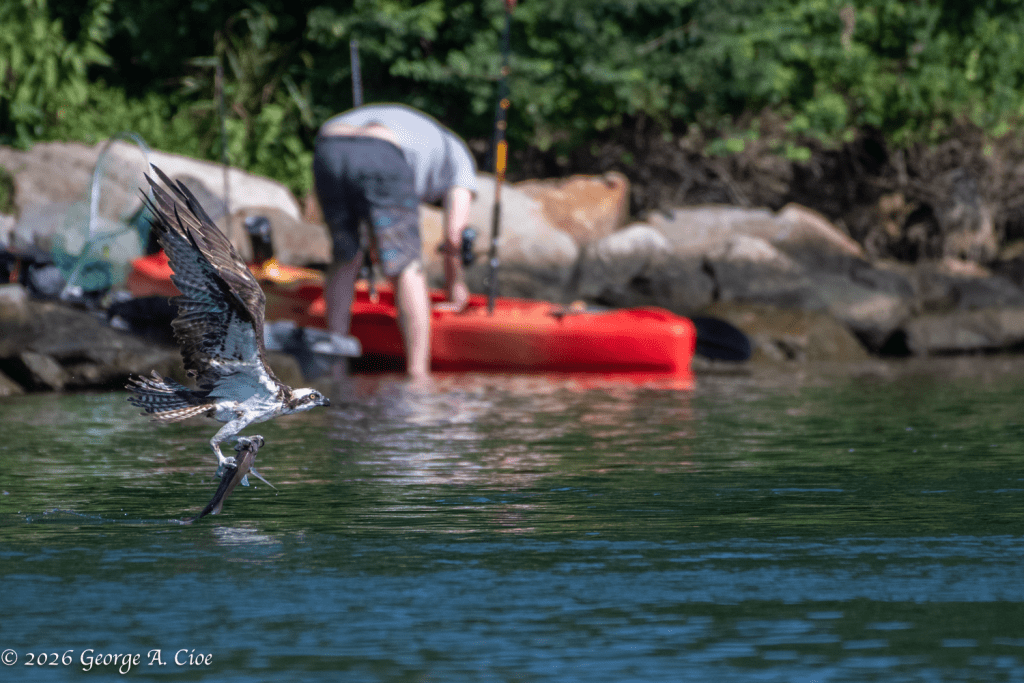
SPLASH!
Right at the bridge.
With kayakers perhaps twenty feet away.
He had completely fooled me.
But while I missed the plunge itself, I caught what happened next.
And what happened next became an even better story.
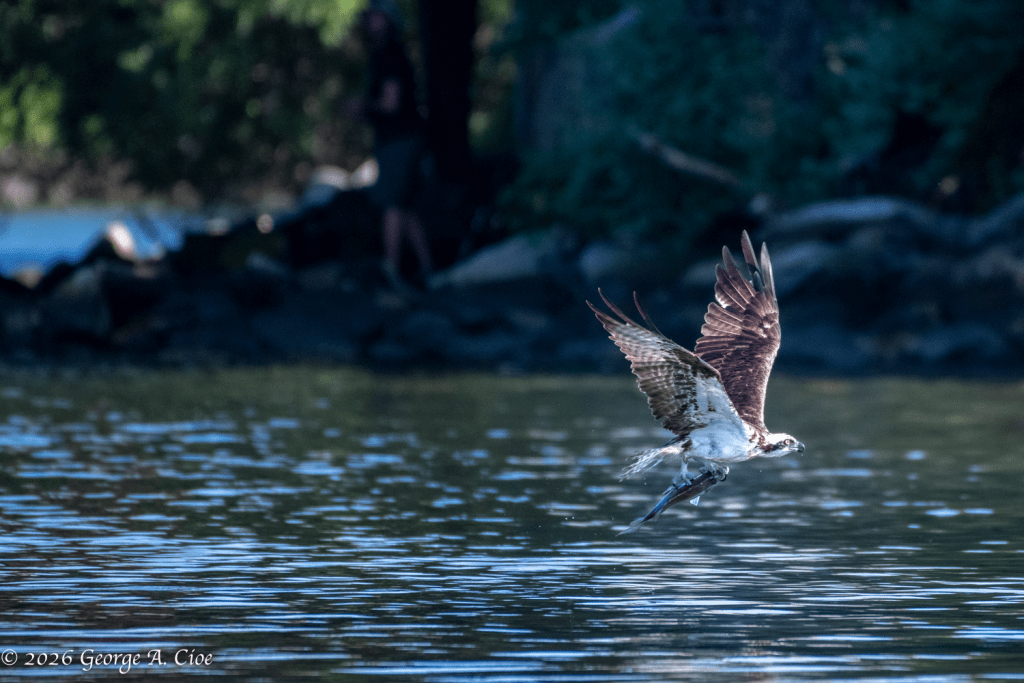
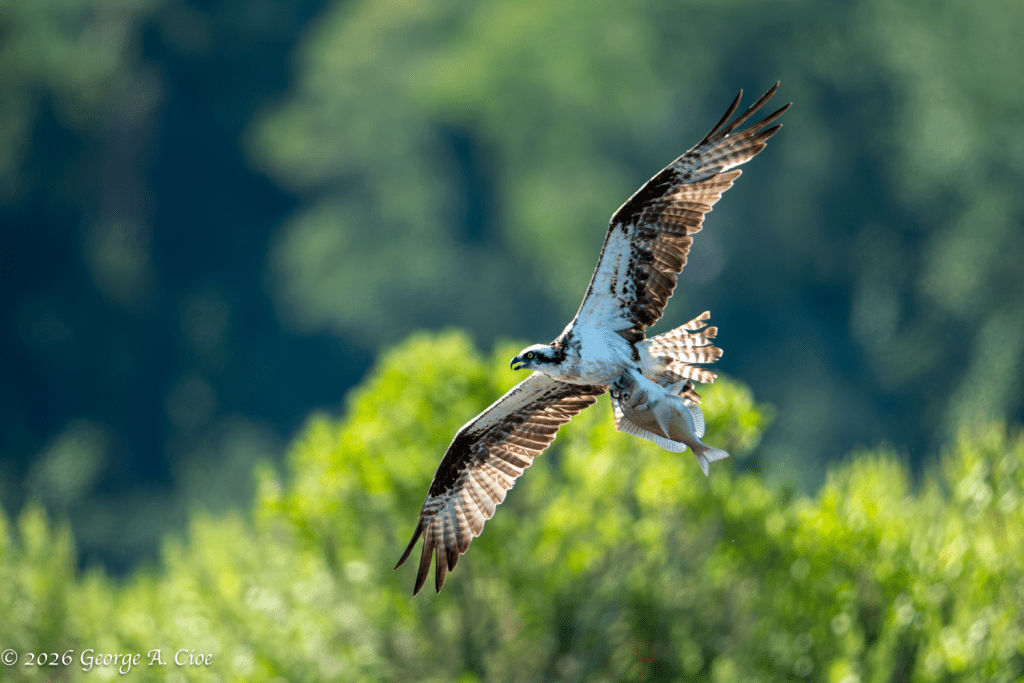
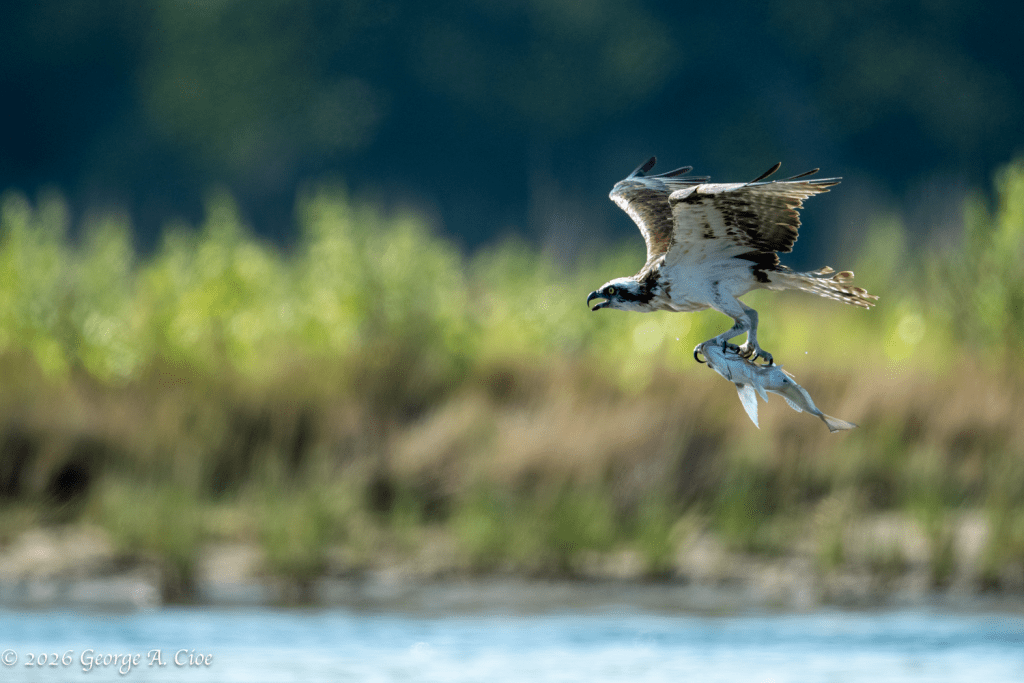
The Osprey erupted from the water carrying a substantial scup.
That alone is a marvel.
An Osprey’s feet are essentially specialized fishing equipment.
Unlike most hawks, an Osprey can rotate its outer toe, allowing it to grip a fish with two toes forward and two backward. The bottoms of its feet are covered with tiny rough projections called spicules, which provide additional traction against wet, slippery scales.
Then there are those talons.
Long.
Strong.
Sharply curved.
And exquisitely designed for one purpose:
Don’t drop the fish.
Even the Osprey’s tendency to turn its catch so the fish faces forward serves a purpose, reducing aerodynamic drag while the bird flies.
Millions of years of evolution have essentially produced a feathered fishing machine.
And this scup was definitely testing the equipment.
Vigorously.
The young Osprey flew just above the river, the fish swinging beneath him, water still dripping from bird and breakfast.
He was never more than about ten feet off the ground.
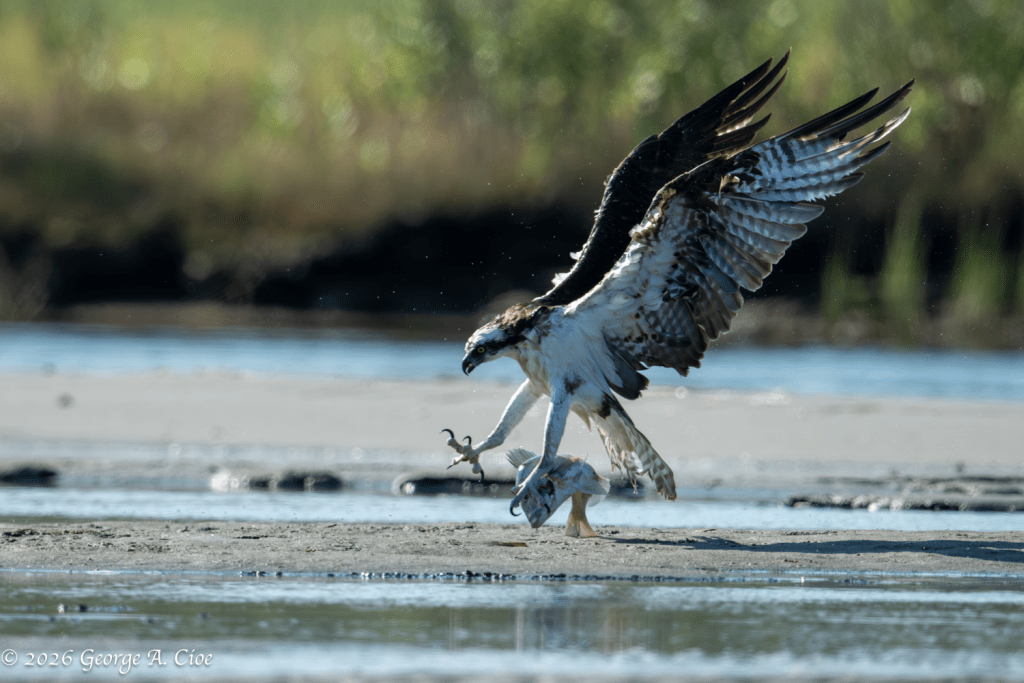
Eventually he reached the sandbar and landed.
He needed a moment.
He was wet.
He was carrying a big fish.
And he needed to dry those feathers and regain enough lift to get himself—and lunch—to someplace safer.
Sound familiar?
Apparently birds occasionally need to restore circulation too.
But there was a problem.
Someone else had noticed the fish.
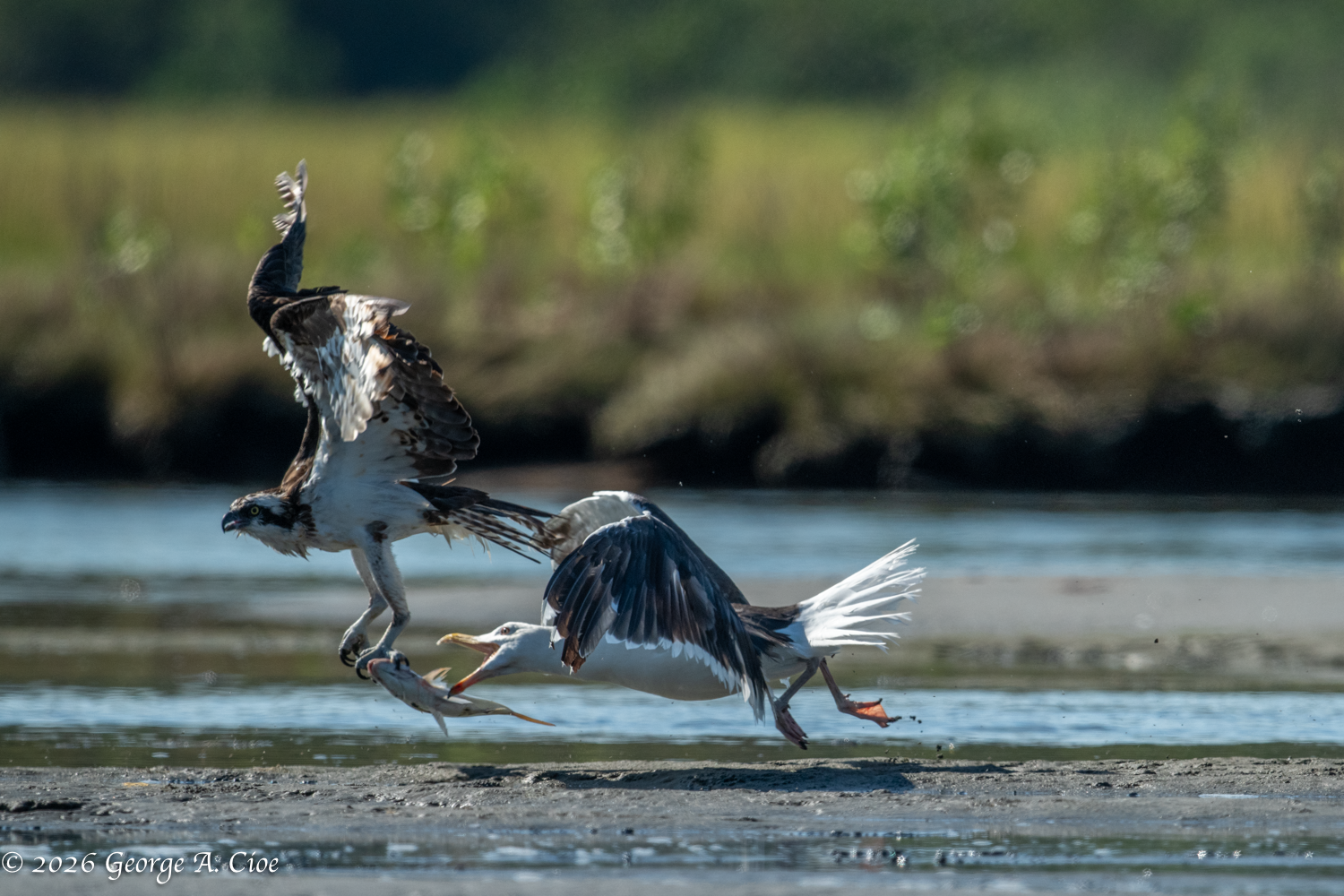
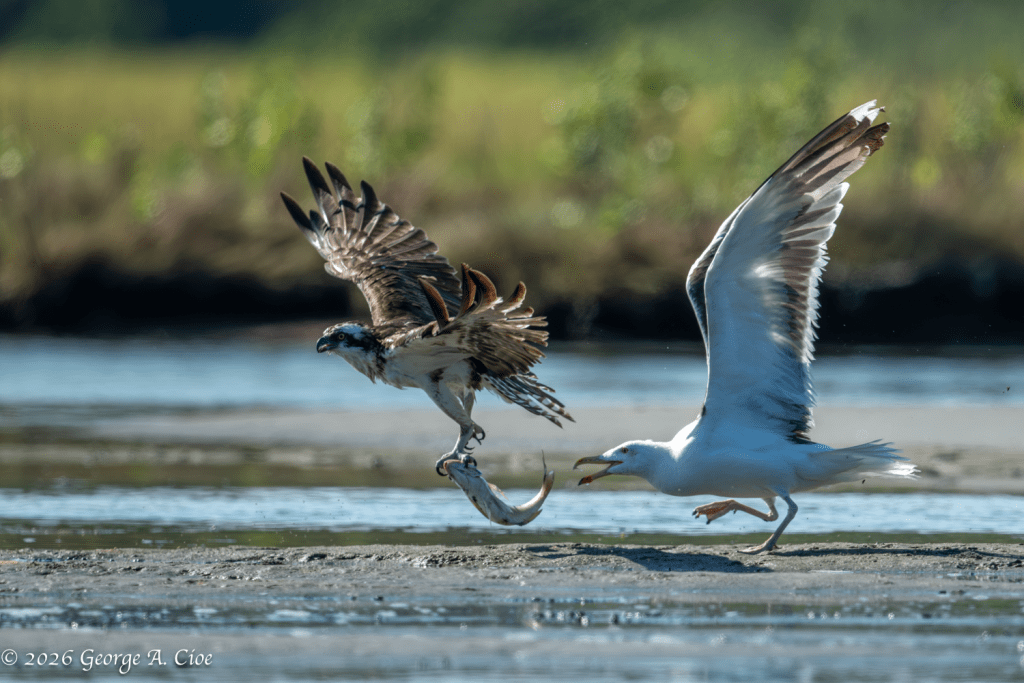
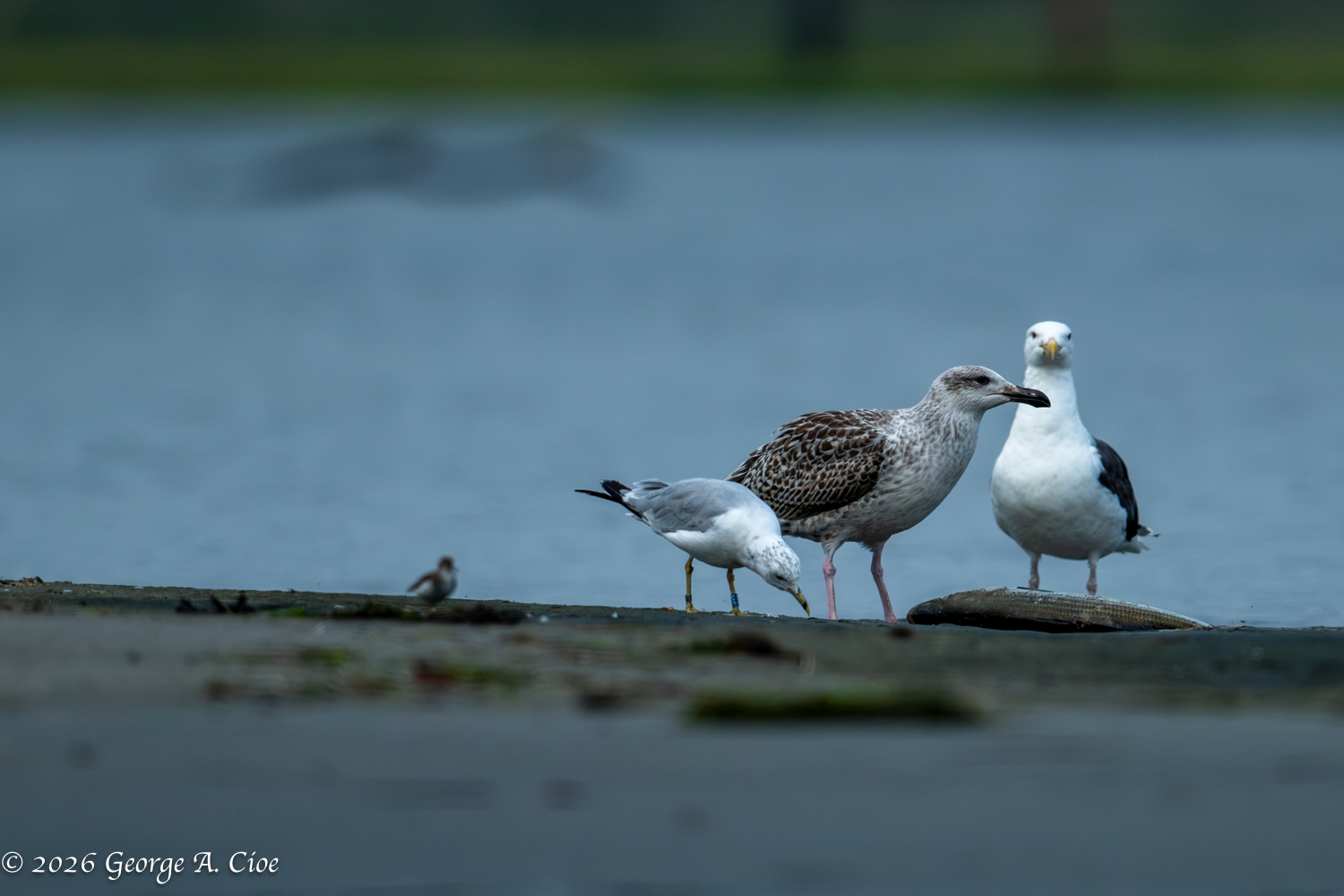
Enter the Great Black-backed Gull.
The largest gull in the world.
Big.
Powerful.
Opportunistic.
And apparently operating under the long-established maritime principle of:
“Your fish is my fish.”
Great Black-backed Gulls have a reputation for being the bullies of the shoreline.
And they have the hardware to back it up.
They are enormous gulls, with heavy bills, powerful wings and a willingness to take advantage of almost any available food source. They are predators, scavengers and accomplished practitioners of kleptoparasitism—stealing food captured by other animals.
Kleptoparasitism.
That’s the scientific term.
It sounds considerably more respectable than:
“Big bird stealing somebody else’s lunch.”
The gull’s intentions were obvious from the moment it arrived.
Steal that fish.
The Osprey disagreed.
What followed was ten minutes of avian “Go Fish.”
The gull would approach.
The Osprey would turn.
The gull would lunge.
The Osprey would spread those enormous wings and face it.
Back off.
Circle.
Try again.
And through all of this, the scup was still very much involved in the discussion.
I kept looking at those enormous Osprey talons buried around the fish and wondering:
How in the world could the gull possibly steal it?
The answer probably wasn’t by simply pulling it out of the Osprey’s feet.
Those feet were built over millions of years of evolution for precisely the opposite outcome.
The better strategy was intimidation.
Harass the Osprey.
Rush it.
Force it to move.
Make it spend energy.
Perhaps force it into the air before it was ready.
And hope that somewhere in the chaos…
the fish gets dropped.
The Great Black-backed Gull had another enormous advantage.
It was dry.
The Osprey wasn’t.
So this became a waiting game.
The Osprey kept testing its wings.
The gull kept testing the Osprey.
Fortunately, so did I.
I was shooting at 1/2500 of a second.
Every lunge.
Every wingbeat.
Every splash.
Every defensive maneuver.
Frozen into fractions of a second my eyes could never fully appreciate while they were happening.
Then I could see the balance changing.
The sun was doing its work.
The Osprey’s feathers were drying.
Those wing tests were becoming stronger.
The Great Black-backed Gull must have noticed too.
Because suddenly the entire encounter seemed to accelerate.
The Osprey spread its wings.
Not halfway.
Not as a warning.
All the way.
This was it.
One tremendous downstroke.
Then another.
The fish swung beneath him.
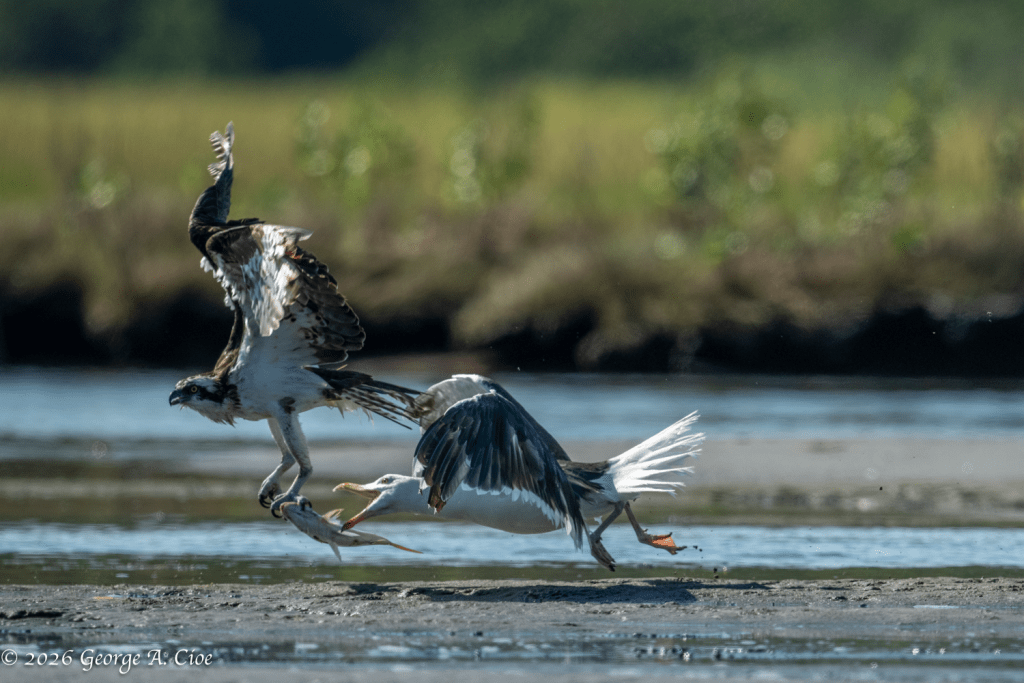
The gull charged.
For a moment, predator, pirate and prey were all moving together.
The Osprey strained for altitude.
The Great Black-backed Gull came after him.
The scup continued its vigorous objection to the entire arrangement.
And I just kept shooting.
Then the Osprey found lift.
Those long wings grabbed clean air.
The gull made one final desperate run.
And the youngster escaped.
Barely.
But once the Osprey had air beneath those wings, the contest changed.
He climbed.
The Great Black-backed Gull couldn’t make him surrender the fish.
And amazingly, after the plunge, the wet feathers, the low flight, the sandbar standoff and ten minutes of attempted grand larceny…
the scup was still locked in those remarkable feet.
The Osprey headed for a familiar stag.
Up there, finally, he could enjoy the meal he had actually earned – twice.
The Great Black-backed Gull remained behind.
And complained.
Loudly.
Very loudly.
I’d never really thought about whether a gull could sound disappointed.
Now I know.
It can.
And apparently the entire watershed needs to hear about it.
I had gone to the river hoping to photograph an Osprey diving for a fish.
I missed it.
Completely.
Instead, I watched a young bird demonstrate nearly every piece of equipment evolution had given it for survival:
Extraordinary eyesight.
A feet-first plunge.
Powerful wings capable of lifting a wet body from the water.
A reversible outer toe.
Rough gripping pads.
Long, curved talons.
And the ability to carry one of the slipperiest meals imaginable through the air while another enormous bird tried to mug him for it.
And then I watched the Great Black-backed Gull demonstrate an equally ancient survival strategy:
Let somebody else do the fishing.
One bird had speed.
Precision.
Specialized anatomy.
And remarkable fishing ability.
The other had size.
Power.
Persistence.
Opportunism.
And absolutely no respect for property rights.
Nature doesn’t always give you the photograph you’re waiting for.
Sometimes it gives you something better.
A story.
I’d love to share my posts with you. If you subscribe, they’ll come straight to your inbox—most days, like a little note from me to you. It means a lot to know you’re reading along.
Browse my complete art portfolio and shop for prints at imagesbygacioe.shop


Leave a Reply