
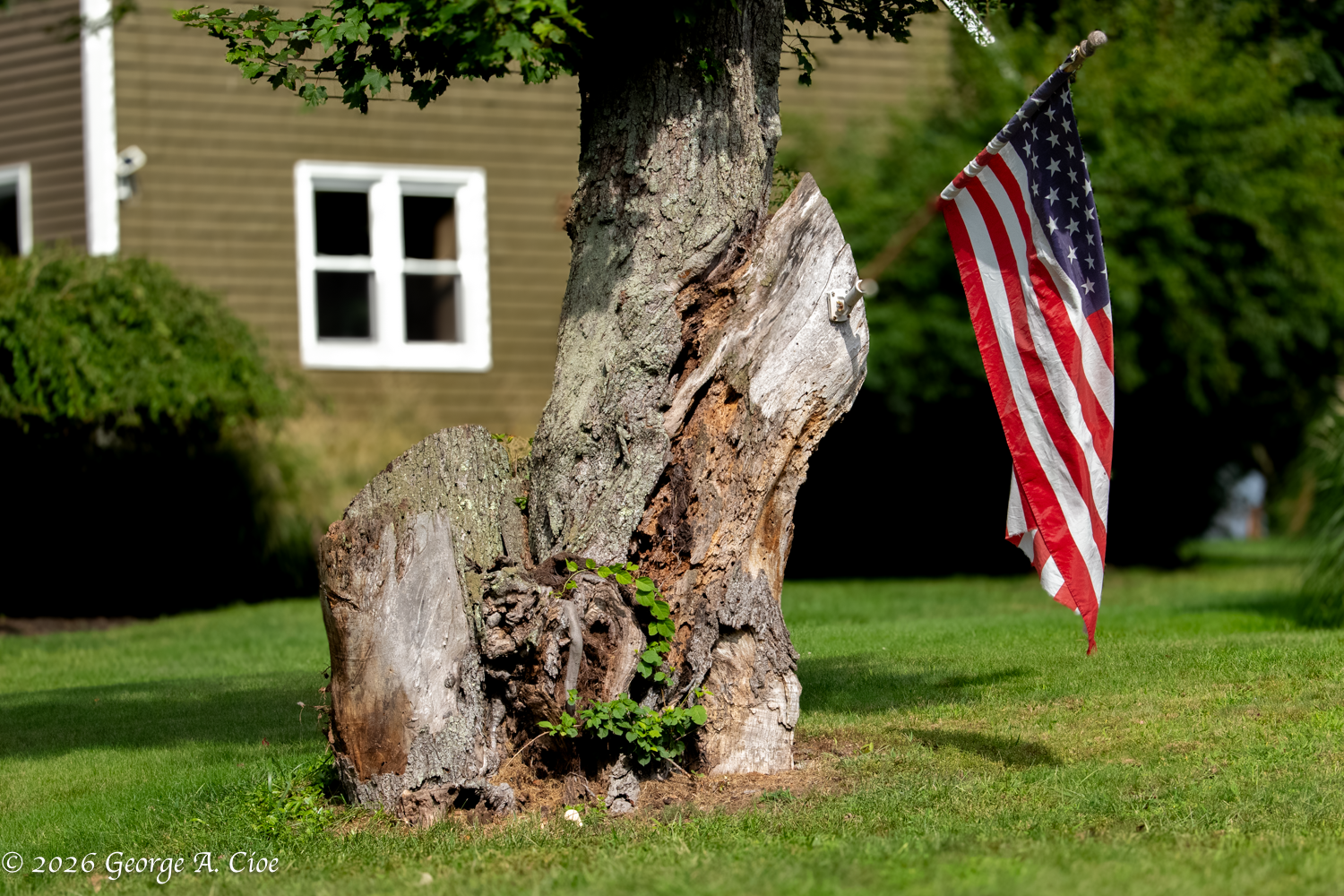
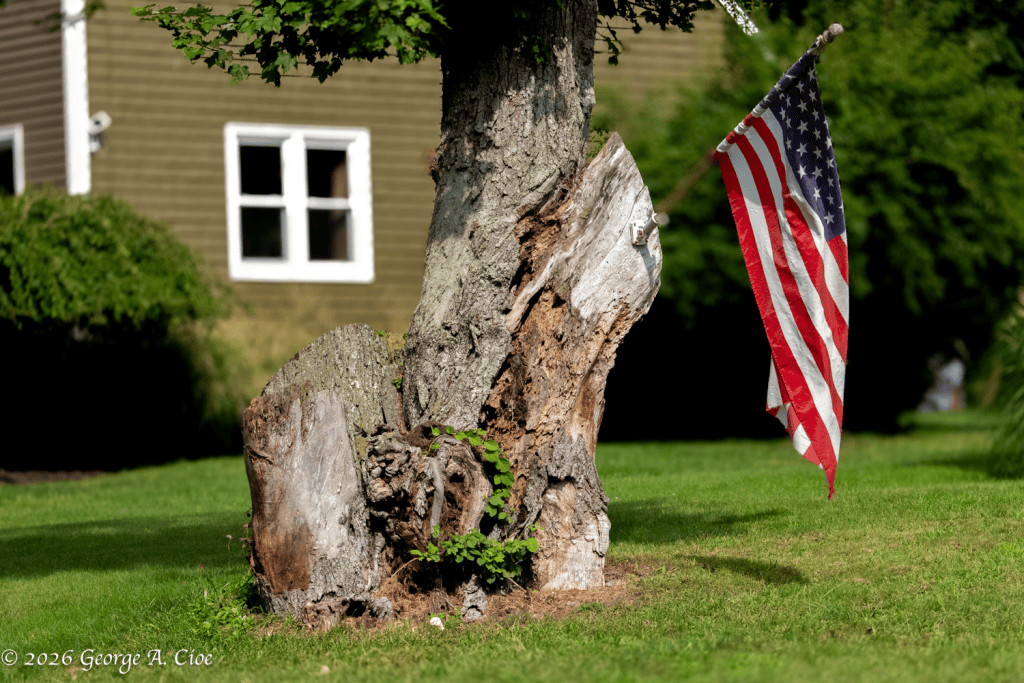
There is an American flag hanging from a tree in my neighborhood.
I have passed it many times.
But on this particular day, I stopped.
And stared.
The flag was suspended barely a foot above the ground, attached to what remained of a once-mighty limb.
The limb had been amputated.
The wood beneath it was weathered, hollowed and scarred by rot.
And Old Glory hung beside it—
faded in places,
folded upon itself,
and seemingly dependent upon a branch that had already lost much of its strength.
My first reaction surprised me.
It looked like a metaphor for the condition of our country.
A republic hanging precariously from a damaged limb.
Institutions weakened.
Public trust decaying.
Congress divided and too often dysfunctional.
Political arguments becoming louder, harsher and more personal.
Americans no longer merely disagreeing with one another, but increasingly questioning one another’s motives, intelligence, patriotism and even humanity.
That is how I sometimes feel when I watch the news.
But then I stopped looking at the flag—
and began looking at my own perspective.
Why had I immediately interpreted this scene as despair?
My neighbor had obviously placed the flag there for a reason.
Perhaps it was simply an expression of love for country.
A gesture of gratitude.
A declaration of hope.
It certainly was not a symbol of distress. The flag was not upside down.
It was still hanging as it was intended—
stars above stripes,
held proudly in the sunlight.
And while I have grave concerns about the direction of our republic, I still believe better days are possible.
That realization sent me deeper into the photograph.
I was born in 1956.
For seventy years, I have watched this country endure moments that must have felt, to the people living through them, as though America might never be the same again.
I grew up beneath the shadow of the Cold War, when schoolchildren practiced emergency drills and families wondered whether nuclear war might arrive without warning.
I lived through the struggle against segregation, the violence surrounding the Civil Rights Movement and the long-overdue national reckoning over whether America would honor the promises written into its own founding documents.
I remember the Cuban Missile Crisis, when the world moved terrifyingly close to nuclear war.
Then came the assassinations.
John F. Kennedy.
Malcolm X.
Martin Luther King Jr.
Robert F. Kennedy.
Each death seemed to tear another piece from the country’s soul.
The Vietnam War divided families, campuses and communities. Protest filled the streets. Four students were killed at Kent State. The Pentagon Papers deepened public suspicion that the government had not been honest with the people it served.
Then came Watergate—a break-in, a cover-up, congressional hearings and a constitutional crisis that eventually led to President Richard Nixon’s resignation. Yet the institutions of accountability responded: journalists investigated, courts ruled, Congress conducted bipartisan hearings and the constitutional system endured. The Senate’s official history credits the Watergate investigation with helping restore confidence in congressional oversight. United States Senate
We endured oil embargoes, gasoline lines, inflation and unemployment.
The fall of Saigon.
The Iran hostage crisis.
The AIDS epidemic.
The farm crisis.
The Challenger disaster.
Iran-Contra.
The savings-and-loan collapse.
The Persian Gulf War.
The Los Angeles riots.
The first bombing of the World Trade Center.
The Oklahoma City bombing.
A presidential impeachment.
A disputed presidential election.
The collapse of the dot-com bubble.
And then came September 11, 2001.
Nearly three thousand people were killed in a single morning. Buildings fell. Smoke covered New York. The Pentagon burned. A field in Pennsylvania became sacred ground.
For a time, grief united us.
Then came the long wars in Afghanistan and Iraq, bringing sacrifice, controversy and consequences that would span decades.
We witnessed Hurricane Katrina and the catastrophic failure of levees and emergency systems.
We watched the housing market collapse, banks fail, retirement accounts evaporate and families lose their homes during the Great Recession.
We have faced the opioid epidemic.
Mass shootings.
Domestic terrorism.
Cyberattacks.
Foreign interference.
Government shutdowns.
Debt-ceiling confrontations.
Natural disasters of increasing frequency and severity.
Then a virus brought much of the world to a halt.
COVID-19 took lives, separated families, shuttered businesses and left wounds—physical, emotional and political—that remain with us. The history of that national emergency, including the public-health response and the extraordinary speed with which vaccines were developed, is documented by the Centers for Disease Control and Prevention.
We endured the murder of George Floyd and the nationwide protests that followed.
A bitterly contested presidential election.
And on January 6, 2021, violence entered the United States Capitol as Congress met to certify the electoral vote.
Through all of it, our country bent.
At times, it buckled.
We stumbled.
We failed one another.
We wounded one another.
We sometimes abandoned reason for anger, truth for convenience and conversation for accusation.
But we also marched.
Investigated.
Testified.
Protested.
Legislated.
Rebuilt.
Healed.
Voted.
And carried on.
That does not mean everything worked out as it should have.
It does not erase the lives lost, the injustices endured or the damage done.
It does not mean our democracy is indestructible.
History does not promise that a nation will survive tomorrow simply because it survived yesterday.
A republic is not self-sustaining.
It cannot live on ceremony, slogans or nostalgia.
It depends upon laws being respected, truth being defended, power being questioned and citizens remaining engaged.
It depends upon people who can disagree without becoming enemies.
People willing to listen.
People willing to learn.
People willing to place country above party and principle above personality.
I looked again at the flag.
This time, I did not see a nation hanging from a dying limb.
I saw something else.
The limb was damaged—but the tree was still alive.
New leaves were growing above it.
Small green shoots were emerging from the old wood.
And the flag was still flying.
Perhaps that is America.
Scarred but standing.
Imperfect but capable of renewal.
Tested but not yet defeated.
The future of this country will not be determined solely by presidents, politicians, judges, billionaires, television commentators or social-media influencers.
It will be determined by us.
By whether we seek truth before sharing outrage.
By whether we defend the rights of people with whom we disagree.
By whether we demand honesty and accountability from every party and every public official.
By whether we participate.
Democracy is not something we inherit and place safely on a shelf.
It is something each generation must protect, practice and pass along.
The flag still flies.
The tree still lives.
The republic is still ours.
But only if we care enough to preserve it.
Only if we are courageous enough to improve it.
Only if we accept that citizenship carries not merely the freedom to complain, but the responsibility to act.
Learn the issues.
Examine the evidence.
Reject hatred.
Question those who seek power.
Defend the truth.
Listen to one another.
And when the time comes, do not surrender your voice through indifference or despair.
Register.
Participate.
Stand for something greater than yourself.
I’d love to share my posts with you. If you subscribe, they’ll come straight to your inbox—most days, like a little note from me to you. It means a lot to know you’re reading along.
Browse my complete art portfolio and shop for prints at imagesbygacioe.shop



Leave a Reply